PDFTests Originals

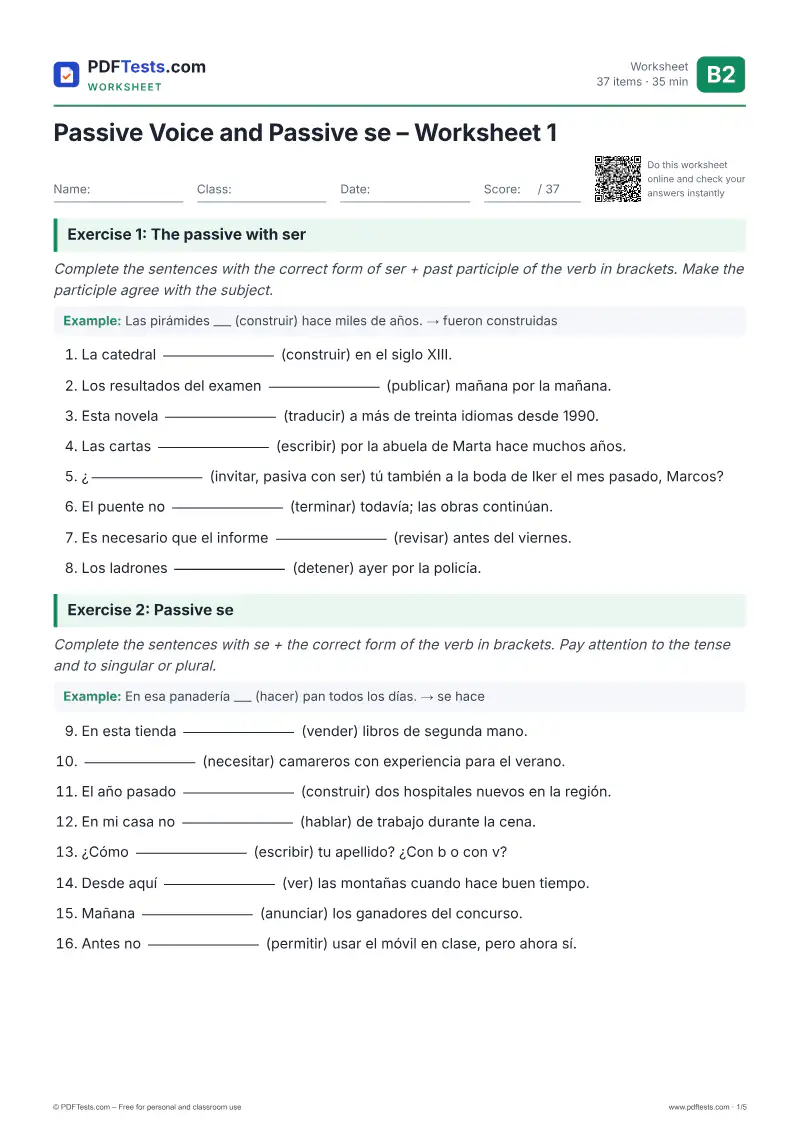
Passive Voice and Passive se – Worksheet 1

B2 Upper-intermediate WorksheetSpanish

This B2 worksheet practises the two main ways of expressing the passive in Spanish: ser + past participle (with agreement and an optional agent introduced by por) and the pasiva refleja with se. Learners work through different tenses, negatives and questions, from controlled gap-fills to error correction and sentence building. It suits upper-intermediate learners preparing for exams or reviewing formal written Spanish.
items
37
Time
35 min
PDF
5 pages
Answer key
Included
  • 100% free
  • No sign-up or email
  • Print-ready A4 PDF
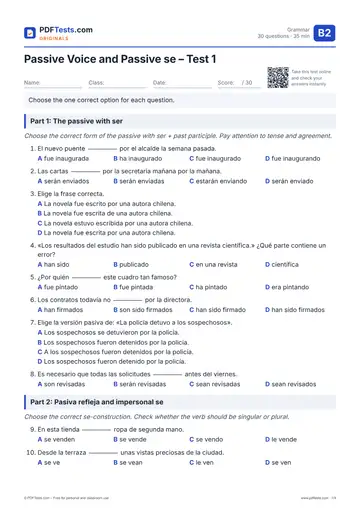
Preview of page 1 of Passive Voice and Passive se – Worksheet 1 Open PDF
New to this topic? Read the guide first: Passive Voice and Passive se in Spanish: Rules, Examples and Common Mistakes

Do the worksheet online

Type your answers, then press “Check my answers”. Alternative correct answers are accepted.

Exercise 1: The passive with ser

Complete the sentences with the correct form of ser + past participle of the verb in brackets. Make the participle agree with the subject.

Example: Las pirámides ___ (construir) hace miles de años. → fueron construidas

  1. La catedral (construir) en el siglo XIII.

  2. Los resultados del examen (publicar) mañana por la mañana.

  3. Esta novela (traducir) a más de treinta idiomas desde 1990.

  4. Las cartas (escribir) por la abuela de Marta hace muchos años.

  5. ¿ (invitar, pasiva con ser) tú también a la boda de Iker el mes pasado, Marcos?

  6. El puente no (terminar) todavía; las obras continúan.

  7. Es necesario que el informe (revisar) antes del viernes.

  8. Los ladrones (detener) ayer por la policía.

Exercise 2: Passive se

Complete the sentences with se + the correct form of the verb in brackets. Pay attention to the tense and to singular or plural.

Example: En esa panadería ___ (hacer) pan todos los días. → se hace

  1. En esta tienda (vender) libros de segunda mano.

  2. (necesitar) camareros con experiencia para el verano.

  3. El año pasado (construir) dos hospitales nuevos en la región.

  4. En mi casa no (hablar) de trabajo durante la cena.

  5. ¿Cómo (escribir) tu apellido? ¿Con b o con v?

  6. Desde aquí (ver) las montañas cuando hace buen tiempo.

  7. Mañana (anunciar) los ganadores del concurso.

  8. Antes no (permitir) usar el móvil en clase, pero ahora sí.

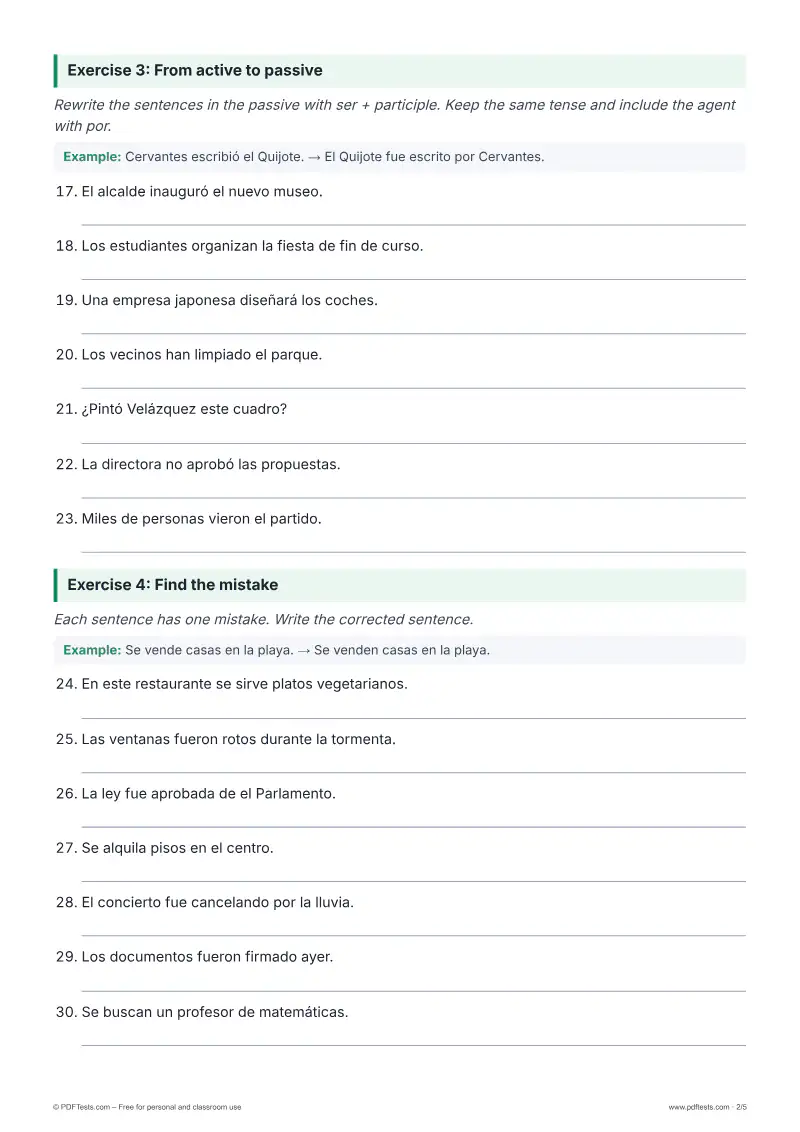
Exercise 3: From active to passive

Rewrite the sentences in the passive with ser + participle. Keep the same tense and include the agent with por.

Example: Cervantes escribió el Quijote. → El Quijote fue escrito por Cervantes.

  1. El alcalde inauguró el nuevo museo.

  2. Los estudiantes organizan la fiesta de fin de curso.

  3. Una empresa japonesa diseñará los coches.

  4. Los vecinos han limpiado el parque.

  5. ¿Pintó Velázquez este cuadro?

  6. La directora no aprobó las propuestas.

  7. Miles de personas vieron el partido.

Exercise 4: Find the mistake

Each sentence has one mistake. Write the corrected sentence.

Example: Se vende casas en la playa. → Se venden casas en la playa.

  1. En este restaurante se sirve platos vegetarianos.

  2. Las ventanas fueron rotos durante la tormenta.

  3. La ley fue aprobada de el Parlamento.

  4. Se alquila pisos en el centro.

  5. El concierto fue cancelando por la lluvia.

  6. Los documentos fueron firmado ayer.

  7. Se buscan un profesor de matemáticas.

  8. La reunión será celebrado en la sala 3.

Exercise 5: Build the sentences

Put the words in the correct order to make passive sentences.

Example: fue / el / por / teléfono / Bell / inventado → El teléfono fue inventado por Bell.

  1. fue / por / la / descubierta / penicilina / Fleming

  2. se / cuatro / hablan / en / lenguas / Suiza

  3. no / sido / han / todavía / los / corregidos / exámenes

  4. cómo / se / dice / esto / en / español

  5. serán / las / entradas / mañana / vendidas / a partir de

  6. se / reparan / bicicletas / aquí

Was this page helpful?

Report a mistake

Spotted a wrong answer, a typo or an unclear explanation? Tell us and we will fix it.

Preview

About this test

B2 Spanish worksheet on the passive voice (ser + participle) and passive se: form, agreement, tenses, negatives and questions. Printable, with answers.

Topics covered

Passive with ser + participlePassive se (pasiva refleja)Participle agreementAgent with porNegatives and questions in the passive

Notes for teachers

Start by contrasting the two structures on the board: ser passive (often with an agent, more formal) versus passive se (no agent, very common in speech, signs and adverts). Typical mistakes are forgetting participle agreement (las ventanas fueron rotos), using a singular verb with plural nouns after se (se vende pisos) and using de instead of por for the agent. As a follow-up, ask learners to write five signs or adverts using passive se (Se alquila..., Se necesitan...) and a short news report using the ser passive.

All Spanish B2 tests →