PDFTests Originals

Compréhension écrite – Test 2

B2 Intermédiaire avancé Compréhension écriteAnglais

Ce test de compréhension écrite en anglais de niveau B2 comprend trois textes originaux : un article d'opinion sur l'ennui, un avis d'information d'un jardin partagé et une nouvelle autour d'une boîte de recettes de famille. Ses 20 questions à choix multiples évaluent la compréhension globale, les détails, l'inférence, le vocabulaire en contexte et le point de vue de l'auteur. Il convient aux apprenants de niveau intermédiaire avancé qui préparent un examen B2 ainsi qu'aux enseignants à la recherche d'une évaluation de lecture prête à l'emploi.

Questions
20
Durée
35 min
PDF
6 pages
Corrigé
Inclus
  • 100 % gratuit
  • Sans inscription
  • PDF A4 prêt à imprimer
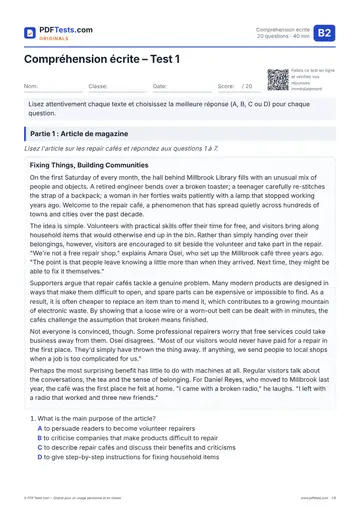
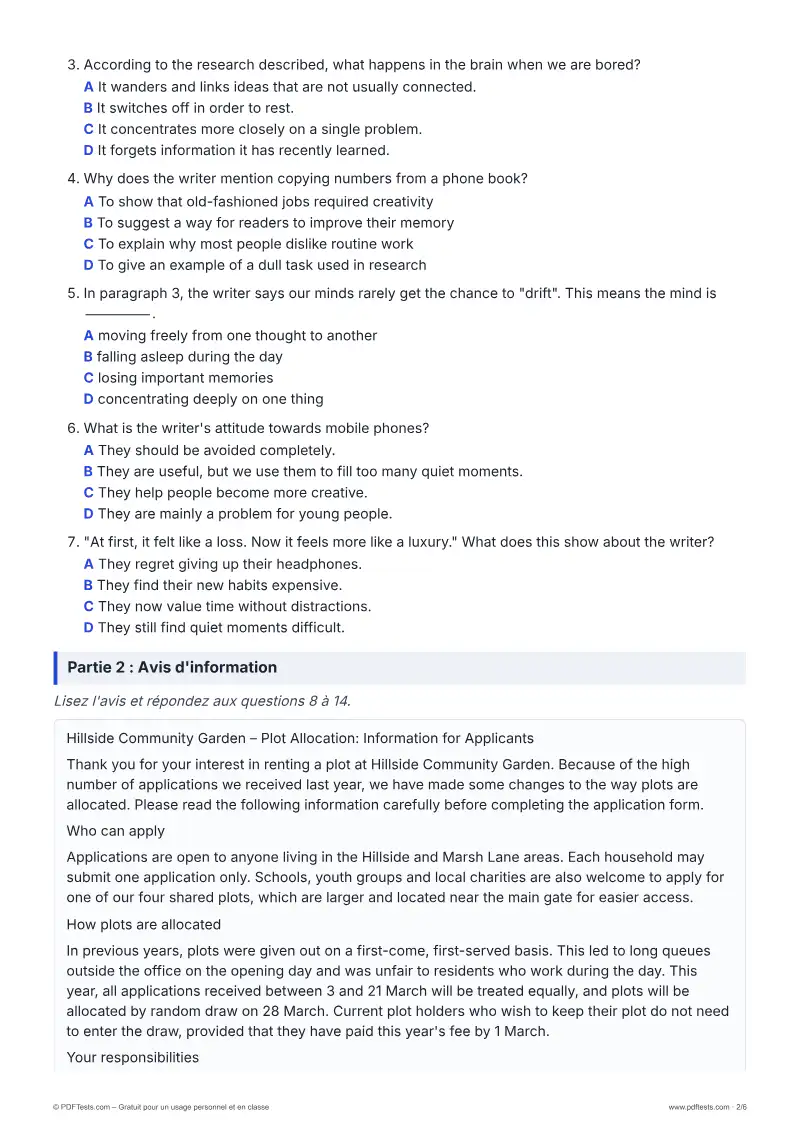
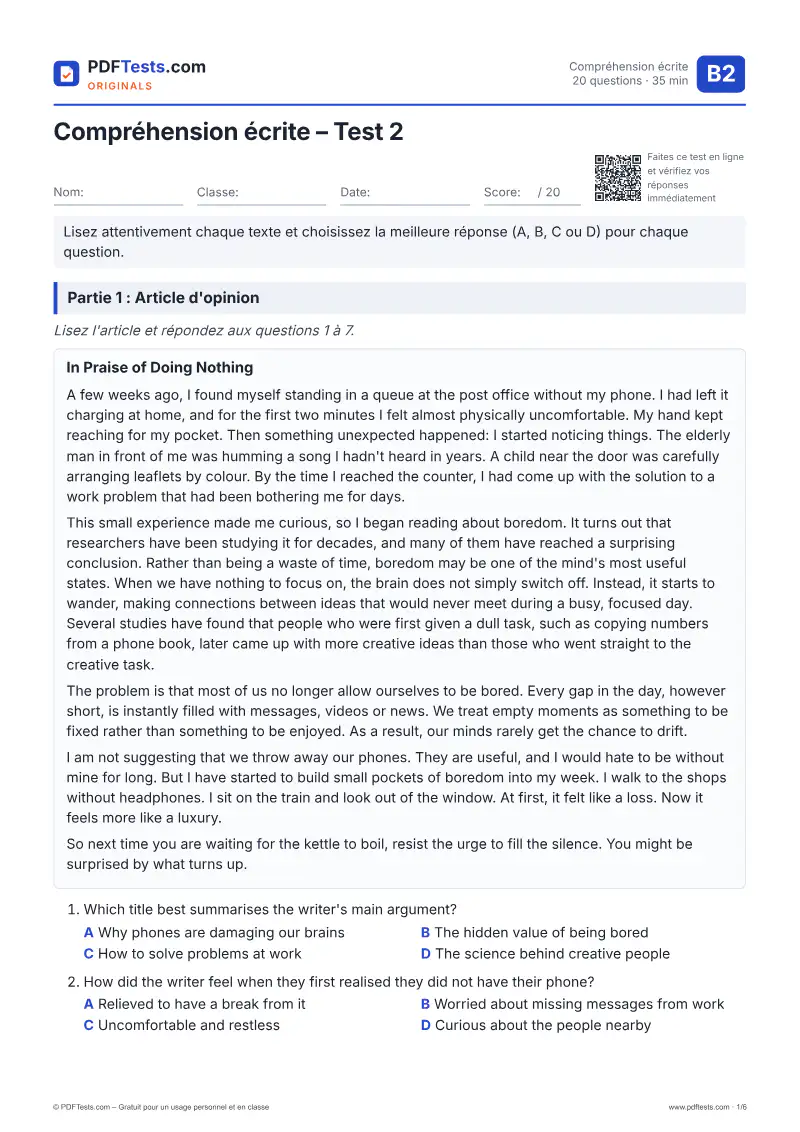
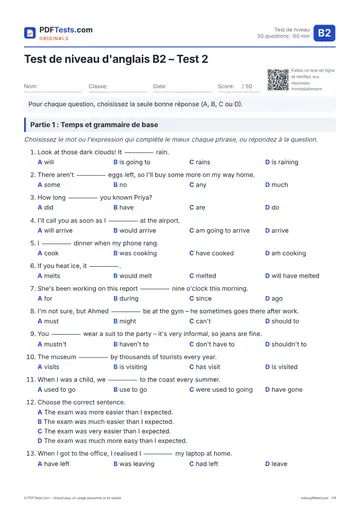
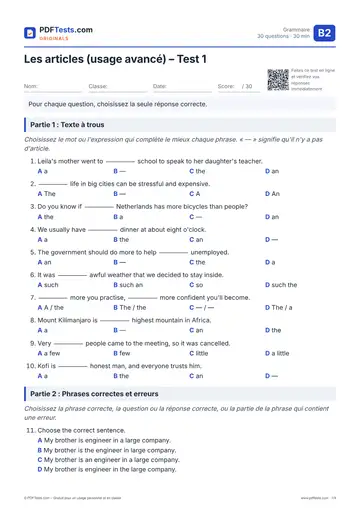
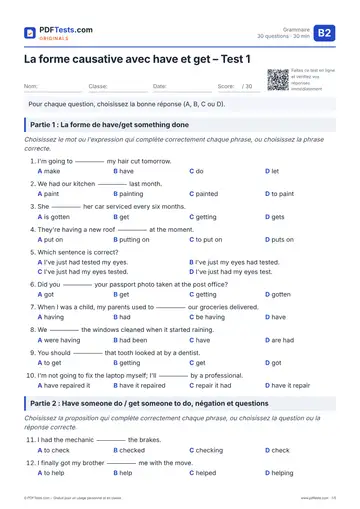
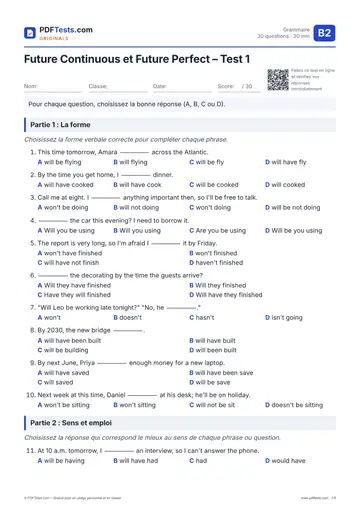
Aperçu de la page 1 : Compréhension écrite – Test 2 Ouvrir le PDF

Faire le test en ligne

Lisez attentivement chaque texte et choisissez la meilleure réponse (A, B, C ou D) pour chaque question. Choisissez vos réponses, puis cliquez sur « Vérifier mes réponses ».

Partie 1 : Article d'opinion

Lisez l'article et répondez aux questions 1 à 7.

In Praise of Doing Nothing

A few weeks ago, I found myself standing in a queue at the post office without my phone. I had left it charging at home, and for the first two minutes I felt almost physically uncomfortable. My hand kept reaching for my pocket. Then something unexpected happened: I started noticing things. The elderly man in front of me was humming a song I hadn't heard in years. A child near the door was carefully arranging leaflets by colour. By the time I reached the counter, I had come up with the solution to a work problem that had been bothering me for days.

This small experience made me curious, so I began reading about boredom. It turns out that researchers have been studying it for decades, and many of them have reached a surprising conclusion. Rather than being a waste of time, boredom may be one of the mind's most useful states. When we have nothing to focus on, the brain does not simply switch off. Instead, it starts to wander, making connections between ideas that would never meet during a busy, focused day. Several studies have found that people who were first given a dull task, such as copying numbers from a phone book, later came up with more creative ideas than those who went straight to the creative task.

The problem is that most of us no longer allow ourselves to be bored. Every gap in the day, however short, is instantly filled with messages, videos or news. We treat empty moments as something to be fixed rather than something to be enjoyed. As a result, our minds rarely get the chance to drift.

I am not suggesting that we throw away our phones. They are useful, and I would hate to be without mine for long. But I have started to build small pockets of boredom into my week. I walk to the shops without headphones. I sit on the train and look out of the window. At first, it felt like a loss. Now it feels more like a luxury.

So next time you are waiting for the kettle to boil, resist the urge to fill the silence. You might be surprised by what turns up.

  1. Which title best summarises the writer's main argument?

  2. How did the writer feel when they first realised they did not have their phone?

  3. According to the research described, what happens in the brain when we are bored?

  4. Why does the writer mention copying numbers from a phone book?

  5. In paragraph 3, the writer says our minds rarely get the chance to "drift". This means the mind is _____.

  6. What is the writer's attitude towards mobile phones?

  7. "At first, it felt like a loss. Now it feels more like a luxury." What does this show about the writer?

Partie 2 : Avis d'information

Lisez l'avis et répondez aux questions 8 à 14.

Hillside Community Garden – Plot Allocation: Information for Applicants

Thank you for your interest in renting a plot at Hillside Community Garden. Because of the high number of applications we received last year, we have made some changes to the way plots are allocated. Please read the following information carefully before completing the application form.

Who can apply

Applications are open to anyone living in the Hillside and Marsh Lane areas. Each household may submit one application only. Schools, youth groups and local charities are also welcome to apply for one of our four shared plots, which are larger and located near the main gate for easier access.

How plots are allocated

In previous years, plots were given out on a first-come, first-served basis. This led to long queues outside the office on the opening day and was unfair to residents who work during the day. This year, all applications received between 3 and 21 March will be treated equally, and plots will be allocated by random draw on 28 March. Current plot holders who wish to keep their plot do not need to enter the draw, provided that they have paid this year's fee by 1 March.

Your responsibilities

Plot holders are expected to keep their plot in good condition throughout the growing season. Plots that appear neglected for more than six weeks will receive a written warning. If no improvement is seen within a further month, the plot may be offered to the next person on the waiting list. We understand that illness or family circumstances can make gardening difficult at times. If this applies to you, please let us know and we will do our best to be flexible.

Fees and tools

The annual fee is €35 for a standard plot, reduced to €15 for students and residents over 65. Basic tools can be borrowed free of charge from the shed, but they must be returned by the end of the same day.

How to apply

Application forms are available from the garden office (open Saturdays, 9 a.m.–1 p.m.) or can be downloaded from the community noticeboard website. Completed forms can be posted through the office letterbox at any time.

  1. Who is this notice mainly written for?

  2. Why has the way of allocating plots been changed?

  3. What must current plot holders do if they want to keep their plot without entering the draw?

  4. Which of the following is NOT mentioned as a group that can apply for a shared plot?

  5. What will happen if a plot looks neglected for more than six weeks?

  6. When the organisers say they "will do our best to be flexible", they mean they will _____.

  7. A student borrows a spade from the shed on a Saturday morning. What must she do?

Partie 3 : Nouvelle

Lisez la nouvelle et répondez aux questions 15 à 20.

The Recipe Box

When her grandmother moved into a care home, Mei was given the job nobody else wanted: clearing out the kitchen. Her brothers had taken the furniture and the old car. What was left were cupboards full of chipped plates, mysterious jars and a small wooden box that rattled when she picked it up.

Inside were dozens of recipe cards, each written in her grandmother's neat, sloping handwriting. Mei had expected instructions for the dishes she remembered from childhood: the sesame noodles, the ginger biscuits that were always slightly burnt at the edges. Those were there. But many of the cards had notes added at the bottom, in a different pen and clearly written years later.

"Made this for Arun's first day at school. He refused to eat it," said one. "Too much salt. Tom said nothing, bless him," said another. On the card for a plum cake, the note simply read: "The day the letter came. Baked it anyway."

Mei sat down on the kitchen floor and read every card twice. She had always thought of her grandmother as a practical, rather quiet woman who did not waste words. Now she found herself holding forty years of small jokes, disappointments and private victories, hidden between measurements for flour and sugar.

She did not know which letter the plum cake card referred to, and the thought of asking made her nervous. Her grandmother's memory was unreliable these days, and Mei worried that the question might upset her.

That weekend, she baked the plum cake and took a slice to the care home. Her grandmother tasted it slowly, frowning slightly as if checking it for mistakes.

"You used too much cinnamon," she said at last. Then, after a long pause, she added, "Your grandfather always said the same thing. Even on the day he was offered the job abroad and we thought he would have to leave us."

Mei waited, but nothing more came. Her grandmother simply took another bite, looked out of the window and smiled.

Mei did not ask again. She decided that some stories were meant to arrive in their own time, like the notes at the bottom of the cards.

  1. Why did Mei end up clearing out the kitchen?

  2. What surprised Mei about the recipe cards?

  3. Why did the grandmother write "bless him" about Tom?

  4. How did reading the cards change Mei's view of her grandmother?

  5. Why did Mei feel nervous about asking about the letter?

  6. Why does Mei compare some stories to "the notes at the bottom of the cards"?

Aperçu

À propos de ce test

Ce test de compréhension écrite en anglais de niveau B2 comprend trois textes originaux : un article d'opinion sur l'ennui, un avis d'information d'un jardin partagé et une nouvelle autour d'une boîte de recettes de famille. Ses 20 questions à choix multiples évaluent la compréhension globale, les détails, l'inférence, le vocabulaire en contexte et le point de vue de l'auteur. Il convient aux apprenants de niveau intermédiaire avancé qui préparent un examen B2 ainsi qu'aux enseignants à la recherche d'une évaluation de lecture prête à l'emploi.

Thèmes abordés

Compréhension écriteCompréhension globale et idée principaleRepérage d'informations précisesInférenceVocabulaire en contextePoint de vue de l'auteurApplication des informations

Comment utiliser ce test

  1. Téléchargez le PDF et imprimez-le, ou faites le test en ligne ci-dessous.
  2. Répondez à toutes les questions sans dictionnaire et sans vous presser.
  3. Vérifiez vos réponses et notez les points à revoir.

Notes pour l’enseignant

Chaque partie peut être proposée comme activité distincte en cours, ou le test entier peut être fait en une seule séance d'environ 35 minutes. Les distracteurs ciblent les erreurs de lecture typiques au niveau B2 : choisir une option parce qu'elle reprend des mots du texte, confondre ce qui est affirmé avec ce qui est simplement plausible, et appliquer une règle au mauvais cas (par exemple les dates limites de l'avis du jardin). En prolongement, demandez aux élèves de souligner dans le texte les éléments qui justifient chaque réponse. Ils peuvent aussi rédiger une courte réponse à l'article d'opinion ou poursuivre la nouvelle du point de vue de la grand-mère.