PDFTests Originals

Crime and Law – Test 1

B1 Intermediate VocabularyEnglish

This B1 vocabulary test covers everyday words for crime and the law, such as types of crime, people in the justice system and punishments. It also practises common collocations, word families and understanding words in a short news article. It suits intermediate learners and teachers who need a ready-made classroom or homework test.

Questions
30
Time
30 min
PDF
4 pages
Answer key
Included
  • 100% free
  • No sign-up or email
  • Print-ready A4 PDF
Preview of page 1 of Crime and Law – Test 1 Open PDF

Take the test online

Choose the best answer (A, B, C or D) for each question. Choose your answers, then press “Check my answers”.

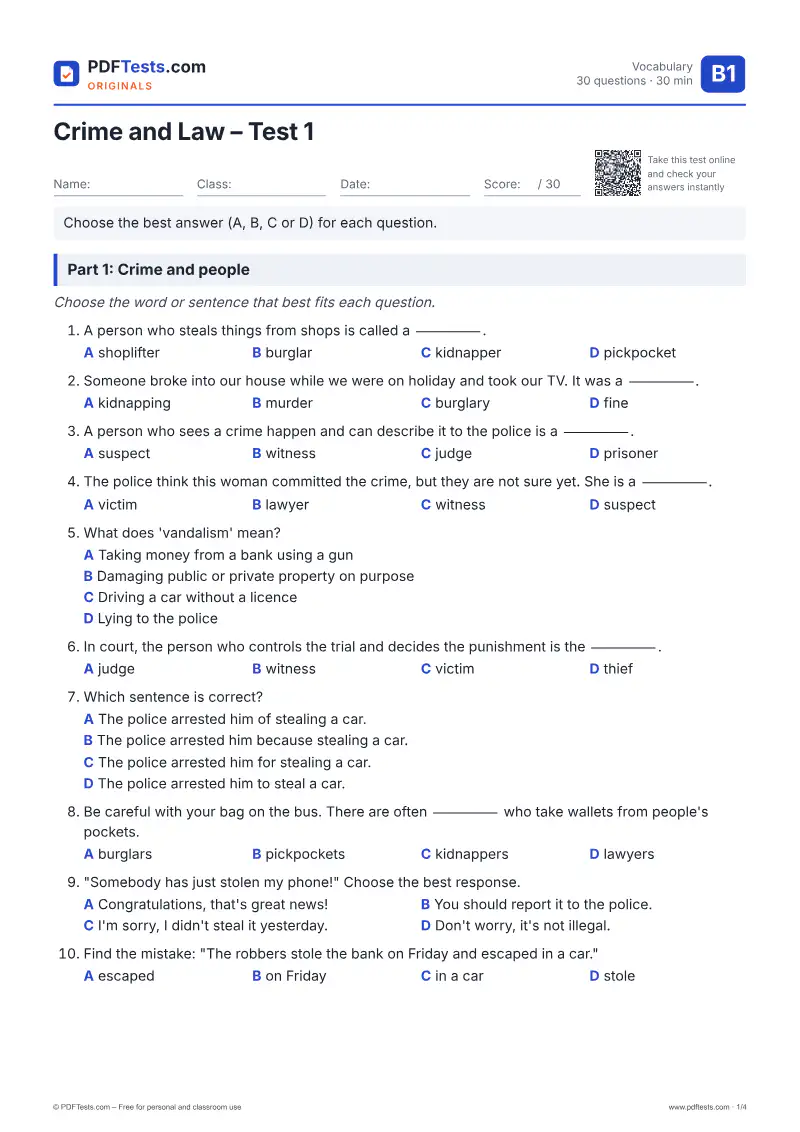
Part 1: Crime and people

Choose the word or sentence that best fits each question.

  1. A person who steals things from shops is called a _____.

  2. Someone broke into our house while we were on holiday and took our TV. It was a _____.

  3. A person who sees a crime happen and can describe it to the police is a _____.

  4. The police think this woman committed the crime, but they are not sure yet. She is a _____.

  5. What does 'vandalism' mean?

  6. In court, the person who controls the trial and decides the punishment is the _____.

  7. Which sentence is correct?

  8. Be careful with your bag on the bus. There are often _____ who take wallets from people's pockets.

  9. "Somebody has just stolen my phone!" Choose the best response.

  10. Find the mistake: "The robbers stole the bank on Friday and escaped in a car."

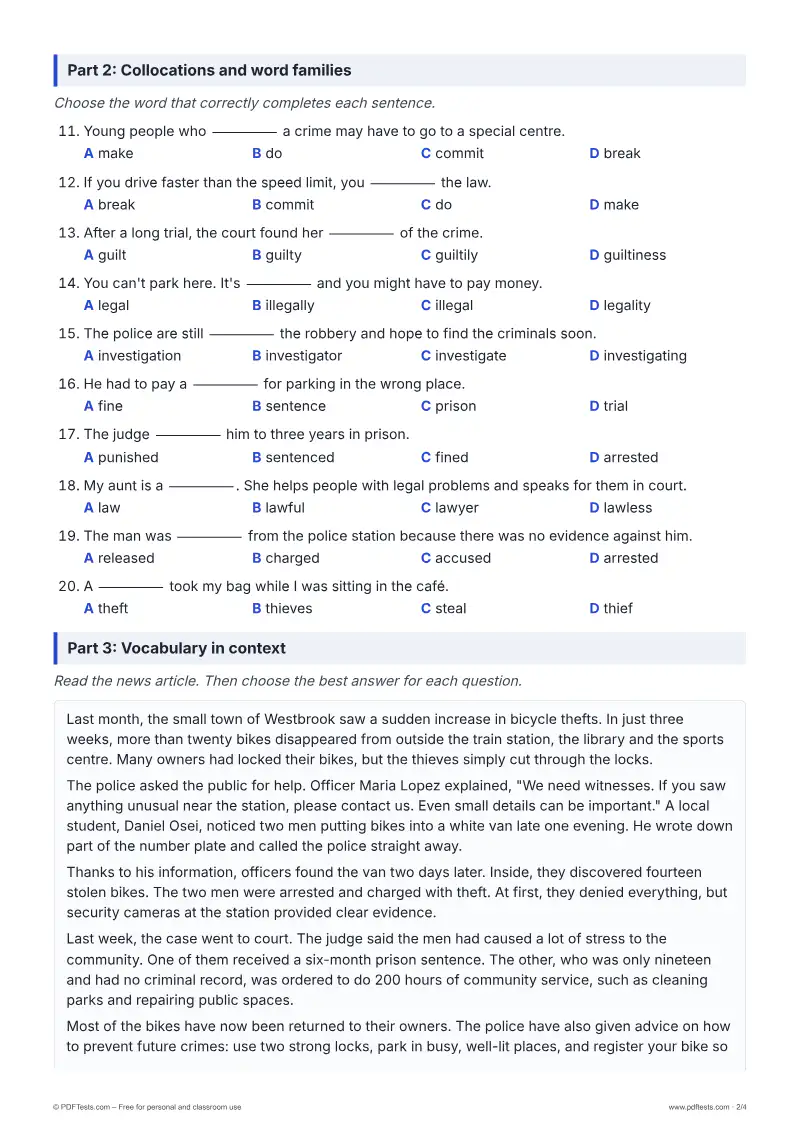
Part 2: Collocations and word families

Choose the word that correctly completes each sentence.

  1. Young people who _____ a crime may have to go to a special centre.

  2. If you drive faster than the speed limit, you _____ the law.

  3. After a long trial, the court found her _____ of the crime.

  4. You can't park here. It's _____ and you might have to pay money.

  5. The police are still _____ the robbery and hope to find the criminals soon.

  6. He had to pay a _____ for parking in the wrong place.

  7. The judge _____ him to three years in prison.

  8. My aunt is a _____. She helps people with legal problems and speaks for them in court.

  9. The man was _____ from the police station because there was no evidence against him.

  10. A _____ took my bag while I was sitting in the café.

Part 3: Vocabulary in context

Read the news article. Then choose the best answer for each question.

Last month, the small town of Westbrook saw a sudden increase in bicycle thefts. In just three weeks, more than twenty bikes disappeared from outside the train station, the library and the sports centre. Many owners had locked their bikes, but the thieves simply cut through the locks.

The police asked the public for help. Officer Maria Lopez explained, "We need witnesses. If you saw anything unusual near the station, please contact us. Even small details can be important." A local student, Daniel Osei, noticed two men putting bikes into a white van late one evening. He wrote down part of the number plate and called the police straight away.

Thanks to his information, officers found the van two days later. Inside, they discovered fourteen stolen bikes. The two men were arrested and charged with theft. At first, they denied everything, but security cameras at the station provided clear evidence.

Last week, the case went to court. The judge said the men had caused a lot of stress to the community. One of them received a six-month prison sentence. The other, who was only nineteen and had no criminal record, was ordered to do 200 hours of community service, such as cleaning parks and repairing public spaces.

Most of the bikes have now been returned to their owners. The police have also given advice on how to prevent future crimes: use two strong locks, park in busy, well-lit places, and register your bike so it can be identified if it is stolen.

  1. In paragraph 1, "more than twenty bikes disappeared" means the bikes _____.

  2. Why did Officer Lopez ask for witnesses?

  3. The two men were "charged with theft". This means that they were _____.

  4. "At first, they denied everything" means that the men _____.

  5. In paragraph 3, "evidence" is closest in meaning to _____.

  6. The younger man "had no criminal record". This means he _____.

  7. "Community service" in paragraph 4 is _____.

  8. Who decided the punishments for the two men?

  9. In the last paragraph, "prevent future crimes" means _____ them.

  10. If your bike "can be identified", people can _____.

Was this page helpful?

Report a mistake

Spotted a wrong answer, a typo or an unclear explanation? Tell us and we will fix it.

Practise with a worksheet: Crime and Law – Worksheet 1

Preview

About this test

This B1 vocabulary test covers everyday words for crime and the law, such as types of crime, people in the justice system and punishments. It also practises common collocations, word families and understanding words in a short news article. It suits intermediate learners and teachers who need a ready-made classroom or homework test.

Topics covered

Types of crimeCriminals and victimsCourts and punishmentCollocationsWord familiesReading in context

How to use this test

  1. Download the PDF and print it, or take the test online below.
  2. Answer every question without a dictionary or time pressure.
  3. Check your answers and note the topics you need to review.

Notes for teachers

Part 1 checks core meanings, Part 2 focuses on collocations such as 'commit a crime' and 'break the law' and on word forms, and Part 3 tests vocabulary in a short news article. Typical errors targeted include confusing steal and rob, thief and theft, and judge, lawyer and witness. As follow-up, students can retell the news story using the key words or write a short crime report of their own.