PDFTests Originals

Kriminalität und Recht – Test 1

B1 Mittelstufe WortschatzEnglisch

Dieser Wortschatztest auf Niveau B1 behandelt den Grundwortschatz rund um Kriminalität und Recht, etwa Arten von Straftaten, Personen im Justizwesen und Strafen. Außerdem werden häufige Kollokationen und Wortfamilien geübt, und es geht um das Verstehen von Wörtern in einem kurzen Zeitungsartikel. Der Test eignet sich für Lernende auf mittlerem Niveau und für Lehrkräfte, die einen fertigen Test für den Unterricht oder als Hausaufgabe suchen.

Fragen
30
Zeit
30 Min.
PDF
5 Seiten
Lösungen
Enthalten
  • 100 % kostenlos
  • Ohne Anmeldung
  • Druckfertiges A4-PDF
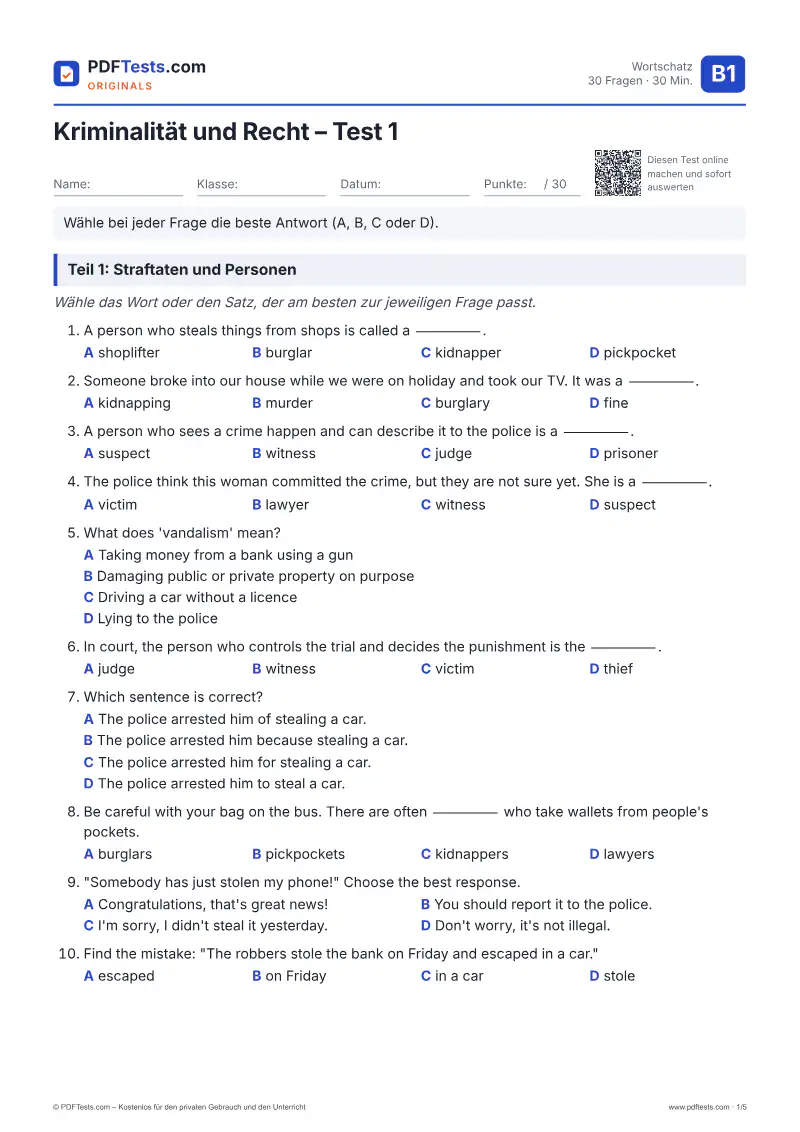
Vorschau von Seite 1: Kriminalität und Recht – Test 1 PDF öffnen

Test online machen

Wähle bei jeder Frage die beste Antwort (A, B, C oder D). Wählen Sie Ihre Antworten und klicken Sie auf „Antworten prüfen“.

Teil 1: Straftaten und Personen

Wähle das Wort oder den Satz, der am besten zur jeweiligen Frage passt.

  1. A person who steals things from shops is called a _____.

  2. Someone broke into our house while we were on holiday and took our TV. It was a _____.

  3. A person who sees a crime happen and can describe it to the police is a _____.

  4. The police think this woman committed the crime, but they are not sure yet. She is a _____.

  5. What does 'vandalism' mean?

  6. In court, the person who controls the trial and decides the punishment is the _____.

  7. Which sentence is correct?

  8. Be careful with your bag on the bus. There are often _____ who take wallets from people's pockets.

  9. "Somebody has just stolen my phone!" Choose the best response.

  10. Find the mistake: "The robbers stole the bank on Friday and escaped in a car."

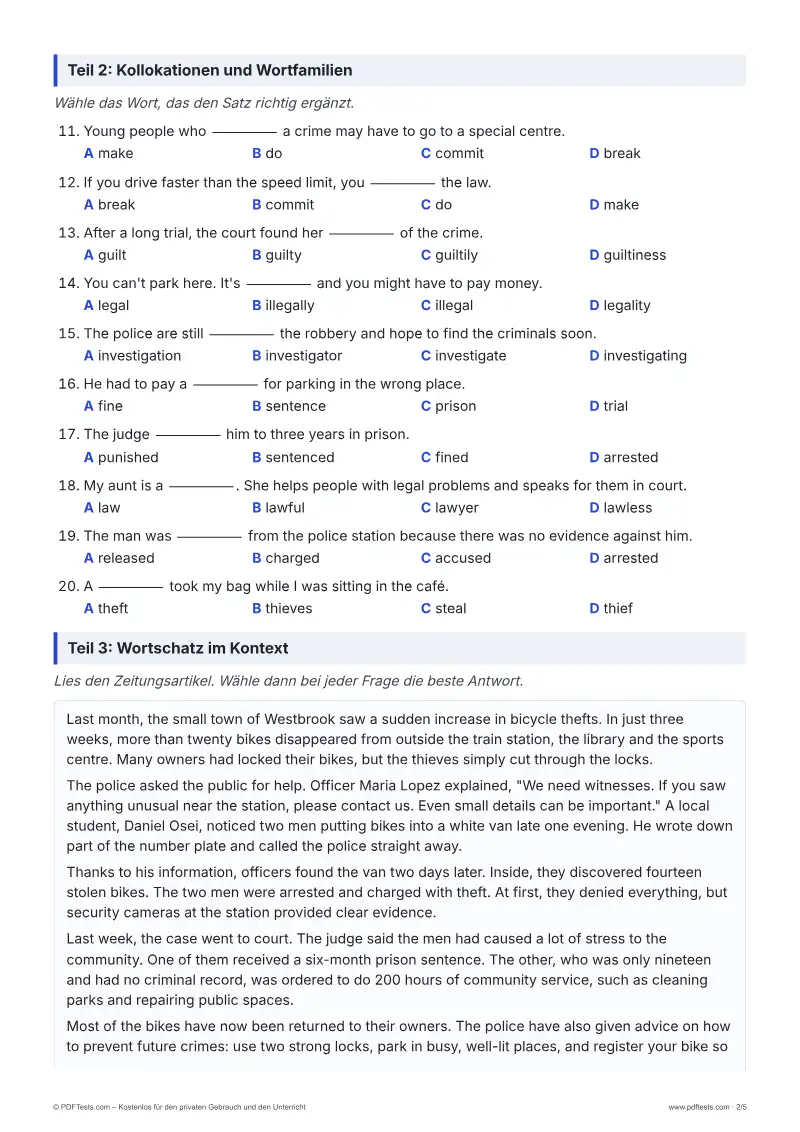
Teil 2: Kollokationen und Wortfamilien

Wähle das Wort, das den Satz richtig ergänzt.

  1. Young people who _____ a crime may have to go to a special centre.

  2. If you drive faster than the speed limit, you _____ the law.

  3. After a long trial, the court found her _____ of the crime.

  4. You can't park here. It's _____ and you might have to pay money.

  5. The police are still _____ the robbery and hope to find the criminals soon.

  6. He had to pay a _____ for parking in the wrong place.

  7. The judge _____ him to three years in prison.

  8. My aunt is a _____. She helps people with legal problems and speaks for them in court.

  9. The man was _____ from the police station because there was no evidence against him.

  10. A _____ took my bag while I was sitting in the café.

Teil 3: Wortschatz im Kontext

Lies den Zeitungsartikel. Wähle dann bei jeder Frage die beste Antwort.

Last month, the small town of Westbrook saw a sudden increase in bicycle thefts. In just three weeks, more than twenty bikes disappeared from outside the train station, the library and the sports centre. Many owners had locked their bikes, but the thieves simply cut through the locks.

The police asked the public for help. Officer Maria Lopez explained, "We need witnesses. If you saw anything unusual near the station, please contact us. Even small details can be important." A local student, Daniel Osei, noticed two men putting bikes into a white van late one evening. He wrote down part of the number plate and called the police straight away.

Thanks to his information, officers found the van two days later. Inside, they discovered fourteen stolen bikes. The two men were arrested and charged with theft. At first, they denied everything, but security cameras at the station provided clear evidence.

Last week, the case went to court. The judge said the men had caused a lot of stress to the community. One of them received a six-month prison sentence. The other, who was only nineteen and had no criminal record, was ordered to do 200 hours of community service, such as cleaning parks and repairing public spaces.

Most of the bikes have now been returned to their owners. The police have also given advice on how to prevent future crimes: use two strong locks, park in busy, well-lit places, and register your bike so it can be identified if it is stolen.

  1. In paragraph 1, "more than twenty bikes disappeared" means the bikes _____.

  2. Why did Officer Lopez ask for witnesses?

  3. The two men were "charged with theft". This means that they were _____.

  4. "At first, they denied everything" means that the men _____.

  5. In paragraph 3, "evidence" is closest in meaning to _____.

  6. The younger man "had no criminal record". This means he _____.

  7. "Community service" in paragraph 4 is _____.

  8. Who decided the punishments for the two men?

  9. In the last paragraph, "prevent future crimes" means _____ them.

  10. If your bike "can be identified", people can _____.

War diese Seite hilfreich?

Fehler melden

Falsche Lösung, Tippfehler oder unklare Erklärung? Schreiben Sie uns, wir korrigieren es.

Mit einem Arbeitsblatt üben: Kriminalität und Recht – Arbeitsblatt 1

Vorschau

Über diesen Test

Dieser Wortschatztest auf Niveau B1 behandelt den Grundwortschatz rund um Kriminalität und Recht, etwa Arten von Straftaten, Personen im Justizwesen und Strafen. Außerdem werden häufige Kollokationen und Wortfamilien geübt, und es geht um das Verstehen von Wörtern in einem kurzen Zeitungsartikel. Der Test eignet sich für Lernende auf mittlerem Niveau und für Lehrkräfte, die einen fertigen Test für den Unterricht oder als Hausaufgabe suchen.

Themen

Arten von StraftatenTäter und OpferGericht und StrafenKollokationenWortfamilienWortschatz im Kontext

So nutzen Sie diesen Test

  1. Laden Sie das PDF herunter und drucken Sie es aus – oder machen Sie den Test unten online.
  2. Beantworten Sie alle Fragen ohne Wörterbuch und ohne Zeitdruck.
  3. Prüfen Sie Ihre Antworten und notieren Sie, was Sie wiederholen sollten.

Hinweise für Lehrkräfte

Teil 1 prüft die Grundbedeutungen, Teil 2 konzentriert sich auf Kollokationen wie „commit a crime“ und „break the law“ sowie auf Wortbildung, und Teil 3 testet den Wortschatz in einem kurzen Zeitungsartikel. Abgefragt werden typische Fehler wie die Verwechslung von steal und rob, thief und theft sowie judge, lawyer und witness. Zur Vertiefung können die Lernenden die Nachricht mit den Schlüsselwörtern nacherzählen oder selbst einen kurzen Polizeibericht schreiben.