PDFTests Originals

Crimen y justicia – Test 1

B1 Intermedio VocabularioInglés

Este test de vocabulario de nivel B1 trabaja palabras cotidianas relacionadas con el crimen y la justicia, como los tipos de delito, las personas que intervienen en el sistema judicial y los castigos. También practica colocaciones habituales, familias de palabras y la comprensión de vocabulario en una breve noticia. Es ideal para estudiantes de nivel intermedio y para profesores que buscan un test listo para usar en clase o como deberes.

Preguntas
30
Tiempo
30 min
PDF
4 páginas
Soluciones
Incluidas
  • 100 % gratis
  • Sin registro
  • PDF A4 listo para imprimir
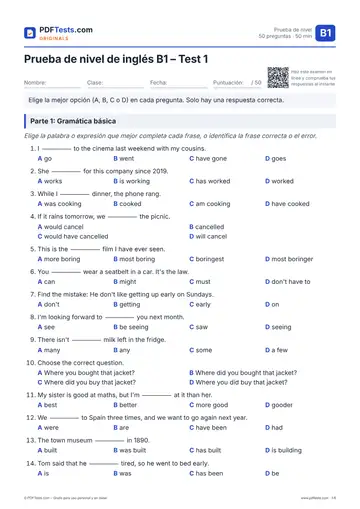
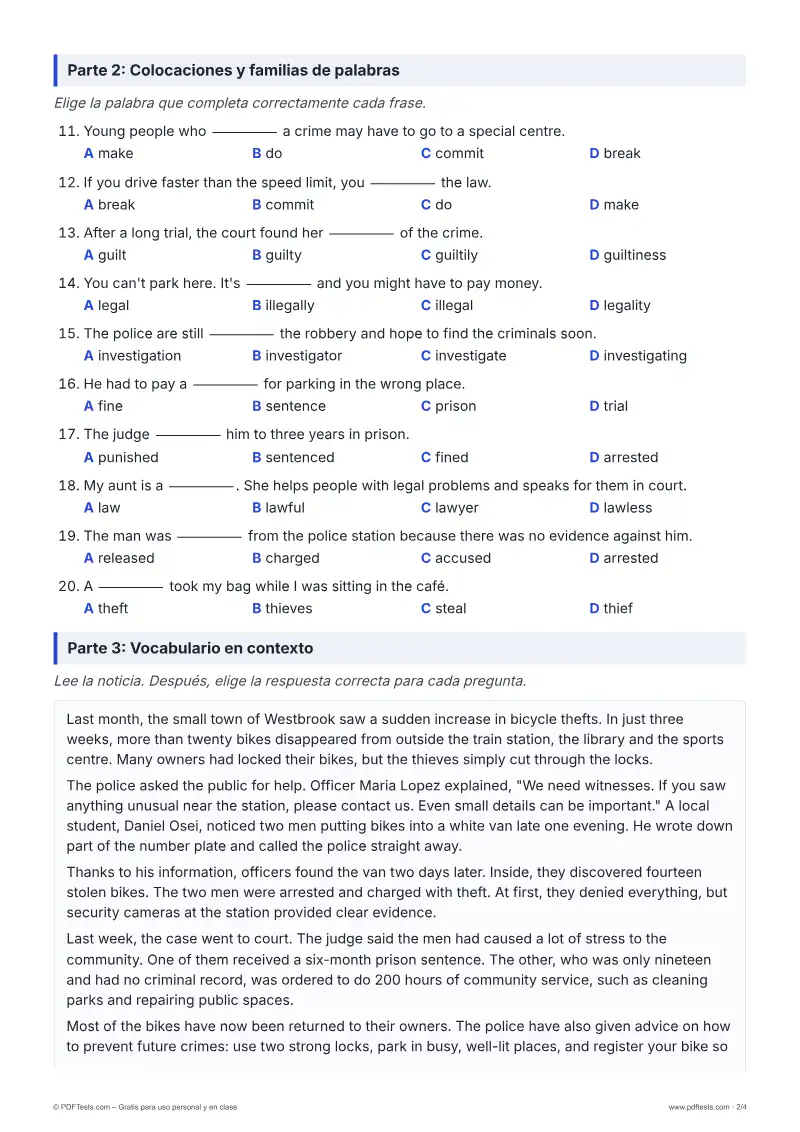
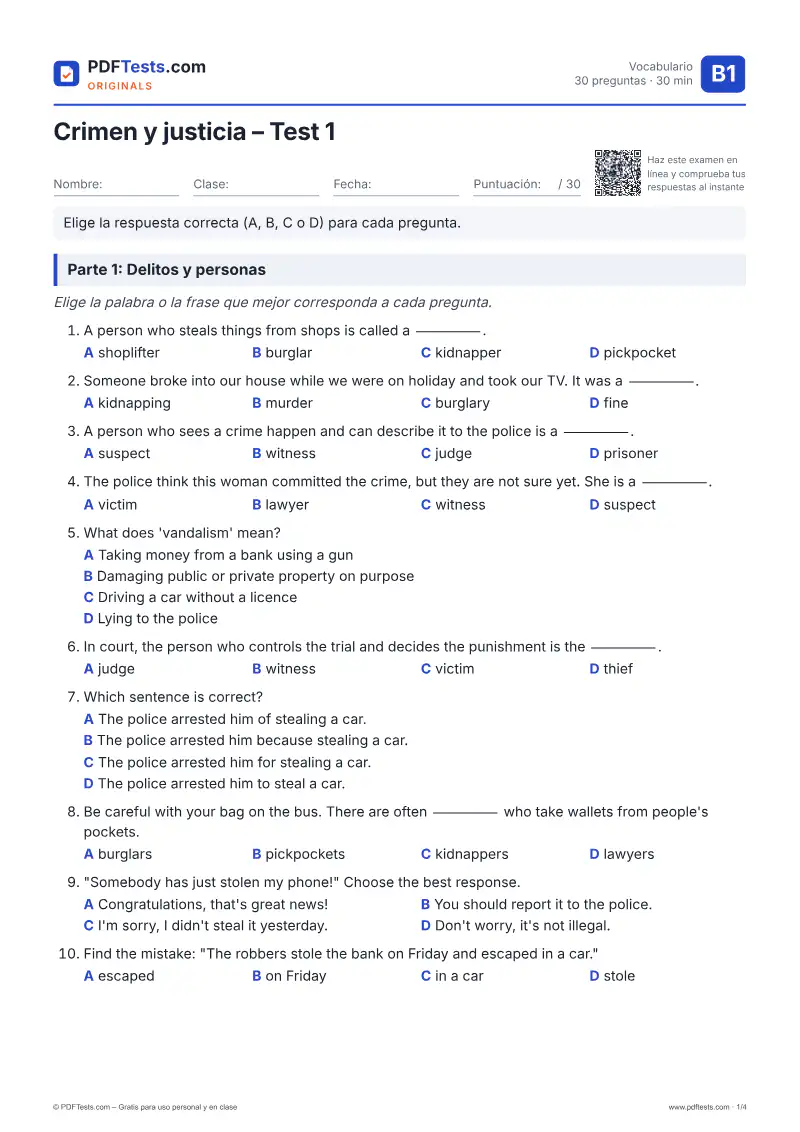
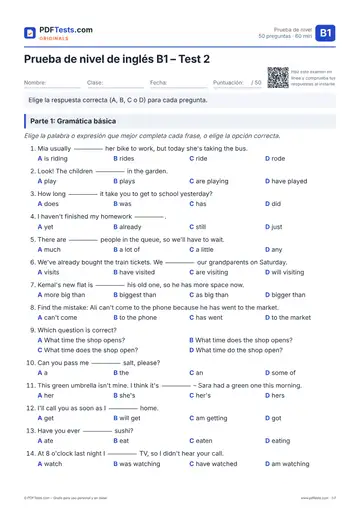
Vista previa de la página 1: Crimen y justicia – Test 1 Abrir PDF

Haz el examen en línea

Elige la respuesta correcta (A, B, C o D) para cada pregunta. Elige tus respuestas y pulsa «Comprobar respuestas».

Parte 1: Delitos y personas

Elige la palabra o la frase que mejor corresponda a cada pregunta.

  1. A person who steals things from shops is called a _____.

  2. Someone broke into our house while we were on holiday and took our TV. It was a _____.

  3. A person who sees a crime happen and can describe it to the police is a _____.

  4. The police think this woman committed the crime, but they are not sure yet. She is a _____.

  5. What does 'vandalism' mean?

  6. In court, the person who controls the trial and decides the punishment is the _____.

  7. Which sentence is correct?

  8. Be careful with your bag on the bus. There are often _____ who take wallets from people's pockets.

  9. "Somebody has just stolen my phone!" Choose the best response.

  10. Find the mistake: "The robbers stole the bank on Friday and escaped in a car."

Parte 2: Colocaciones y familias de palabras

Elige la palabra que completa correctamente cada frase.

  1. Young people who _____ a crime may have to go to a special centre.

  2. If you drive faster than the speed limit, you _____ the law.

  3. After a long trial, the court found her _____ of the crime.

  4. You can't park here. It's _____ and you might have to pay money.

  5. The police are still _____ the robbery and hope to find the criminals soon.

  6. He had to pay a _____ for parking in the wrong place.

  7. The judge _____ him to three years in prison.

  8. My aunt is a _____. She helps people with legal problems and speaks for them in court.

  9. The man was _____ from the police station because there was no evidence against him.

  10. A _____ took my bag while I was sitting in the café.

Parte 3: Vocabulario en contexto

Lee la noticia. Después, elige la respuesta correcta para cada pregunta.

Last month, the small town of Westbrook saw a sudden increase in bicycle thefts. In just three weeks, more than twenty bikes disappeared from outside the train station, the library and the sports centre. Many owners had locked their bikes, but the thieves simply cut through the locks.

The police asked the public for help. Officer Maria Lopez explained, "We need witnesses. If you saw anything unusual near the station, please contact us. Even small details can be important." A local student, Daniel Osei, noticed two men putting bikes into a white van late one evening. He wrote down part of the number plate and called the police straight away.

Thanks to his information, officers found the van two days later. Inside, they discovered fourteen stolen bikes. The two men were arrested and charged with theft. At first, they denied everything, but security cameras at the station provided clear evidence.

Last week, the case went to court. The judge said the men had caused a lot of stress to the community. One of them received a six-month prison sentence. The other, who was only nineteen and had no criminal record, was ordered to do 200 hours of community service, such as cleaning parks and repairing public spaces.

Most of the bikes have now been returned to their owners. The police have also given advice on how to prevent future crimes: use two strong locks, park in busy, well-lit places, and register your bike so it can be identified if it is stolen.

  1. In paragraph 1, "more than twenty bikes disappeared" means the bikes _____.

  2. Why did Officer Lopez ask for witnesses?

  3. The two men were "charged with theft". This means that they were _____.

  4. "At first, they denied everything" means that the men _____.

  5. In paragraph 3, "evidence" is closest in meaning to _____.

  6. The younger man "had no criminal record". This means he _____.

  7. "Community service" in paragraph 4 is _____.

  8. Who decided the punishments for the two men?

  9. In the last paragraph, "prevent future crimes" means _____ them.

  10. If your bike "can be identified", people can _____.

¿Te ha resultado útil esta página?

Informar de un error

¿Has visto una respuesta incorrecta, una errata o una explicación poco clara? Avísanos y lo corregiremos.

Practica con una ficha: Delitos y justicia – Ficha 1

Vista previa

Sobre este examen

Este test de vocabulario de nivel B1 trabaja palabras cotidianas relacionadas con el crimen y la justicia, como los tipos de delito, las personas que intervienen en el sistema judicial y los castigos. También practica colocaciones habituales, familias de palabras y la comprensión de vocabulario en una breve noticia. Es ideal para estudiantes de nivel intermedio y para profesores que buscan un test listo para usar en clase o como deberes.

Temas

Tipos de delitoDelincuentes y víctimasTribunales y castigosColocaciones (collocations)Familias de palabras (word families)Vocabulario en contexto

Cómo usar este examen

  1. Descarga el PDF e imprímelo, o haz el examen en línea más abajo.
  2. Responde todas las preguntas sin diccionario y sin prisas.
  3. Comprueba tus respuestas y apunta los temas que debes repasar.

Notas para el profesor

La Parte 1 comprueba los significados básicos; la Parte 2 se centra en colocaciones como 'commit a crime' y 'break the law' y en la formación de palabras; y la Parte 3 evalúa el vocabulario dentro de una breve noticia. Entre los errores típicos que se trabajan están confundir steal y rob, thief y theft, así como judge, lawyer y witness. Como actividad de ampliación, los alumnos pueden volver a contar la noticia usando las palabras clave o redactar su propio breve informe sobre un delito.