PDFTests Originals

Media and News – Test 1

B1 Intermediate VocabularyEnglish

This B1 vocabulary test covers the language of media and news, including newspapers, TV, radio and online news. It checks word meaning, common collocations, word choice in context and word families. It suits intermediate learners and teachers who want a ready-to-print topic test.

Questions
30
Time
30 min
PDF
4 pages
Answer key
Included
  • 100% free
  • No sign-up or email
  • Print-ready A4 PDF
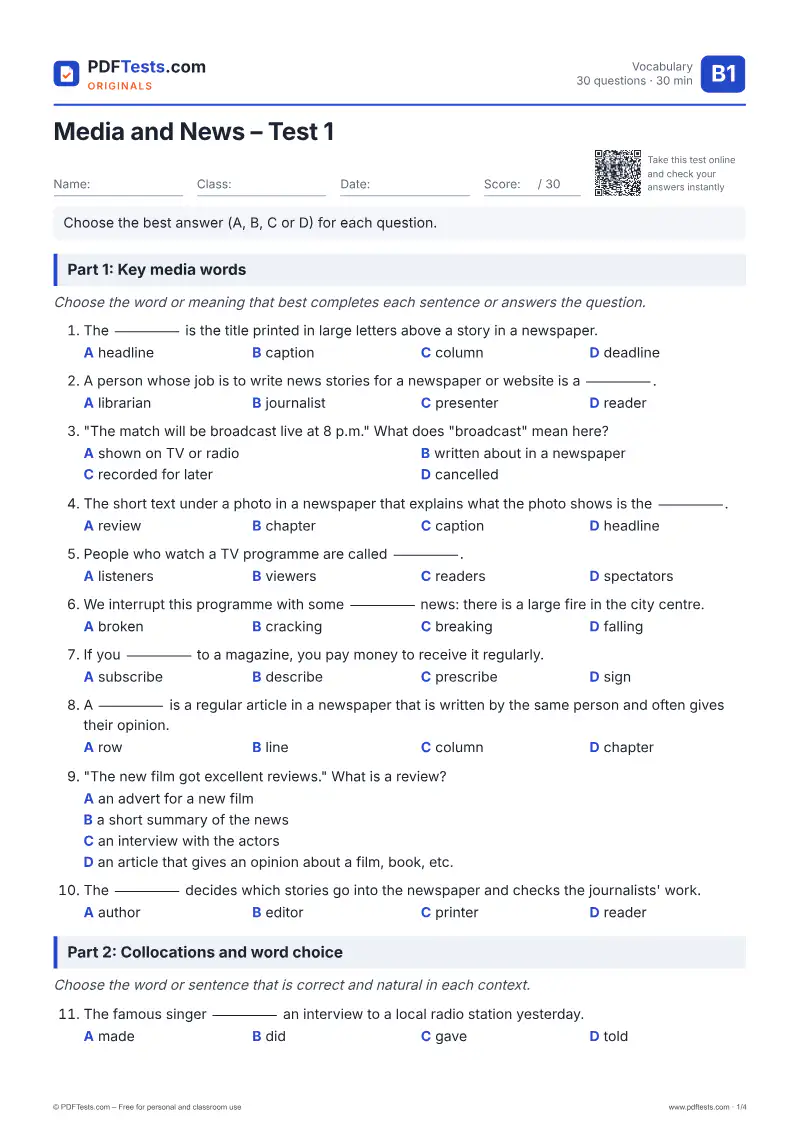
Preview of page 1 of Media and News – Test 1 Open PDF

Take the test online

Choose the best answer (A, B, C or D) for each question. Choose your answers, then press “Check my answers”.

Part 1: Key media words

Choose the word or meaning that best completes each sentence or answers the question.

  1. The _____ is the title printed in large letters above a story in a newspaper.

  2. A person whose job is to write news stories for a newspaper or website is a _____.

  3. "The match will be broadcast live at 8 p.m." What does "broadcast" mean here?

  4. The short text under a photo in a newspaper that explains what the photo shows is the _____.

  5. People who watch a TV programme are called _____.

  6. We interrupt this programme with some _____ news: there is a large fire in the city centre.

  7. If you _____ to a magazine, you pay money to receive it regularly.

  8. A _____ is a regular article in a newspaper that is written by the same person and often gives their opinion.

  9. "The new film got excellent reviews." What is a review?

  10. The _____ decides which stories go into the newspaper and checks the journalists' work.

Part 2: Collocations and word choice

Choose the word or sentence that is correct and natural in each context.

  1. The famous singer _____ an interview to a local radio station yesterday.

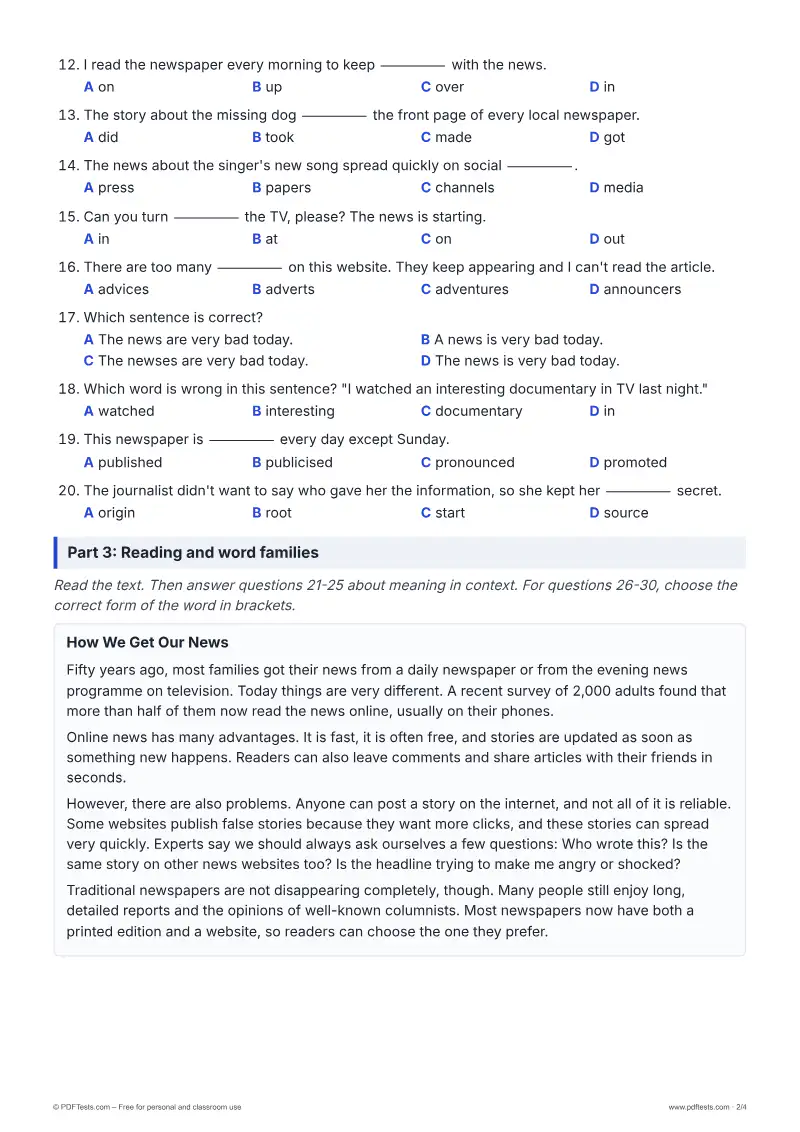
  2. I read the newspaper every morning to keep _____ with the news.

  3. The story about the missing dog _____ the front page of every local newspaper.

  4. The news about the singer's new song spread quickly on social _____.

  5. Can you turn _____ the TV, please? The news is starting.

  6. There are too many _____ on this website. They keep appearing and I can't read the article.

  7. Which sentence is correct?

  8. Which word is wrong in this sentence? "I watched an interesting documentary in TV last night."

  9. This newspaper is _____ every day except Sunday.

  10. The journalist didn't want to say who gave her the information, so she kept her _____ secret.

Part 3: Reading and word families

Read the text. Then answer questions 21-25 about meaning in context. For questions 26-30, choose the correct form of the word in brackets.

How We Get Our News

Fifty years ago, most families got their news from a daily newspaper or from the evening news programme on television. Today things are very different. A recent survey of 2,000 adults found that more than half of them now read the news online, usually on their phones.

Online news has many advantages. It is fast, it is often free, and stories are updated as soon as something new happens. Readers can also leave comments and share articles with their friends in seconds.

However, there are also problems. Anyone can post a story on the internet, and not all of it is reliable. Some websites publish false stories because they want more clicks, and these stories can spread very quickly. Experts say we should always ask ourselves a few questions: Who wrote this? Is the same story on other news websites too? Is the headline trying to make me angry or shocked?

Traditional newspapers are not disappearing completely, though. Many people still enjoy long, detailed reports and the opinions of well-known columnists. Most newspapers now have both a printed edition and a website, so readers can choose the one they prefer.

  1. In paragraph 1, what is a "survey"?

  2. In paragraph 2, "stories are updated" means that _____.

  3. In paragraph 3, "not all of it is reliable" means that some of it _____.

  4. In paragraph 3, false stories "can spread very quickly". This means they can _____.

  5. In paragraph 4, what is "a printed edition" of a newspaper?

  6. The programme about the ocean was very _____. I learned a lot from it. (INFORM)

  7. The article was full of mistakes. It was very _____. (ACCURATE)

  8. My uncle is a _____. He takes pictures for a news agency. (PHOTOGRAPH)

  9. My cousin works in _____. She creates adverts for TV and websites. (ADVERTISE)

  10. The documentary was really _____. I laughed a lot and learned something too. (ENTERTAIN)

Was this page helpful?

Report a mistake

Spotted a wrong answer, a typo or an unclear explanation? Tell us and we will fix it.

Practise with a worksheet: Media and News – Worksheet 1

Preview

About this test

This B1 vocabulary test covers the language of media and news, including newspapers, TV, radio and online news. It checks word meaning, common collocations, word choice in context and word families. It suits intermediate learners and teachers who want a ready-to-print topic test.

Topics covered

Newspapers and journalismTV and radioOnline news and social mediaCollocationsWord formationReading for meaning in context

How to use this test

  1. Download the PDF and print it, or take the test online below.
  2. Answer every question without a dictionary or time pressure.
  3. Check your answers and note the topics you need to review.

Notes for teachers

Use this test after a unit on media, or as a diagnostic before one. It targets common learner errors such as treating 'news' as plural or countable, wrong prepositions ('in TV' instead of 'on TV'), confusing adverts with advice, and mixing up word forms such as informative and information. As a follow-up, ask students to write a short news story using five words from the test. You could also bring in real headlines and ask students to discuss how reliable they are.