PDFTests Originals

Media and News – Worksheet 1

B1 Intermediate WorksheetEnglish

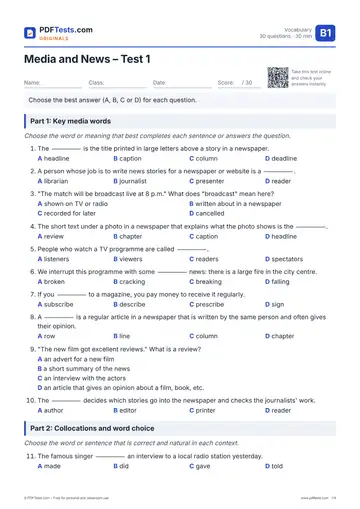
This worksheet practises key media and news vocabulary at B1 level, including words for people, programmes and online news. Learners work on meaning, common collocations such as 'on the radio' and 'breaking news', and word forms like reporter, reliable and informative. It suits teenage and adult learners in class or at home.
items
37
Time
35 min
PDF
5 pages
Answer key
Included
  • 100% free
  • No sign-up or email
  • Print-ready A4 PDF
Preview of page 1 of Media and News – Worksheet 1 Open PDF

Do the worksheet online

Type your answers, then press “Check my answers”. Alternative correct answers are accepted.

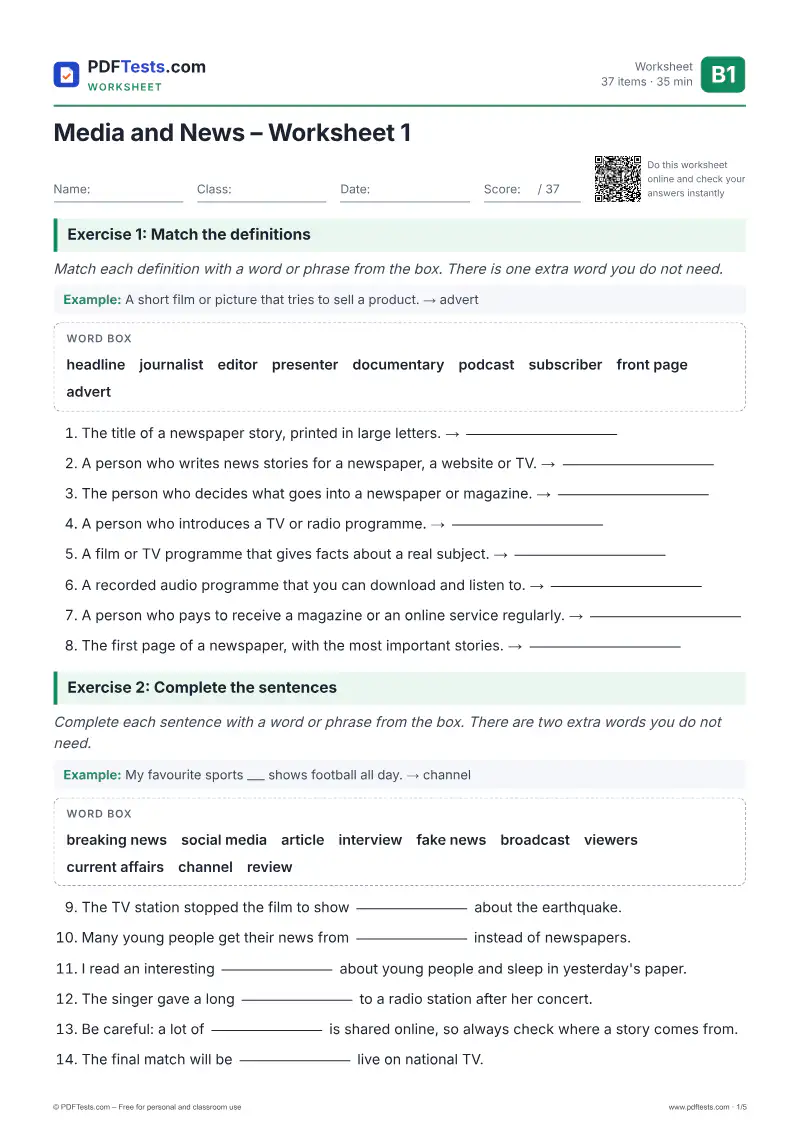
Exercise 1: Match the definitions

Match each definition with a word or phrase from the box. There is one extra word you do not need.

Example: A short film or picture that tries to sell a product. → advert

Word box headlinejournalisteditorpresenterdocumentarypodcastsubscriberfront pageadvert

  1. The title of a newspaper story, printed in large letters.

  2. A person who writes news stories for a newspaper, a website or TV.

  3. The person who decides what goes into a newspaper or magazine.

  4. A person who introduces a TV or radio programme.

  5. A film or TV programme that gives facts about a real subject.

  6. A recorded audio programme that you can download and listen to.

  7. A person who pays to receive a magazine or an online service regularly.

  8. The first page of a newspaper, with the most important stories.

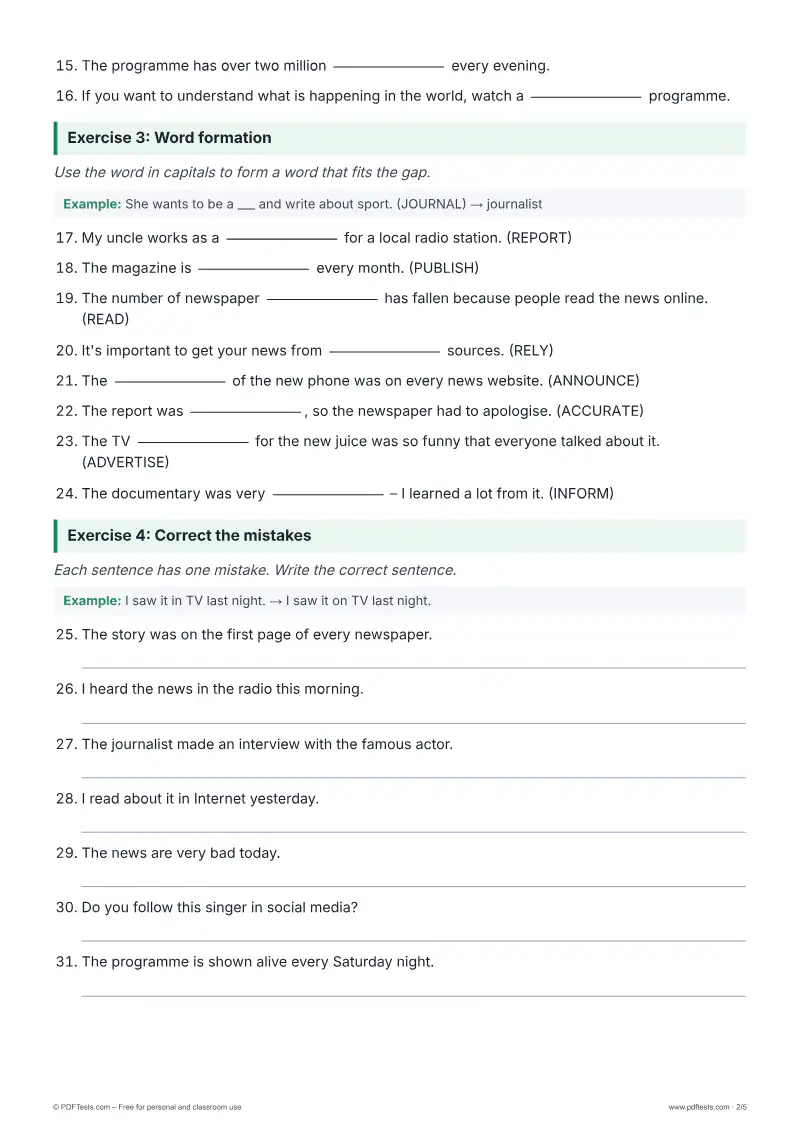
Exercise 2: Complete the sentences

Complete each sentence with a word or phrase from the box. There are two extra words you do not need.

Example: My favourite sports ___ shows football all day. → channel

Word box breaking newssocial mediaarticleinterviewfake newsbroadcastviewerscurrent affairschannelreview

  1. The TV station stopped the film to show about the earthquake.

  2. Many young people get their news from instead of newspapers.

  3. I read an interesting about young people and sleep in yesterday's paper.

  4. The singer gave a long to a radio station after her concert.

  5. Be careful: a lot of is shared online, so always check where a story comes from.

  6. The final match will be live on national TV.

  7. The programme has over two million every evening.

  8. If you want to understand what is happening in the world, watch a programme.

Exercise 3: Word formation

Use the word in capitals to form a word that fits the gap.

Example: She wants to be a ___ and write about sport. (JOURNAL) → journalist

  1. My uncle works as a for a local radio station. (REPORT)

  2. The magazine is every month. (PUBLISH)

  3. The number of newspaper has fallen because people read the news online. (READ)

  4. It's important to get your news from sources. (RELY)

  5. The of the new phone was on every news website. (ANNOUNCE)

  6. The report was , so the newspaper had to apologise. (ACCURATE)

  7. The TV for the new juice was so funny that everyone talked about it. (ADVERTISE)

  8. The documentary was very – I learned a lot from it. (INFORM)

Exercise 4: Correct the mistakes

Each sentence has one mistake. Write the correct sentence.

Example: I saw it in TV last night. → I saw it on TV last night.

  1. The story was on the first page of every newspaper.

  2. I heard the news in the radio this morning.

  3. The journalist made an interview with the famous actor.

  4. I read about it in Internet yesterday.

  5. The news are very bad today.

  6. Do you follow this singer in social media?

  7. The programme is shown alive every Saturday night.

Exercise 5: Put the words in order

Put the words in the correct order to make sentences.

Example: news / watch / the / I / every evening → I watch the news every evening.

  1. people / news / online / most / their / get

  2. the / headline / did / see / you / this morning

  3. always / the / check / you / should / source

  4. was / the / live / broadcast / interview

  5. to / a / subscribed / I've / podcast / science

  6. she / for / works / a / magazine / as / an / editor

Was this page helpful?

Report a mistake

Spotted a wrong answer, a typo or an unclear explanation? Tell us and we will fix it.

Preview

About this test

B1 English worksheet on media and news vocabulary: headlines, journalists, breaking news, collocations and word forms. Printable, with answers.

Topics covered

Media vocabularyNews and journalismCollocationsWord formationOnline news and social media

Notes for teachers

Start with the matching exercise to check meaning, then move on to the collocation and word-form tasks. Common mistakes include 'in the radio' or 'in Internet' instead of 'on', and using a plural verb after 'news' ('the news are'). As a follow-up, ask pairs to write three headlines about school or local events and present them as a short news broadcast.

All English B1 tests →