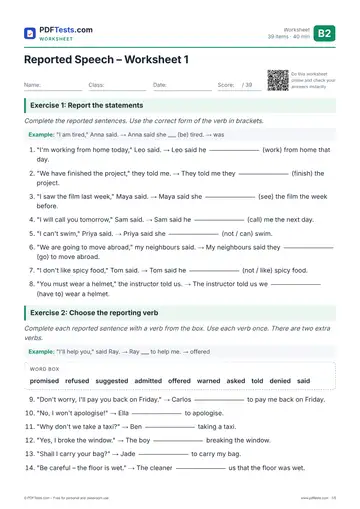
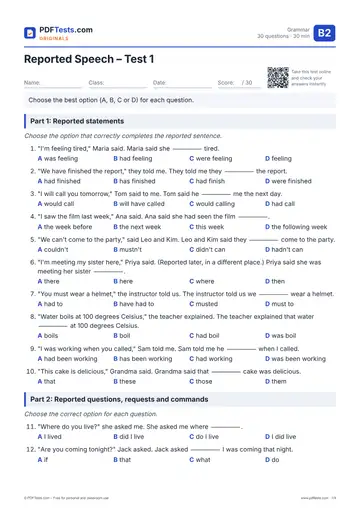
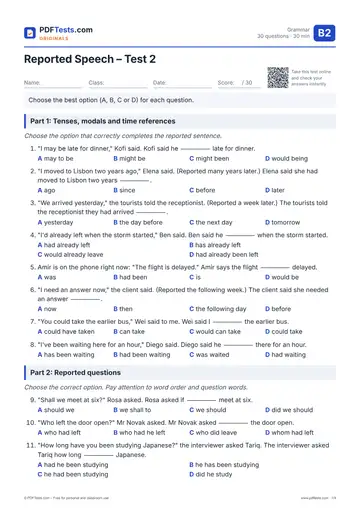
Reported speech (also called indirect speech) is how we tell someone what another person said, asked or thought without quoting their exact words. At B2, you need more than the basic tense changes. You also need to decide when to keep the original tense, report questions with the correct word order, and use reporting verbs such as admit, warn and suggest.
If the basics are new to you, start with our guide to reported speech for statements and questions, then come back here.
How reported speech works
Compare direct and reported speech:
- Direct: “I’m exhausted,” she said.
- Reported: She said (that) she was exhausted.
When you report something later, three things usually change:
- The tense moves one step back into the past. This is called backshift.
- Pronouns and possessives change to fit the new speaker: I → she, my → her.
- Time and place words change if the time or place is now different: today → that day.
The word that is optional after say, tell and most reporting verbs. It is common in writing and often dropped in speech.
Tense changes (backshift)
| Direct speech | Reported speech | Example |
|---|---|---|
| present simple | past simple | “I work from home.” → He said he worked from home. |
| present continuous | past continuous | “We’re moving to Bristol.” → They said they were moving to Bristol. |
| present perfect | past perfect | “I’ve lost my keys.” → She said she had lost her keys. |
| past simple | past perfect (or past simple) | “I missed the bus.” → He said he had missed the bus. |
| past continuous | past perfect continuous | “I was sleeping.” → She said she had been sleeping. |
| will | would | “I’ll send it later.” → He said he would send it later. |
| can | could | “I can’t come.” → She said she couldn’t come. |
| may | might | “It may rain.” → They said it might rain. |
| must (obligation) | had to (or must) | “You must register.” → She said we had to register. |
| am/is/are going to | was/were going to | “I’m going to resign.” → He said he was going to resign. |
These forms do not change: had done (past perfect), would, could, should, might, ought to and used to.
- “You should apologise.” → She said I should apologise.
- “I’d never seen snow before.” → He said he had never seen snow before.
For a full review of the form used most often after backshift, see our Past Perfect guide.
When you don’t need to backshift
Backshift is always grammatically safe when you report something later. However, in these situations you can keep the original tense, and often should.
The reporting verb is in the present
If you report while the situation is still happening, use says, tells, thinks and keep the tense.
- She says she’s running late.
- The forecast says it’ll be sunny tomorrow.
The information is still true
If the statement is still true when you report it, you can keep the present.
- “I live in Leeds.” → He told me he lives in Leeds. (He still does.)
- Our teacher explained that water boils at 100°C.
Using lived is also correct. Keeping the present simply makes it clear that the fact has not changed.
Past simple with a clear time reference
The past simple often stays when the time of the event is clear:
- “I moved here in 2019.” → She said she moved / had moved here in 2019.
Unreal forms
Second conditionals and wish sentences usually stay the same:
- “If I had more time, I’d travel.” → He said if he had more time, he’d travel.
Pronouns, time and place words
Change these words only when the context has changed. If you report on the same day, today stays today.
| Direct speech | Reported speech |
|---|---|
| now | then / at that moment |
| today | that day |
| tonight | that night |
| tomorrow | the next day / the following day |
| yesterday | the day before / the previous day |
| next week | the following week |
| last month | the month before / the previous month |
| two years ago | two years before / earlier |
| here | there |
| this (week, place) | that (week, place) |
- “I’ll call you tomorrow.” (said last Monday) → He said he’d call me the next day.
- “I started this job three weeks ago.” → She said she’d started that job three weeks before.
Reporting questions
Reported questions are not real questions, so they use statement word order: subject + verb. There is no do/does/did and no question mark.
Yes/no questions: if or whether
| Direct question | Reported question |
|---|---|
| “Are you coming?” | She asked if I was coming. |
| “Have you finished the report?” | My boss wanted to know whether I had finished the report. |
| “Can you drive?” | They asked me if I could drive. |
Whether is slightly more formal and is preferred before or not: He asked whether or not we had booked.
Wh- questions: question word + statement order
| Direct question | Reported question |
|---|---|
| “Where do you work?” | He asked me where I worked. |
| “Why did you leave?” | She asked why I had left. |
| “What time does the film start?” | I asked what time the film started. |
Subject questions
When who or what is the subject, the word order is already the same as a statement:
- “Who called?” → He asked who had called.
- “What happened?” → She wanted to know what had happened.
Polite indirect questions
Phrases such as Could you tell me…? and Do you know…? use the same statement word order, but there is no backshift because you are asking now:
- Could you tell me where the station is?
Reporting commands, requests and advice
Use tell / ask + object + (not) to + infinitive:
- “Sit down.” → The teacher told us to sit down.
- “Please don’t shout.” → She asked him not to shout.
- “Could you close the window?” → He asked me to close the window.
Reporting verbs
At B2, writers often replace say and tell with a verb that summarises the speaker’s purpose. This makes reports shorter and more precise. The key is learning the pattern that follows each verb.
| Pattern | Verbs | Example |
|---|---|---|
| verb + to-infinitive | agree, offer, promise, refuse, threaten | “I’ll help you move.” → He offered to help me move. |
| verb + object + to-infinitive | advise, encourage, invite, persuade, remind, warn | “Don’t forget to lock the door.” → She reminded me to lock the door. |
| verb + -ing | admit, deny, recommend, suggest | “I didn’t take the money.” → He denied taking the money. |
| verb + preposition + -ing | apologise for, insist on, accuse sb of, blame sb for, congratulate sb on | “Sorry I’m late.” → She apologised for being late. |
| verb + that-clause | admit, complain, explain, insist, promise, warn | “The train was delayed.” → She explained that the train had been delayed. |
Some verbs take more than one pattern:
- He admitted breaking the vase. / He admitted that he had broken the vase.
- They promised to call. / They promised that they would call.
Suggest and recommend
These verbs never take object + to-infinitive. Use -ing or a that-clause:
- “Let’s take a taxi.” → She suggested taking a taxi.
- “You should see a doctor.” → He suggested (that) I see / should see a doctor.
The infinitive vs -ing choice after these verbs follows the same rules as elsewhere in English. Review them in our Gerunds and Infinitives guide.
Say vs tell
These two verbs are the most common source of errors.
| say | tell |
|---|---|
| say + (that) + clause | tell + person + (that) + clause |
| say something to someone | tell someone something |
| She said (that) she was busy. | She told me (that) she was busy. |
| He said hello to us. | He told us a story. |
Fixed expressions: tell the truth, tell a lie, tell a joke, tell the time; say sorry, say goodbye, say yes/no, say a few words.
For questions, use ask, wonder or want to know, not say.
Common mistakes
- ✗ She said me that she was tired. → ✓ She told me / said to me that she was tired.
Say doesn’t take a direct personal object. - ✗ He asked me where did I live. → ✓ He asked me where I lived.
Reported questions use statement word order without did. - ✗ She asked me was I hungry. → ✓ She asked me if I was hungry.
Yes/no questions need if or whether. - ✗ He suggested me to take a taxi. → ✓ He suggested taking a taxi / suggested (that) I take a taxi.
Suggest is never followed by object + to-infinitive. - ✗ They told us don’t be late. → ✓ They told us not to be late.
Negative commands use not to + infinitive. - ✗ He denied to break the window. → ✓ He denied breaking the window.
Deny is followed by -ing or a that-clause. - ✗ She apologised to be late. → ✓ She apologised for being late.
Apologise takes for + -ing. - ✗ (a week later) She said she will call me tomorrow. → ✓ She said she would call me the next day.
The time has changed, so both the verb and the time expression shift.
Quick check
Report each sentence. Assume you are reporting a week later.
- “I’m meeting Sam tonight,” Lisa said.
- “Where did you park?” he asked me.
- Choose the correct verb: She ___ me to call the police. (said / told / suggested)
- “Don’t touch the screen,” the technician said to us. → The technician warned us…
- “I didn’t take your charger,” Tom said to me. → Tom denied…
Answers
- Lisa said (that) she was meeting Sam that night.
- He asked me where I had parked.
- told
- The technician warned us not to touch the screen.
- Tom denied taking (or having taken) my charger.
Next step
Now put the rules into practice with our B2 Reported Speech test, which mixes backshift, reported questions and reporting verb patterns. If you made mistakes with word order in reported questions or with basic tense changes, warm up first with the B1 Reported Speech test on statements and questions, then try the B2 test again and focus on the verbs that caught you out.
Was this page helpful?
What was the problem?
Thank you for your feedback!