The causative uses have or get to show that someone else does something for us, usually because we arrange it or pay for it: I had my car serviced, not I serviced my car. It is also used for unpleasant things that happen to us, such as He had his wallet stolen, and for making or persuading someone to act: She got her brother to help.
The basic idea
Compare these two sentences:
- I painted the kitchen. (I did the painting myself.)
- I had the kitchen painted. (A decorator did it. I organised it.)
In the second sentence, the subject (I) is not the person doing the work. The focus is on the result and on the fact that the subject arranged it. Who did the work is usually obvious or unimportant.
Uses of causative have and get
1. Arranging a service: have/get + object + past participle
This is the most common use. We use it for services: repairs, beauty treatments, medical checks, deliveries and home improvements.
- I need to have my eyes tested. My glasses aren’t strong enough any more.
- We’re getting the boiler fixed on Monday.
- She had her nails done for the wedding.
- You should get that tooth looked at by a dentist.
2. Something bad that happens to you
The same structure can describe an unpleasant experience that was not planned. Here nobody “arranged” anything; the subject is the victim.
- He had his wallet stolen on the underground.
- We had our flight cancelled at the last minute.
- She got her fingers caught in the car door.
The context makes the meaning clear. Nobody arranges to have their wallet stolen.
3. Persuading someone: get + person + to-infinitive
Get someone to do something means persuading or convincing a person to do it, often with some effort.
- I finally got my flatmate to clean the bathroom.
- Can you get the shop to deliver it tomorrow?
- How did you get your kids to eat vegetables?
4. Giving an instruction: have + person + bare infinitive
Have someone do something means telling or asking someone to do a task, usually someone whose job it is. It sounds natural in work and service contexts, and it is especially common in American English.
- I’ll have my assistant send you the contract.
- The manager had everyone stay late to finish the report.
Note the difference in form: get + person + to do, but have + person + do (no to).
5. Get + object + past participle for finishing a task
In informal English, get something done can also mean finishing a job yourself, often with a sense of effort or urgency.
- I need to get this essay finished tonight.
- Let’s get the dishes washed before the guests arrive.
Form
Have/get + object + past participle in different tenses
Only have or get changes for tense. The object and the past participle stay the same.
| Tense / form | Have | Get |
|---|---|---|
| Present simple | I have my hair cut every month. | I get my hair cut every month. |
| Present continuous | We’re having the kitchen painted. | We’re getting the kitchen painted. |
| Past simple | She had her phone repaired. | She got her phone repaired. |
| Present perfect | They’ve had the roof fixed. | They’ve got / gotten (US) the roof fixed. |
| Past perfect | He’d had the car cleaned. | He’d got the car cleaned. |
| Will | I’ll have it checked. | I’ll get it checked. |
| Going to | I’m going to have my eyes tested. | I’m going to get my eyes tested. |
| Modal | You should have that looked at. | You should get that looked at. |
| -ing form | I hate having my photo taken. | I hate getting my photo taken. |
With have in the present perfect, you get have twice: one is the auxiliary, the other is the causative verb (I’ve had my car serviced). This is correct.
Negatives and questions
In the causative, have is a main verb, so it needs do / does / did in questions and negatives in the simple tenses.
| Example | |
|---|---|
| Affirmative | She had her passport renewed. |
| Negative | She didn’t have her passport renewed. |
| Question | Did she have her passport renewed? |
| Negative (get) | We don’t get our windows cleaned very often. |
| Question (get) | Do you get your shopping delivered? |
| Question (present perfect) | Have you had your hair cut? It looks great. |
Have/get + person + verb
| Structure | Example |
|---|---|
| have + person + bare infinitive | I’ll have the receptionist call you back. |
| get + person + to-infinitive | I’ll get the receptionist to call you back. |
| get/have + person + -ing (cause an ongoing action) | The comedian had the whole audience laughing. |
The -ing pattern describes a situation you start that then continues: Within minutes, she had the engine running again.
Word order
The object always comes between have/get and the past participle:
subject + have/get + object + past participle
- ✓ I had my bike repaired.
- ✗ I had repaired my bike. (This is the past perfect and means you repaired it yourself.)
If you want to say who did the work, add by at the end: We had the house valued by two different agents.
Have or get: what’s the difference?
In most service sentences, have and get are interchangeable. The differences are mostly in style and nuance.
- Get is more informal and very common in spoken British and American English.
- Have sounds slightly more neutral or formal: Passengers must have their bags weighed at check-in.
- Get can suggest more effort, urgency or difficulty: I finally got the landlord to fix the heating.
- Get is more common for accidents and things done to oneself: I got my sleeve caught on a nail.
- For giving instructions to staff, have + person + do is typical: I’ll have someone show you to your room.
Causative vs passive vs active
The causative looks similar to the passive because both use a past participle. Learners often confuse the three.
| Structure | Example | Meaning |
|---|---|---|
| Active | I repaired my laptop. | I did it myself. |
| Passive | My laptop was repaired. | Someone repaired it; the focus is on the laptop. |
| Causative | I had my laptop repaired. | I arranged for someone to repair it; the focus is on me and my arrangement. |
The passive does not say who organised the work. The causative tells us the subject was responsible for it happening (or, in use 2, that the subject experienced it). If you need a refresher on passive forms across tenses, read our Passive Voice guide and try the B2 Passive Voice test.
Common contexts and collocations
These phrases appear often with the causative and are worth learning as chunks:
- Appearance: have/get your hair cut, dyed, styled; your nails done; your ears pierced
- Health: have your eyes tested, your blood pressure checked, a tooth taken out
- Home: have the house painted, the locks changed, a new kitchen fitted, the carpets cleaned
- Car and devices: get the car serviced, the tyres changed, your phone screen replaced
- Documents: have your passport renewed, a document translated, a contract checked
- Bad experiences: have your bag stolen, your car broken into, your flight cancelled
There are no fixed signal words, but time phrases for regular services (every year, once a month) and verbs like need to, should, must, going to often introduce the causative.
Common mistakes
✗ I repaired my car at the garage. → ✓ I had my car repaired at the garage. The mechanic did the work, so use the causative.
✗ I had cut my hair yesterday. → ✓ I had my hair cut yesterday. The object goes before the past participle; had cut is the past perfect.
✗ We had our windows clean last week. → ✓ We had our windows cleaned last week. The causative needs a past participle, not the base form.
✗ She got her brother help her move. → ✓ She got her brother to help her move. Get + person takes a to-infinitive.
✗ I’ll have the technician to check it. → ✓ I’ll have the technician check it. Have + person takes a bare infinitive, without to.
✗ Had you your nails done for the party? → ✓ Did you have your nails done for the party? Causative have is a main verb, so questions in the past simple need did.
✗ We had stolen our bikes outside the station. → ✓ We had our bikes stolen outside the station. The first sentence says we stole the bikes; word order changes the meaning.
✗ I want to have done my teeth whitened. → ✓ I want to have my teeth whitened. Use only one past participle, after the object.
Quick check
Complete or correct each sentence.
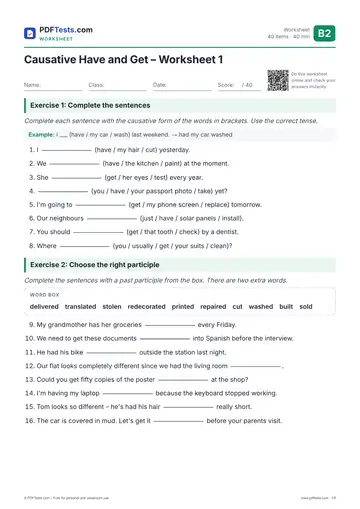
- I’m going to ______ (my jacket / dry-clean) before the interview.
- She got the mechanic ______ (check) the brakes.
- ______ you ______ your passport photo taken yet?
- Rewrite with the causative: A thief stole Tom’s phone on the train.
- Correct the mistake: I’ll have my secretary to send you the details.
Answers
- I’m going to have / get my jacket dry-cleaned before the interview.
- She got the mechanic to check the brakes.
- Have you had your passport photo taken yet?
- Tom had his phone stolen on the train.
- I’ll have my secretary send you the details.
Next step
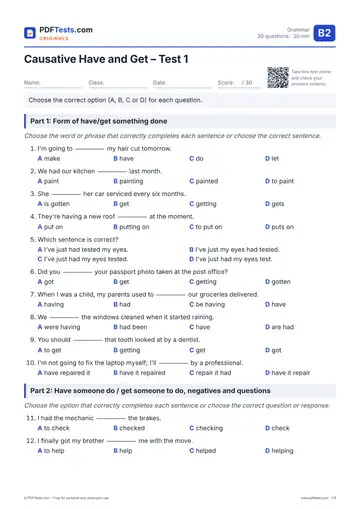
Now put the rules into practice with our B2 Causative Have and Get test, which mixes service sentences, bad experiences and the get someone to do pattern. If you mix up to do and doing after verbs, review our Gerunds and Infinitives guide, and when you feel confident, explore more grammar and vocabulary practice in our B2 English tests.
Practise this topic: Causative Have and Get
Was this page helpful?
What was the problem?
Thank you for your feedback!