Narrative tenses are the past tenses we use to tell stories and describe past events: the past simple, past continuous, past perfect and past perfect continuous. Together they show the order of events, which actions were in progress, and what had already happened before the main point of the story. You need them for anecdotes, news reports, emails about your weekend and the story-writing tasks in B2 exams.
The four narrative tenses at a glance
| Tense | Form | Main job in a story | Example |
|---|---|---|---|
| Past simple | verb + -ed / irregular form | the main events, in order | She opened the door. |
| Past continuous | was/were + -ing | background; actions in progress | It was raining. |
| Past perfect | had + past participle | an earlier event | Someone had broken the window. |
| Past perfect continuous | had been + -ing | an earlier activity with duration | She had been waiting for an hour. |
Here is how they work together in a short story:
It was getting dark and the wind was blowing hard. Maya had been walking for three hours and she was exhausted. When she finally reached the hut, she realised that someone had left the door open. She stepped inside and lit a candle.
- was getting, was blowing – the scene (past continuous)
- had been walking – an activity that continued up to that moment (past perfect continuous)
- reached, realised, stepped, lit – the main events (past simple)
- had left – something that happened before she arrived (past perfect)
Past simple: the main events
The past simple carries the storyline. Each verb moves the story forward, and the events happen in the order you mention them.
- I got home, switched on the lights and saw the mess.
- The plane landed at midnight and we took a taxi to the hotel.
| Affirmative | Negative | Question |
|---|---|---|
| She left early. | She didn’t leave early. | Did she leave early? |
| They called the police. | They didn’t call the police. | Did they call the police? |
Remember that irregular verbs (go – went, find – found, catch – caught) need to be learned. If you need a refresher, see our Past Continuous vs Past Simple guide.
Past continuous: the background
The past continuous describes actions that were in progress at a particular moment. In a story it has three main jobs.
1. Setting the scene
- The sun was shining and people were sitting outside the cafés.
2. An action interrupted by a shorter event
The longer action is in the past continuous; the short, interrupting action is in the past simple.
- I was cooking dinner when the smoke alarm went off.
- While we were driving to the airport, the car broke down.
3. Two actions happening at the same time
- She was checking her emails while her colleague was talking to the client.
| Affirmative | Negative | Question |
|---|---|---|
| I/He/She was working. | I/He/She wasn’t working. | Was she working? |
| We/You/They were working. | We/You/They weren’t working. | Were they working? |
Past perfect: going further back
The past perfect takes the reader back to an event that happened before another past event. Think of it as the past of the past.
- When I got to the station, the train had already left. (The train left first; then I arrived.)
- She had never seen snow before she moved to Canada.
- By the time the firefighters arrived, the fire had spread to the roof.
It is very common after verbs like realise, discover, find out, remember and notice:
- I suddenly realised I had left my passport at home.
- He discovered that someone had used his credit card.
| Affirmative | Negative | Question |
|---|---|---|
| They had finished. | They hadn’t finished. | Had they finished? |
| She**’d gone** home. | She hadn’t gone home. | Had she gone home? |
For a deeper look at this tense, read our Past Perfect guide.
Past perfect continuous: an earlier activity in progress
The past perfect continuous describes an activity that continued for a period of time up to a moment in the past. It is the past equivalent of the present perfect continuous.
1. Duration up to a past moment
It often appears with for, since and how long.
- We had been queuing for two hours when the doors finally opened.
- How long had you been living there when you met your wife?
2. Explaining a visible result in the past
- His clothes were wet because he had been walking in the rain.
- Her eyes were red. She had been crying.
| Affirmative | Negative | Question |
|---|---|---|
| He had been running. | He hadn’t been running. | Had he been running? |
State verbs such as know, believe, own, like and understand are not normally used in continuous forms. Use the past perfect simple instead: I had known her for years (not had been knowing).
How the tense after when changes the meaning
The same sentence can tell a very different story depending on the tense you choose after the when clause.
| Sentence | What happened |
|---|---|
| When I arrived at the party, Tom left. | I arrived, then Tom left (maybe because of me). |
| When I arrived at the party, Tom was leaving. | Tom was in the middle of leaving; we passed at the door. |
| When I arrived at the party, Tom had left. | Tom left before I arrived; I missed him. |
| When I arrived at the party, Tom had been dancing. | He danced before I arrived and was probably hot and tired. |
This is one of the most frequently tested points at B2, so read when sentences carefully.
Signal words and linkers
Certain time expressions tend to go with particular tenses. They are useful clues, not fixed rules.
| Linker or expression | Typical tense | Example |
|---|---|---|
| when, as soon as, then, after that, eventually | Past simple | As soon as she saw me, she smiled. |
| while, as, at that moment, all evening | Past continuous | As I was leaving, the phone rang. |
| by the time, already, just, never… before, after | Past perfect | By the time we got there, the shop had closed. |
| for, since, how long, all day (before a past point) | Past perfect continuous | They had been arguing all morning. |
Past perfect or past simple?
Learners at B2 often use the past perfect too much. Use it only when you need to make an earlier event clear.
When the order of events is obvious, especially with before or after, the past simple is usually fine:
- After I finished work, I went to the gym. ✓
- After I had finished work, I went to the gym. ✓ (also correct; slightly more emphasis on completion)
In a longer story, use the past perfect to signal the move back in time, then return to the past simple:
Leo had worked in the restaurant for ten years. He had started as a dishwasher. Within a year, he became assistant chef, and soon everyone knew his name.
After the first two sentences, the reader understands the time frame, so the past simple continues the flashback naturally.
Past continuous or past perfect continuous?
Both describe activities in progress, but the reference point is different.
- I was working when he called. (I was in the middle of working at the moment he called.)
- I had been working for ten hours when he called. (The activity started earlier and continued up to the call; the focus is on duration.)
If you mention how long, you almost always need the past perfect continuous.
Common mistakes
- ✗ When I got to the station, the train already left. → ✓ When I got to the station, the train had already left. – The train left before I arrived, so use the past perfect.
- ✗ By the time we arrived, the film started. → ✓ By the time we arrived, the film had started. – By the time usually signals an earlier completed action.
- ✗ I had gone to Paris last year. → ✓ I went to Paris last year. – There is no later past event, so use the past simple.
- ✗ She had been knowing him for years. → ✓ She had known him for years. – Know is a state verb and is not used in continuous forms.
- ✗ He was crashing the car while he was texting. → ✓ He crashed the car while he was texting. – A short, completed event takes the past simple.
- ✗ When the phone rang, I had a shower. (meaning: I was in the shower) → ✓ When the phone rang, I was having a shower. – The past simple suggests the shower started after the call.
- ✗ We were waiting for two hours when the bus came. → ✓ We had been waiting for two hours when the bus came. – Duration up to a past moment needs the past perfect continuous.
- ✗ They had been played tennis all afternoon. → ✓ They had been playing tennis all afternoon. – The form is had been + -ing.
Quick check
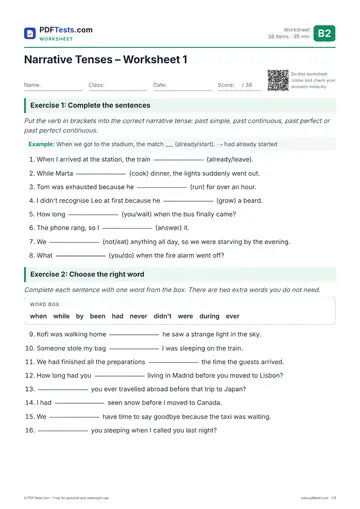
Put the verbs in brackets into the correct narrative tense.
- By the time the police arrived, the thieves ___ (escape).
- I ___ (cook) dinner when the power went off.
- Her hands were covered in paint. She ___ (decorate) the kitchen all morning.
- He ___ (open) the letter, ___ (read) it and ___ (burst) into tears.
- I didn’t recognise her at first because she ___ (change) her hair colour.
Answers
- had escaped – they escaped before the police arrived.
- was cooking – an action in progress, interrupted by a shorter event.
- had been decorating – an activity over a period of time explaining a past result.
- opened, read, burst – a sequence of main events in order.
- had changed – the change happened before the moment I saw her.
Next step
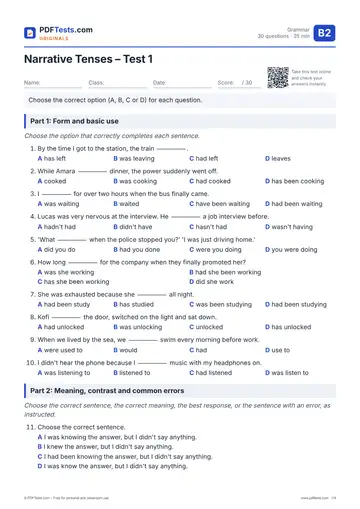
Now put the four tenses into practice with our B2 Narrative Tenses test, paying special attention to when and by the time sentences. If the past perfect still feels unsure, warm up with the B1 Past Perfect test first. Once you are confident, make your stories more varied by adding participle clauses, for example Having missed the last bus, we walked home, and try writing a short anecdote of your own that uses all four tenses.
Was this page helpful?
What was the problem?
Thank you for your feedback!