Advanced article use covers the harder choices between a/an, the and no article. These include talking about things in general, abstract nouns, groups of people, institutions, place names and fixed expressions. At B2 you need these patterns to write and speak accurately in essays, emails and exams.
If you need to revise the basics first, read our guide to articles a, an and the. In this guide, Ø means “no article” (the zero article).
Quick recap: three choices
| Article | Basic idea | Example |
|---|---|---|
| a/an | one of many; new or unspecified | I’ve joined a gym. |
| the | specific; speaker and listener know which | The gym near my office is cheap. |
| Ø | plural or uncountable nouns in general | Gyms are expensive. Exercise is good for you. |
Most advanced problems come down to one question: is the noun general or specific?
1. Talking about things in general
English has three ways to make generalisations with countable nouns.
| Structure | Example | Style / meaning |
|---|---|---|
| Ø + plural | Smartphones have changed how we communicate. | Most common, neutral |
| the + singular | The smartphone has changed how we communicate. | More formal; a whole class, species or invention |
| a/an + singular | A smartphone is a small portable computer. | Any single example; definitions |
Generic the is typical when writing about inventions, animals, plants and musical instruments:
- The tiger is now an endangered species.
- Who invented the printing press?
- She plays the cello in an orchestra.
Generic a/an cannot describe a whole class as a group. A tiger is endangered is wrong, because one tiger cannot be a species. Use Tigers are endangered or The tiger is endangered.
With uncountable nouns in general, use Ø: Pollution is a growing problem. Music helps me concentrate.
2. Abstract nouns: general vs specific
Abstract nouns such as life, love, history, society, nature, education, crime and technology take no article when used in a general sense. They take the when they become specific, usually through an of-phrase or a relative clause.
- History was my favourite subject. → The history of Japan is fascinating.
- Society is changing fast. → The society we live in is very competitive.
- Crime has fallen in the city centre. → The crime he committed was serious.
- Nature is full of surprises. → The nature of the problem is unclear. (here nature means “character”)
An adjective alone usually does not make the noun specific. Modern art, British history, human nature and Western society all take Ø. Compare: the art of the Renaissance.
For more on clauses that identify a noun, see our guide to defining and non-defining relative clauses.
3. A/an with uncountable nouns
Some uncountable nouns take a/an when an adjective or phrase describes a particular kind or amount. Common examples are knowledge, understanding, education, interest, variety, range and shortage.
- She has a good knowledge of Spanish law.
- He received an excellent education.
- There’s a shortage of nurses.
- We offer a wide range of courses.
However, some uncountable nouns never take a/an, even with an adjective: advice, information, news, progress, weather, furniture, luggage, work. Say some useful advice, a piece of advice or terrible weather, never a terrible weather. For the full distinction, see our guide to countable and uncountable nouns.
4. The + adjective for groups of people
The + adjective refers to a whole group of people. The verb is plural, and the adjective never takes -s.
- The elderly need better healthcare.
- The unemployed are entitled to benefits.
- The rich get richer while the poor struggle.
Common examples: the young, the old, the elderly, the rich, the poor, the homeless, the sick, the disabled, the injured, the unemployed.
This structure only refers to the group. For one person, add a noun: a homeless man, an elderly woman, a young person.
Nationalities ending in -sh, -ch, -ese or -ss work the same way: the British, the French, the Japanese, the Swiss. Most others use a plural noun: Americans, Brazilians (or the Americans for the nation as a whole).
5. Institutions: purpose vs building
Nouns such as school, university, college, hospital, prison, church and court take Ø when we mean the institution’s main purpose. They take the when we mean the building or one particular place.
| Ø (purpose) | the (building / specific place) |
|---|---|
| My son is at school. (he’s a pupil) | I went to the school to meet his teacher. |
| He was sent to prison for fraud. | The prison is near the motorway. |
| She’s in hospital after the accident. (a patient, UK) | I visited her at the hospital. |
| They go to church on Sundays. (to worship) | The church was built in 1450. |
Similar fixed patterns: go to bed, go to work, be at home, go to sea.
American English often uses the with hospital (She’s in the hospital) and says go to college where British English says go to university.
6. Place names
This area has the most rules, but a few patterns cover most cases.
| Usually Ø | Usually the |
|---|---|
| Most countries: France, Japan, Brazil | Plural names or names with Kingdom, States, Republic: the UK, the USA, the Netherlands, the Philippines |
| Continents: Asia, Africa | Oceans, seas, rivers, canals: the Pacific, the Mediterranean, the Danube, the Suez Canal |
| Cities and towns: Madrid, Toronto | Mountain ranges: the Alps, the Himalayas |
| Single mountains: Mount Everest, Kilimanjaro | Island groups: the Maldives, the Canary Islands |
| Lakes: Lake Geneva, Lake Victoria | Deserts: the Sahara, the Gobi |
| Single islands: Sicily, Bali | Regions with of: the south of France, the Middle East |
| Streets, squares, parks: Oxford Street, Times Square, Central Park | Hotels, museums, theatres: the Hilton, the Louvre, the Globe |
| Airports, stations, place + University: Heathrow Airport, Victoria Station, Harvard University | Names with of: the University of Toronto, the Tower of London, the Gulf of Mexico |
Compare: southern Spain (Ø, adjective) but the south of Spain (of-phrase). Many newspapers include the in their name: The Guardian, The New York Times.
7. Uniqueness, superlatives and roles
Use the with superlatives, ordinal numbers and words like only and same:
- It was the best film I’ve seen this year.
- She was the first woman to win the prize.
- We stayed in the same hotel as last time.
With next and last measured from now, use Ø: next week, last year. Compare: the last week of the holiday (the final one in a sequence).
Unique roles after be, become, elect, appoint and as often take Ø:
- She was elected president in 2020.
- He works as head of marketing.
Jobs that are not unique need a/an: She’s an engineer, never She’s engineer.
8. Fixed expressions
Many phrases simply have to be learned as chunks.
With Ø: by car/train/email, at night, at first, in fact, on purpose, in charge of, on time, in bed, have breakfast/lunch/dinner.
With the: in the end, on the other hand, at the moment, in the meantime, the other day, go to the cinema, in the morning/afternoon/evening.
With a/an: a few, a little, all of a sudden, as a rule, as a result, in a hurry, twice a week, €3 a kilo, 100 km an hour.
Meals normally take Ø, but they take a/an or the when described or identified: We had a lovely dinner. The lunch we had in Rome was amazing.
The double comparative always uses the … the: The more you practise, the easier it gets.
9. Common mistakes
- ✗ The life is too short. → ✓ Life is too short. — Abstract nouns in a general sense take no article.
- ✗ The poors need help. → ✓ The poor need help. — The + adjective never takes a plural -s.
- ✗ A homeless was sleeping outside. → ✓ A homeless man was sleeping outside. — For one person, add a noun.
- ✗ He gave me a good advice. → ✓ He gave me some good advice. — Advice never takes a/an.
- ✗ She speaks a good English. → ✓ She speaks good English. — Languages take no article.
- ✗ We climbed the Mount Etna. → ✓ We climbed Mount Etna. — Single mountains take no article.
- ✗ I live in Netherlands. → ✓ I live in the Netherlands. — Plural country names take the.
- ✗ His brother is in the prison. (he’s a prisoner) → ✓ His brother is in prison. — Use Ø when you mean the institution’s purpose.
- ✗ I’m interested in the modern art. → ✓ I’m interested in modern art. — An adjective alone does not make a noun specific.
- ✗ She is best student in the class. → ✓ She is the best student in the class. — Superlatives need the.
Quick check
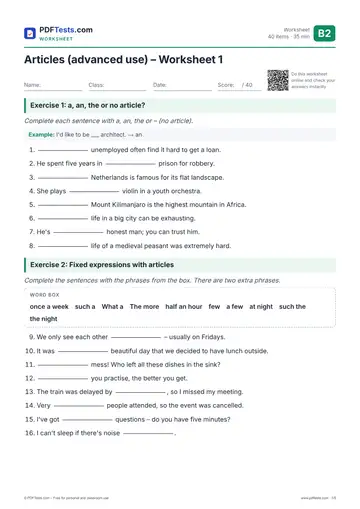
Complete each sentence with a, an, the or Ø (no article).
- ___ unemployed often find it hard to get a mortgage.
- She’s writing a thesis on ___ history of ___ Ottoman Empire.
- He has ___ excellent understanding of financial markets.
- My aunt is in ___ hospital after a minor operation. (British English; she’s a patient)
- We spent two weeks trekking in ___ Andes.
Answers
- The — the + adjective refers to a group of people.
- the, the — history is made specific by the of-phrase; names of empires take the.
- an — understanding takes a/an when described by an adjective, and excellent starts with a vowel sound.
- Ø — in hospital means as a patient in British English.
- the — mountain ranges take the.
Next step
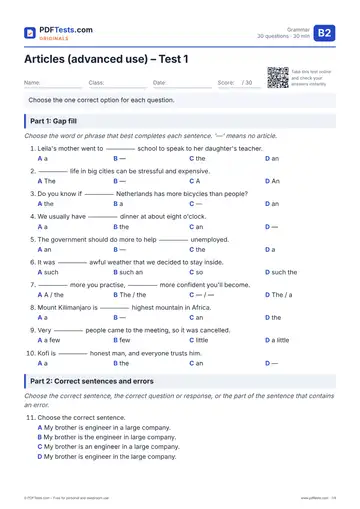
Now put these rules into practice: test yourself with our B2 Articles (advanced use) test, which mixes generic reference, abstract nouns, institutions and place names. Note any items you get wrong, return to the matching section above, and then try the B2 English Level Test to see how your article accuracy holds up alongside other B2 grammar.
Was this page helpful?
What was the problem?
Thank you for your feedback!