A relative clause gives more information about a noun, usually with who, which, that, whose, where or when. A defining relative clause tells us which person or thing we mean, and the sentence doesn’t make sense without it. A non-defining relative clause adds extra information about something we have already identified. It goes between commas and could be removed.
If you need to review the basics of who, which, that and where first, start with our B1 guide to relative clauses.
The key difference
Defining relative clauses
A defining clause identifies the noun. Without it, the listener would ask, “Which one?”
- The woman who called this morning wants a refund.
- I’ve lost the charger that came with my laptop.
- People who cycle to work tend to arrive less stressed.
If you remove the clause, the meaning breaks down: The woman wants a refund. Which woman?
Non-defining relative clauses
A non-defining clause adds extra information about a noun that is already clear, often a name, a unique thing, or something we’ve just mentioned.
- My sister, who works in Berlin, is visiting next week.
- The Eiffel Tower, which was finished in 1889, was meant to be temporary.
- We stayed at the Grand Hotel, where my parents had their wedding.
Remove the clause and the sentence still works: My sister is visiting next week. We know who she is.
Side-by-side comparison
| Feature | Defining | Non-defining |
|---|---|---|
| Purpose | Identifies which one | Adds extra information |
| Commas | No | Yes (or brackets/dashes) |
| Can you remove it? | No, the meaning changes | Yes, the sentence still makes sense |
| That possible? | Yes | No |
| Pronoun can be omitted? | Yes, when it is the object | Never |
| Style | Speech and writing | More common in writing; in speech, marked by pauses |
Relative pronouns and adverbs
| Word | Refers to | Defining | Non-defining |
|---|---|---|---|
| who | people | ✓ the man who helped me | ✓ Tom, who helped me, … |
| whom (formal) | people as object | ✓ the candidate whom we chose | ✓ Ms Lee, whom we interviewed, … |
| which | things, animals | ✓ the app which I use | ✓ Spotify, which I use, … |
| that | people or things | ✓ the app that I use | ✗ |
| whose | possession (people or things) | ✓ the student whose bag was stolen | ✓ Anna, whose bag was stolen, … |
| where | places | ✓ the café where we met | ✓ Lisbon, where we met, … |
| when | times | ✓ the day when it happened | ✓ in 2020, when it happened, … |
| why | reasons | ✓ the reason why I left | ✗ |
Two points to note:
- Whose works for things too: a company whose profits have doubled.
- Whom is formal. In everyday English, people say who or leave the pronoun out: the person (who) I spoke to.
Leaving out the relative pronoun
In a defining clause, you can omit who, which or that when it is the object of the clause, that is, when another subject follows it.
- The film (that) we watched was terrible. → we is the subject, so that can go.
- The colleague (who) I share an office with is leaving.
You cannot omit the pronoun when it is the subject:
- The film that won the award was terrible. (that is the subject of won)
In a non-defining clause, you can never omit the pronoun:
- ✗ My laptop, I bought last year, has stopped working.
- ✓ My laptop, which I bought last year, has stopped working.
Prepositions in relative clauses
There are two possible positions for a preposition:
| Style | Defining | Non-defining |
|---|---|---|
| Informal (preposition at the end) | the flat (that) I live in | the flat, which I live in, … |
| Formal (preposition first) | the flat in which I live | the flat, in which I live, … |
When the preposition comes first, use only which or whom, never that or who:
- ✓ the manager to whom I complained
- ✗ the manager to who I complained
- ✗ the manager to that I complained
Non-defining clauses with quantifiers
At B2, you will often see non-defining clauses that begin with a quantifier + of whom / of which:
- I contacted twenty companies, most of which didn’t reply.
- She has three brothers, all of whom are doctors.
- We tried several restaurants, none of which were open.
Other common patterns: some of, many of, both of, neither of, each of, one of, the majority of. Use whom for people and which for things. Them is wrong here: ✗ most of them didn’t reply would need a new sentence or and.
Which referring to a whole clause
In a non-defining clause, which can refer to the whole previous idea, not just one noun. This is very common in speech and writing.
- He didn’t reply to my message, which was a bit rude.
- The train was cancelled, which meant we missed the concert.
- She passed all her exams, which surprised nobody.
Only which works here. What and that are wrong: ✗ The train was cancelled, what meant we missed the concert.
How commas change meaning
Sometimes the same words have a different meaning with and without commas.
-
My brother who lives in Leeds is an engineer. → I have more than one brother; I mean the one in Leeds.
-
My brother, who lives in Leeds, is an engineer. → I have one brother, and by the way, he lives in Leeds.
-
The students who had revised passed the test. → Only some students revised, and only they passed.
-
The students, who had revised, passed the test. → All the students revised, and all of them passed.
In speech, a non-defining clause is usually marked by a short pause before and after it, and often a slightly lower voice.
Clues that tell you which type to use
Look at the noun before the clause:
- Proper nouns (names of people, places, brands): almost always non-defining. Barcelona, which I visited last summer, …
- Unique things (my mother, the sun, our CEO): usually non-defining.
- Nouns after the with no other identification (the book, the guy): usually defining, because the clause tells us which one.
- Nouns after a/an or plural nouns used generally (a person, people, anyone): defining. Anyone who wants a ticket should email me.
Defining relative clauses vs participle clauses
A defining clause can often be shortened into a participle clause, which drops the pronoun and the auxiliary:
- The woman who is sitting by the window → The woman sitting by the window
- Products that are made in this factory → Products made in this factory
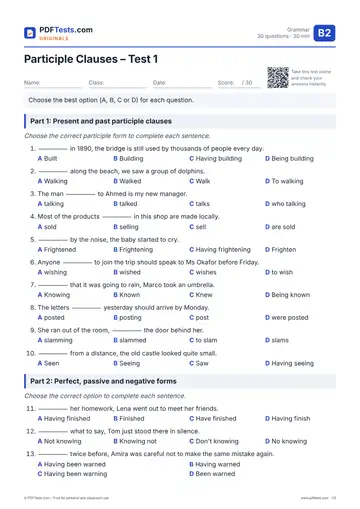
You can learn more in our guide to participle clauses.
Common mistakes
✗ Paris, that is the capital of France, is beautiful. → ✓ Paris, which is the capital of France, is beautiful. That cannot introduce a non-defining clause.
✗ The man, who lives next door, is a pilot. (when you mean which man) → ✓ The man who lives next door is a pilot. If the clause identifies the person, do not use commas.
✗ My boss, I really respect, is retiring. → ✓ My boss, whom / who I really respect, is retiring. You cannot omit the pronoun in a non-defining clause.
✗ The people which work here are friendly. → ✓ The people who / that work here are friendly. Use who or that for people, not which.
✗ The girl who her phone was stolen called the police. → ✓ The girl whose phone was stolen called the police. Use whose for possession; don’t add a possessive adjective.
✗ This is the book which I told you about it. → ✓ This is the book which I told you about. The relative pronoun replaces the object, so don’t repeat it.
✗ He forgot my birthday, what really upset me. → ✓ He forgot my birthday, which really upset me. Use which to refer to a whole clause.
✗ I have two cousins, both of them live in Canada. → ✓ I have two cousins, both of whom live in Canada. After a quantifier in a relative clause, use whom or which.
✗ The hotel where we stayed in was cheap. → ✓ The hotel where we stayed was cheap. / The hotel (that) we stayed in was cheap. Where already includes the meaning of in.
Quick check
Choose or correct each sentence.
- My grandmother, ___ is 90, still goes swimming every day. (that / who)
- Is the pronoun necessary? The jacket ___ I bought online doesn’t fit.
- Correct the mistake: We met Sara, that runs a bakery in town.
- Complete: I sent out 50 invitations, most of ___ were accepted.
- Add commas if needed: The phone that I ordered arrived broken.
Answers
- who – non-defining clause about a unique person; that is not possible.
- No – which/that can be omitted because it is the object (I bought it): The jacket I bought online doesn’t fit.
- We met Sara, who runs a bakery in town.
- which – quantifier + of which for things.
- No commas – the clause tells us which phone, so it is defining.
Next step
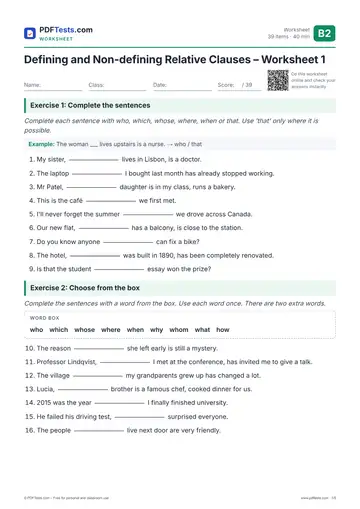
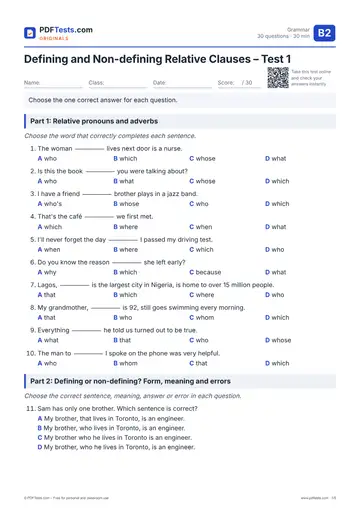
Now put the rules into practice: test yourself with our B2 Defining and Non-defining Relative Clauses test, and pay particular attention to commas, that versus which, and when the pronoun can be left out. If any questions catch you out, try the B2 Participle Clauses test next, since reduced clauses build directly on what you’ve learned here, or browse the full range of B2 English tests to keep improving.
Practise this topic: Defining and Non-defining Relative Clauses
Was this page helpful?
What was the problem?
Thank you for your feedback!