The passive voice puts the focus on the action or on the person or thing that receives it, not on who does it. In the present simple passive we use am/is/are + past participle (Coffee is grown in Brazil). In the past simple passive we use was/were + past participle (The bridge was built in 1932). We use it when the doer is unknown, obvious or less important than the action itself.
Active and passive: the basic idea
In an active sentence, the subject does the action:
- Thousands of tourists visit the museum every year.
In a passive sentence, the object of the active sentence becomes the subject. The doer moves to the end with by, or disappears completely:
- The museum is visited by thousands of tourists every year.
The meaning is the same. What changes is the focus. The second sentence is about the museum, not about the tourists.
When do we use the passive?
1. The doer is unknown
- My bike was stolen last night. (I don’t know who stole it.)
- This painting was found in an old house in 1985.
2. The doer is obvious or not important
- The rubbish is collected every Tuesday. (Obviously by the council or rubbish collectors.)
- He was arrested outside the bank. (Obviously by the police.)
3. The action or result is more important than the person
- English is spoken in many countries.
- The new hospital was opened in March.
4. Processes, facts and formal writing
The passive is very common in news reports, instructions, scientific texts and descriptions of how things are made.
- The oranges are picked by hand and then they are washed.
- Three people were injured in the accident.
- Breakfast is served from 7 to 10 a.m.
Form: present simple passive
Subject + am / is / are + past participle
| Example | |
|---|---|
| Affirmative | The windows are cleaned every month. |
| This cheese is made in France. | |
| Negative | The windows aren’t cleaned very often. |
| Credit cards are not accepted here. | |
| Question | Are the windows cleaned every month? |
| Where is this cheese made? | |
| Short answers | Yes, they are. / No, they aren’t. |
The verb be agrees with the new subject: The car is washed but The cars are washed.
Form: past simple passive
Subject + was / were + past participle
| Example | |
|---|---|
| Affirmative | The letter was sent yesterday. |
| The tickets were sold in two hours. | |
| Negative | The letter wasn’t sent on time. |
| We weren’t told about the change. | |
| Question | Was the letter sent yesterday? |
| When were the tickets sold? | |
| Short answers | Yes, it was. / No, it wasn’t. |
Only be changes for tense and person. The past participle never changes.
Past participles
Regular verbs add -ed, exactly like the past simple: clean → cleaned, invite → invited, stop → stopped, carry → carried.
Irregular verbs have their own past participle, which is often different from the past simple form. This is where most passive mistakes happen. If you need a review of past forms, see our guide to the past simple with regular and irregular verbs.
| Base form | Past simple | Past participle | Passive example |
|---|---|---|---|
| build | built | built | It was built in 1990. |
| write | wrote | written | The book was written in Spanish. |
| speak | spoke | spoken | Is French spoken here? |
| steal | stole | stolen | Our car was stolen. |
| give | gave | given | We were given a free coffee. |
| take | took | taken | This photo was taken in Rome. |
| make | made | made | Phones are made in this factory. |
| sell | sold | sold | The house was sold last year. |
| eat | ate | eaten | Rice is eaten all over the world. |
| choose | chose | chosen | She was chosen as team captain. |
Using by + the agent
The person or thing that does the action is called the agent. We introduce it with by:
- Harry Potter was written by J.K. Rowling.
- The decision is made by the manager.
Only mention the agent when it adds useful information. Most passive sentences have no agent at all.
- ✓ My phone was stolen.
- ✗ My phone was stolen by someone. (by someone tells us nothing new)
Avoid by people, by them, by somebody in passive sentences for the same reason.
Use with for a tool or material, not a person: The cake was decorated with chocolate. The door was opened with a key.
How to change active into passive
Follow these four steps:
- Find the object of the active sentence. It becomes the new subject.
- Keep the tense: present simple → am/is/are, past simple → was/were.
- Add the past participle of the main verb.
- Add by + agent only if it is important.
| Active | Passive |
|---|---|
| They deliver the post at 9. | The post is delivered at 9. |
| Shakespeare wrote Hamlet. | Hamlet was written by Shakespeare. |
| Someone cleans the offices every night. | The offices are cleaned every night. |
| The company didn’t pay the workers. | The workers weren’t paid. |
Notice the last example: the negative auxiliary didn’t disappears. In the passive, be does the job of the auxiliary, so the negative is wasn’t/weren’t.
Verbs that cannot be passive
Only verbs with an object (transitive verbs) can become passive. Verbs like happen, arrive, die, sleep, go, come and disappear have no object, so they have no passive form:
- ✓ The accident happened at 6 p.m.
- ✗ The accident was happened at 6 p.m.
A special case: be born
Born is always passive in this meaning:
- I was born in 2001. My twin sisters were born in Lisbon.
Active or passive: which should I choose?
Both are correct grammar, but they create a different focus.
| Use the active when… | Use the passive when… |
|---|---|
| the doer is important or the topic | the action or the receiver is the topic |
| you are speaking informally about people | you don’t know or don’t care who did it |
| My brother painted the kitchen. | The kitchen was painted last week. |
In everyday conversation English speakers prefer the active, often with they, you or someone: They’re building a new station. The passive is more frequent in written, formal and factual texts.
Signal words and typical contexts
The passive itself has no special signal words, but the tense does. Look for the usual time expressions:
- Present simple passive: every day, usually, often, always, every year, in (country) → Tea is drunk every day in Britain.
- Past simple passive: yesterday, last week, in 1999, ago, when → The film was made ten years ago.
Also watch for typical passive topics: made in, built in, invented by, written by, discovered by, spoken in, grown in, invited to, born in. For a reminder of present simple time expressions, see the present simple guide.
Common mistakes
✗ The window broken yesterday. → ✓ The window was broken yesterday. The passive always needs a form of be.
✗ The book was wrote in 1950. → ✓ The book was written in 1950. Use the past participle, not the past simple form.
✗ It was happened last night. → ✓ It happened last night. Happen has no object, so it can’t be passive.
✗ I born in Madrid. → ✓ I was born in Madrid. Born needs was/were.
✗ The houses was built in 1900. → ✓ The houses were built in 1900. Be must agree with the plural subject.
✗ Did the car repaired? → ✓ Was the car repaired? Passive questions use be, not do.
✗ The car didn’t repaired. → ✓ The car wasn’t repaired. Passive negatives use wasn’t/weren’t or isn’t/aren’t.
✗ This song was written from Adele. → ✓ This song was written by Adele. The agent is introduced with by.
✗ Spanish speaks in Mexico. → ✓ Spanish is spoken in Mexico. Spanish doesn’t speak; people speak it, so use the passive.
Quick check
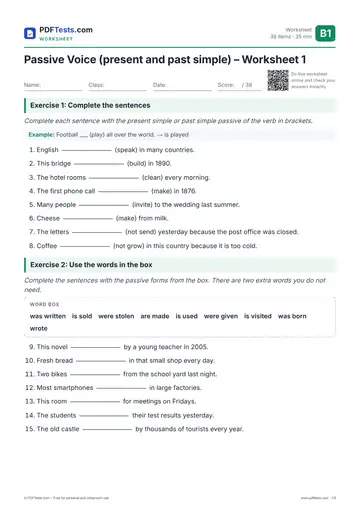
Complete each sentence with the present or past simple passive of the verb in brackets.
- Smartphones ______ (use) by millions of people every day.
- The Eiffel Tower ______ (build) in 1889.
- ______ breakfast ______ (include) in the price of the room?
- We ______ (not / invite) to the party last weekend.
- Where ______ your jacket ______ (make)? It says “Italy” on the label.
Answers
- are used – plural subject, present fact.
- was built – singular subject, past time (in 1889).
- Is breakfast included – question: be goes before the subject.
- weren’t invited / were not invited – past negative with a plural subject.
- was your jacket made – past question about how it was produced.
Next step
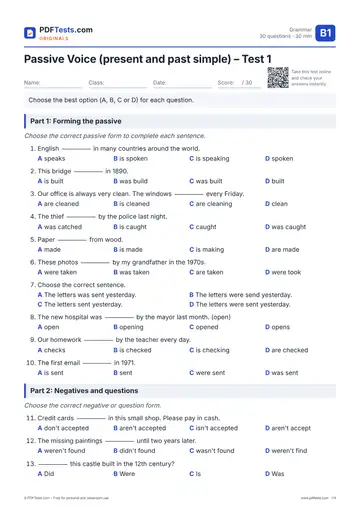
Now put the rules into practice: test yourself with our B1 Passive Voice (present and past simple) test and check which forms still cause problems, especially irregular past participles. When you feel confident, move on to other tenses and structures in our full Passive Voice guide, and then challenge yourself with the B2 Passive Voice test.
Practise this topic: Passive Voice (Present and Past Simple)
Was this page helpful?
What was the problem?
Thank you for your feedback!