The future continuous (will be + -ing) describes an action that will be in progress at a particular moment in the future. The future perfect (will have + past participle) describes an action that will be complete before a particular moment in the future. Both tenses look at the future from a fixed point in time, which is why learners often confuse them.
The future continuous
Uses
1. An action in progress at a specific future time
- This time tomorrow, I’ll be flying to Lisbon.
- Don’t call at 8. We’ll be having dinner.
- At midnight, most of the city will be sleeping.
The action starts before the time mentioned and continues after it. Imagine pausing a video of the future: the future continuous describes what is happening in that frame.
2. Events that will happen in the normal course of things
- I’ll be seeing Maya at work anyway, so I can give her the keys.
- The train will be stopping at all stations to Brighton.
The speaker is not deciding, offering or promising anything. The event is already part of a plan or routine.
3. Polite questions about someone’s plans
- Will you be using the car this evening?
- Will you be joining us for lunch?
Compare Will you join us for lunch?, which sounds like an invitation or a request. The future continuous only asks about plans, so it sounds less direct and more polite.
4. Guesses about what is happening now
- Don’t ring Tom now. He’ll be driving home.
- They’ll be watching the match, I expect.
Form
| Structure | Example | |
|---|---|---|
| Affirmative | subject + will be + verb-ing | She’ll be working late. |
| Negative | subject + won’t (will not) be + verb-ing | She won’t be working late. |
| Question | Will + subject + be + verb-ing? | Will she be working late? |
| Short answers | Yes, + subject + will. / No, + subject + won’t. | Yes, she will. / No, she won’t. |
The form is the same for every person: I’ll be, you’ll be, he’ll be, they’ll be.
Spelling of -ing forms follows the usual rules: make → making, stop → stopping, lie → lying, travel → travelling (British) or traveling (American).
State verbs such as know, believe, own, belong, understand and want are not normally used in the continuous. Say I’ll know the results tomorrow, not I’ll be knowing.
The future perfect
Uses
1. An action completed before a point in the future
- By Friday, I’ll have finished the report.
- The film will have started by the time we get there.
- In five years, they’ll have paid off the mortgage.
We don’t know exactly when the action happens, only that it will be finished before the time mentioned.
2. Duration up to a future point
- Next month, we’ll have lived here for ten years.
- By June, she’ll have been with the company for a decade.
This use is common with state verbs and with be. With action verbs, the future perfect continuous is often more natural when we focus on the activity: By 6 p.m., I’ll have been working for ten hours.
3. Assumptions about the past or present
- It’s nine o’clock. Anna will have landed in Rome by now.
- You’ll have heard the news, I suppose.
Here will have means something like I’m sure that… has happened. It works like must have, but sounds slightly more confident and conversational.
Form
| Structure | Example | |
|---|---|---|
| Affirmative | subject + will have + past participle | They’ll have left. |
| Negative | subject + won’t (will not) have + past participle | They won’t have left. |
| Question | Will + subject + have + past participle? | Will they have left? |
| Short answers | Yes, + subject + will (have). / No, + subject + won’t (have). | Yes, they will. / No, they won’t have. |
Have never changes to has after will: she will have, not she will has.
The past participle is -ed for regular verbs (finish → finished) and must be learned for irregular verbs (go → gone, write → written, take → taken, forget → forgotten).
Pronunciation
In fast speech, will have is heavily reduced. I’ll have finished often sounds like /aɪləv ˈfɪnɪʃt/, and won’t have sounds like /wəʊntəv/. In writing, always use the full words will have or the contraction I’ll have.
Signal words
| Future continuous | Future perfect |
|---|---|
| this time tomorrow / next week | by + time (by Monday, by then, by 2030) |
| at 10 o’clock tomorrow | by the time + clause |
| all day / all evening tomorrow | before + time or clause |
| when + clause (when you arrive) | in + period (in two years) |
| at this time next year | already, not… yet, by now |
By or until
These two words are a frequent source of errors.
- by = not later than; the action is complete at or before that time: I’ll have finished by 5.
- until = up to that time; the action continues: I’ll be working until 5.
So by goes naturally with the future perfect, and until goes with continuing actions.
Time clauses: no will after when, by the time, before
After time conjunctions such as when, by the time, before, after and as soon as, English uses a present tense, even though the meaning is future.
- By the time you get home, I’ll have cooked dinner.
- When you arrive, we’ll be waiting outside.
- They’ll have left before we wake up.
To stress completion inside the time clause, use the present perfect: I’ll call you as soon as I’ve finished.
Future continuous vs future perfect
The clearest way to see the difference is to compare the same situation.
-
At 10 tomorrow, I’ll be taking my driving test. (in progress at 10)
-
By 10 tomorrow, I’ll have taken my driving test. (finished before 10)
-
When you get to the party, everyone will be dancing. (they started before you arrive and are still dancing)
-
When you get to the party, everyone will have gone home. (they left before you arrive)
| Future continuous | Future perfect | |
|---|---|---|
| Question it answers | What will be happening at that moment? | What will be finished by that moment? |
| Timeline | action around the future point | action before the future point |
| Typical time words | at, this time, when | by, by the time, before |
Both tenses are different from plain will, which simply gives a prediction, decision or promise: I’ll take my driving test in May. For a full comparison of will, going to and the present continuous, see our guide to future forms.
The future perfect also mirrors the past perfect. The past perfect looks back from a point in the past (By 2020, she had moved to Berlin); the future perfect looks back from a point in the future (By 2030, she will have moved to Berlin). If you want to focus on the length of an activity, the logic is similar to the present perfect continuous, shifted into the future.
Common mistakes
✗ By the time you will arrive, we’ll have eaten. → ✓ By the time you arrive, we’ll have eaten. Use a present tense, not will, after time conjunctions.
✗ This time tomorrow I’ll lie on the beach. → ✓ This time tomorrow I’ll be lying on the beach. An action in progress at a future moment needs the future continuous.
✗ I’ll have finished it until Monday. → ✓ I’ll have finished it by Monday. Until is for continuing actions; by means not later than.
✗ Next year I’ll be knowing her for ten years. → ✓ Next year I’ll have known her for ten years. State verbs don’t take the continuous, and duration up to a future point uses the future perfect.
✗ She will has finished by then. → ✓ She will have finished by then. After will, always use the base form have.
✗ They will have finish by noon. → ✓ They will have finished by noon. The future perfect needs a past participle, not the base form.
✗ Will you be knowing the answer tomorrow? → ✓ Will you know the answer tomorrow? Know is a state verb, so the polite future continuous isn’t possible here.
Quick check
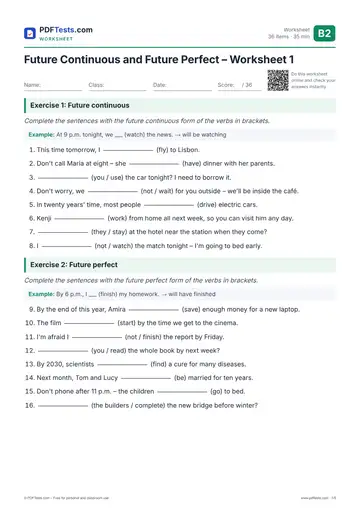
Complete each sentence with the future continuous or future perfect of the verb in brackets, or choose the correct word.
- This time next week, we ___ (sit) on a beach in Crete.
- By the time the guests arrive, I ___ (clean) the whole flat.
- Don’t phone at 3 p.m. I ___ (have) a job interview.
- She ___ (not finish) the project by Friday. It’s far too big.
- I’ll have read the book by / until tomorrow.
Answers
- will be sitting
- will have cleaned
- will be having
- won’t have finished
- by
Next step
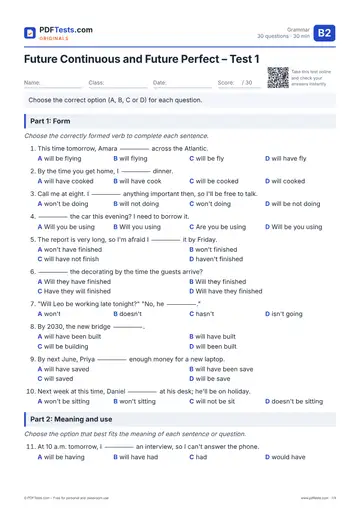
Now put the rules into practice: test yourself with our B2 Future Continuous and Future Perfect test, paying special attention to time expressions like by, until and by the time, since they usually decide which tense is correct. When you feel confident, explore more B2 English tests to review the other tenses and structures at this level.
Was this page helpful?
What was the problem?
Thank you for your feedback!