PDFTests Originals

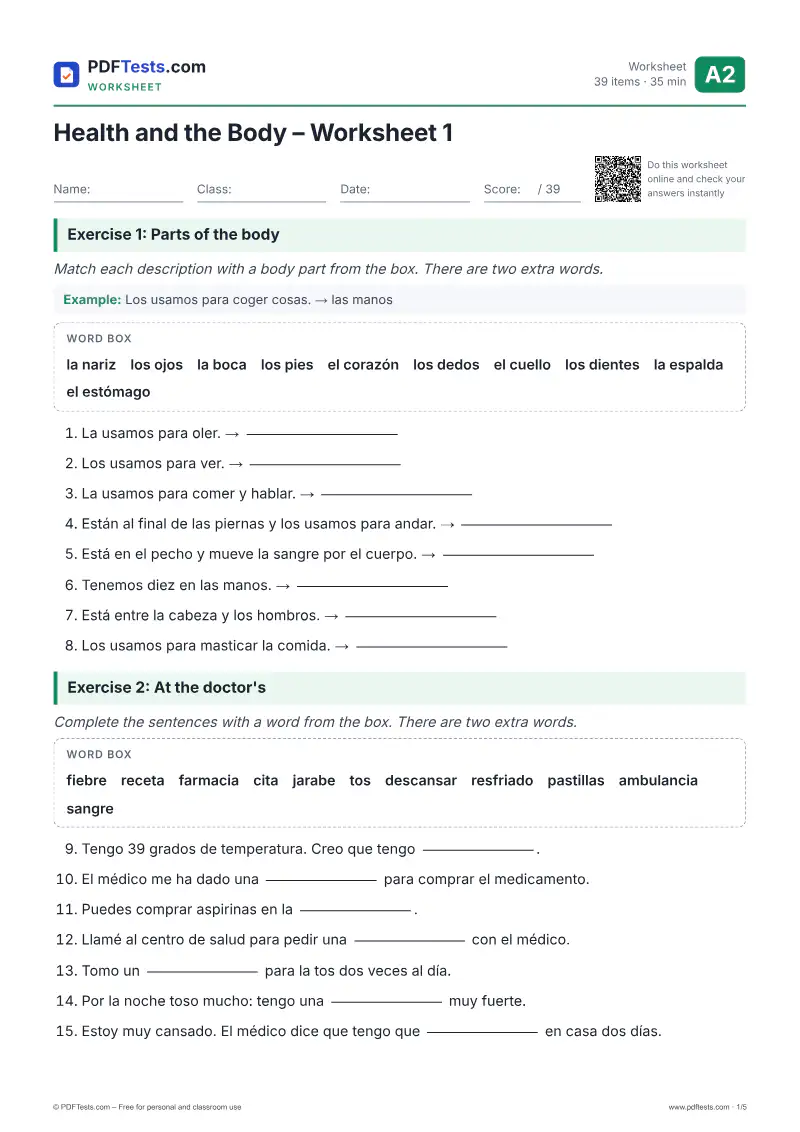
Health and the Body – Worksheet 1

A2 Elementary WorksheetSpanish

This A2 worksheet helps learners of Spanish practise everyday vocabulary for health and the body. Students match body parts, use key words such as fiebre, receta and farmacia in context, practise doler, fix common collocation mistakes and form related words. It suits teenage and adult learners in class or at home.
items
39
Time
35 min
PDF
5 pages
Answer key
Included
  • 100% free
  • No sign-up or email
  • Print-ready A4 PDF
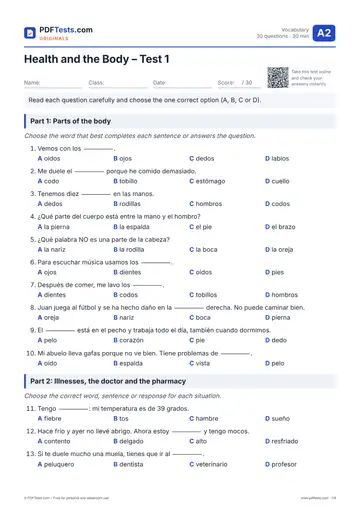
Preview of page 1 of Health and the Body – Worksheet 1 Open PDF

Do the worksheet online

Type your answers, then press “Check my answers”. Alternative correct answers are accepted.

Exercise 1: Parts of the body

Match each description with a body part from the box. There are two extra words.

Example: Los usamos para coger cosas. → las manos

Word box la narizlos ojosla bocalos piesel corazónlos dedosel cuellolos dientesla espaldael estómago

  1. La usamos para oler.

  2. Los usamos para ver.

  3. La usamos para comer y hablar.

  4. Están al final de las piernas y los usamos para andar.

  5. Está en el pecho y mueve la sangre por el cuerpo.

  6. Tenemos diez en las manos.

  7. Está entre la cabeza y los hombros.

  8. Los usamos para masticar la comida.

Exercise 2: At the doctor's

Complete the sentences with a word from the box. There are two extra words.

Word box fiebrerecetafarmaciacitajarabetosdescansarresfriadopastillasambulanciasangre

  1. Tengo 39 grados de temperatura. Creo que tengo .

  2. El médico me ha dado una para comprar el medicamento.

  3. Puedes comprar aspirinas en la .

  4. Llamé al centro de salud para pedir una con el médico.

  5. Tomo un para la tos dos veces al día.

  6. Por la noche toso mucho: tengo una muy fuerte.

  7. Estoy muy cansado. El médico dice que tengo que en casa dos días.

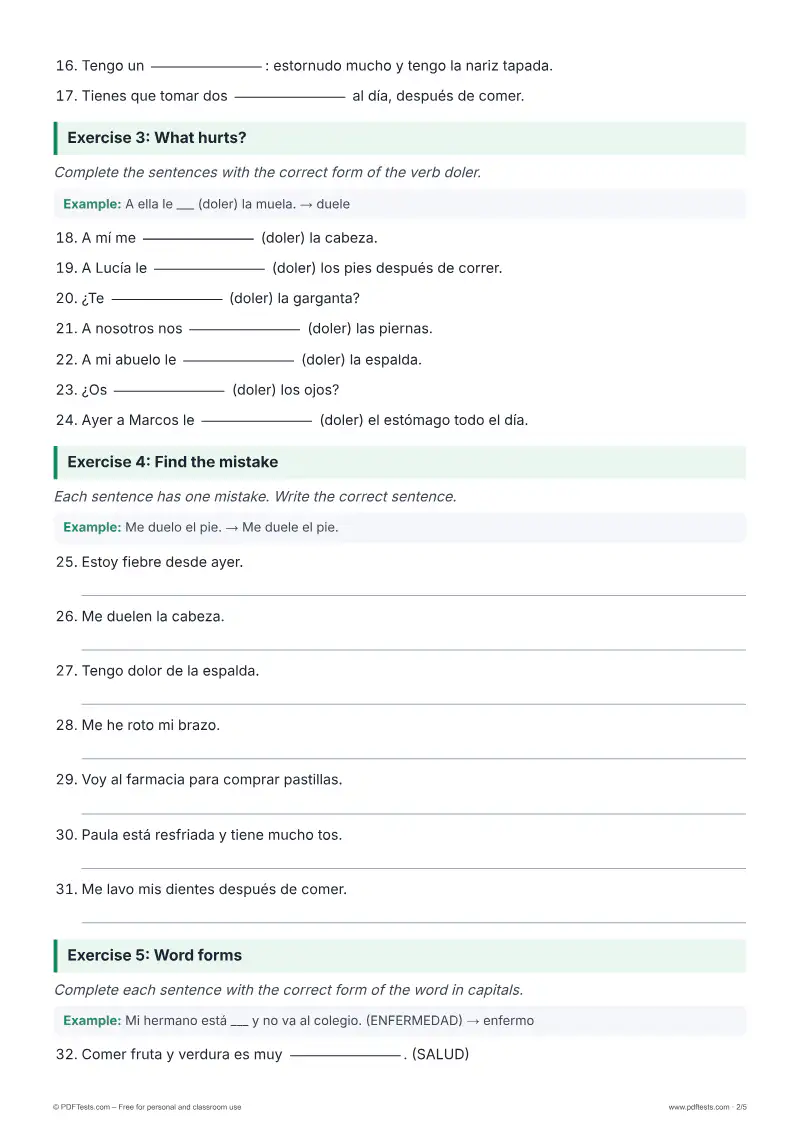
  8. Tengo un : estornudo mucho y tengo la nariz tapada.

  9. Tienes que tomar dos al día, después de comer.

Exercise 3: What hurts?

Complete the sentences with the correct form of the verb doler.

Example: A ella le ___ (doler) la muela. → duele

  1. A mí me (doler) la cabeza.

  2. A Lucía le (doler) los pies después de correr.

  3. ¿Te (doler) la garganta?

  4. A nosotros nos (doler) las piernas.

  5. A mi abuelo le (doler) la espalda.

  6. ¿Os (doler) los ojos?

  7. Ayer a Marcos le (doler) el estómago todo el día.

Exercise 4: Find the mistake

Each sentence has one mistake. Write the correct sentence.

Example: Me duelo el pie. → Me duele el pie.

  1. Estoy fiebre desde ayer.

  2. Me duelen la cabeza.

  3. Tengo dolor de la espalda.

  4. Me he roto mi brazo.

  5. Voy al farmacia para comprar pastillas.

  6. Paula está resfriada y tiene mucho tos.

  7. Me lavo mis dientes después de comer.

Exercise 5: Word forms

Complete each sentence with the correct form of the word in capitals.

Example: Mi hermano está ___ y no va al colegio. (ENFERMEDAD) → enfermo

  1. Comer fruta y verdura es muy . (SALUD)

  2. La gripe es una muy común en invierno. (ENFERMO)

  3. Tengo un muy fuerte en la rodilla. (DOLER)

  4. Mi madre trabaja como en un hospital. (ENFERMO)

  5. Estoy muy porque he trabajado mucho. (CANSANCIO)

  6. El médico me ha un antibiótico. (RECETA)

  7. Después del accidente, Sara tiene una en la pierna. (HERIR)

  8. Mi padre ha ido al porque le duelen las muelas. (DIENTE)

Was this page helpful?

Report a mistake

Spotted a wrong answer, a typo or an unclear explanation? Tell us and we will fix it.

Preview

About this test

Printable A2 Spanish worksheet on health and the body: body parts, symptoms, the verb doler, collocations and word forms. Answers included.

Topics covered

Body partsSymptoms and illnessesThe verb dolerHealth collocationsWord formation

Notes for teachers

Start with the matching exercise to activate body vocabulary, then move through the exercises in order, as they build from recognition to production. Watch for typical errors: using estar instead of tener with fiebre or tos, forgetting that doler agrees with the body part (me duelen los pies), and using possessives instead of articles with body parts (me lavo los dientes). As a follow-up, students can role-play a visit to the doctor or the pharmacy using the vocabulary.

All Spanish A2 tests →