PDFTests Originals

Present Subjunctive – Test 2

B1 Intermediate GrammarSpanish

This B1 test checks your control of the Spanish present subjunctive, from regular, stem-changing and irregular forms to choosing between subjunctive, indicative and infinitive. It also covers time and purpose clauses, relative clauses, negative commands and a short email with gaps. It suits intermediate learners and teachers who want a ready-to-print review.
Questions
30
Time
30 min
PDF
4 pages
Answer key
Included
  • 100% free
  • No sign-up or email
  • Print-ready A4 PDF
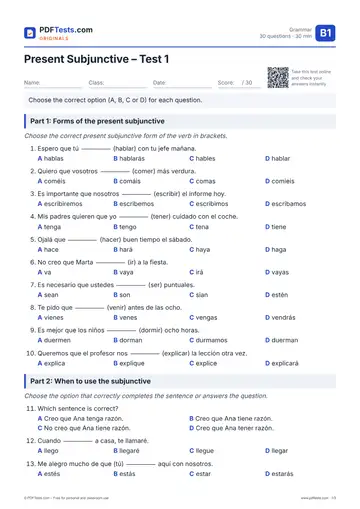
Preview of page 1 of Present Subjunctive – Test 2 Open PDF
New to this topic? Read the guide first: Spanish Present Subjunctive: Forms, Uses and Common Mistakes

Take the test online

Choose the correct option (A, B, C or D) for each question. Choose your answers, then press “Check my answers”.

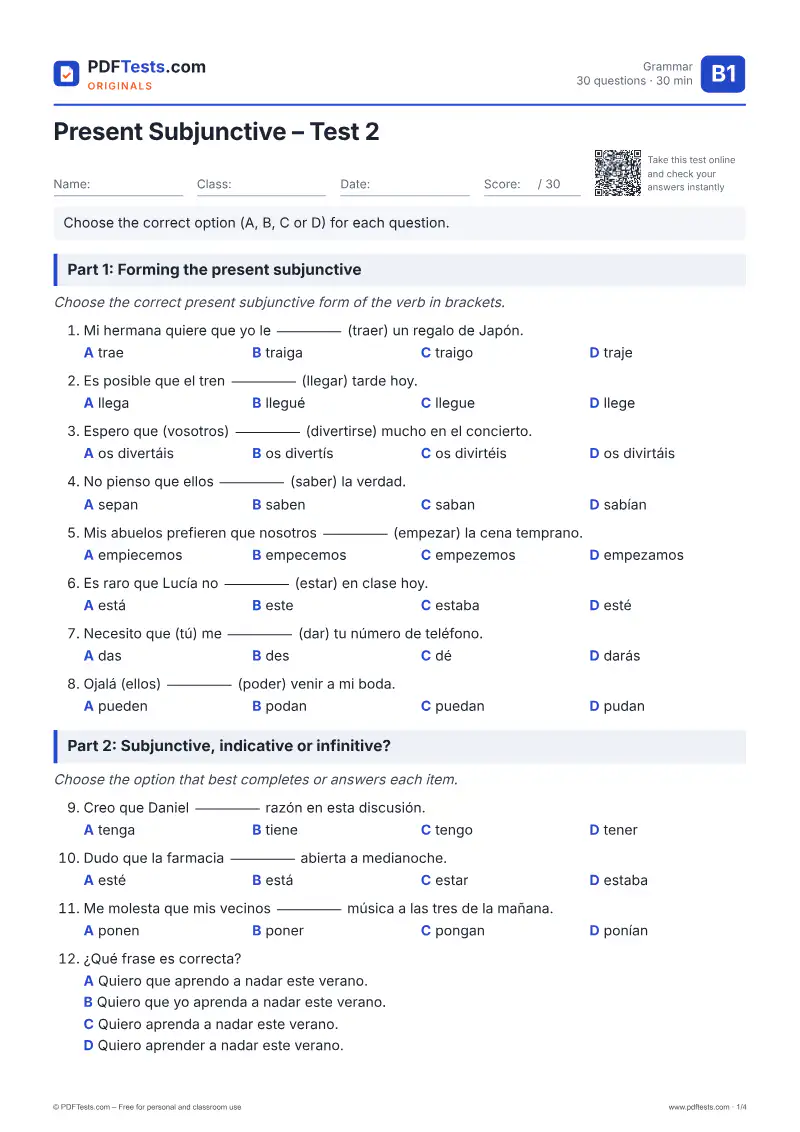
Part 1: Forming the present subjunctive

Choose the correct present subjunctive form of the verb in brackets.

  1. Mi hermana quiere que yo le _____ (traer) un regalo de Japón.

  2. Es posible que el tren _____ (llegar) tarde hoy.

  3. Espero que (vosotros) _____ (divertirse) mucho en el concierto.

  4. No pienso que ellos _____ (saber) la verdad.

  5. Mis abuelos prefieren que nosotros _____ (empezar) la cena temprano.

  6. Es raro que Lucía no _____ (estar) en clase hoy.

  7. Necesito que (tú) me _____ (dar) tu número de teléfono.

  8. Ojalá (ellos) _____ (poder) venir a mi boda.

Part 2: Subjunctive, indicative or infinitive?

Choose the option that best completes or answers each item.

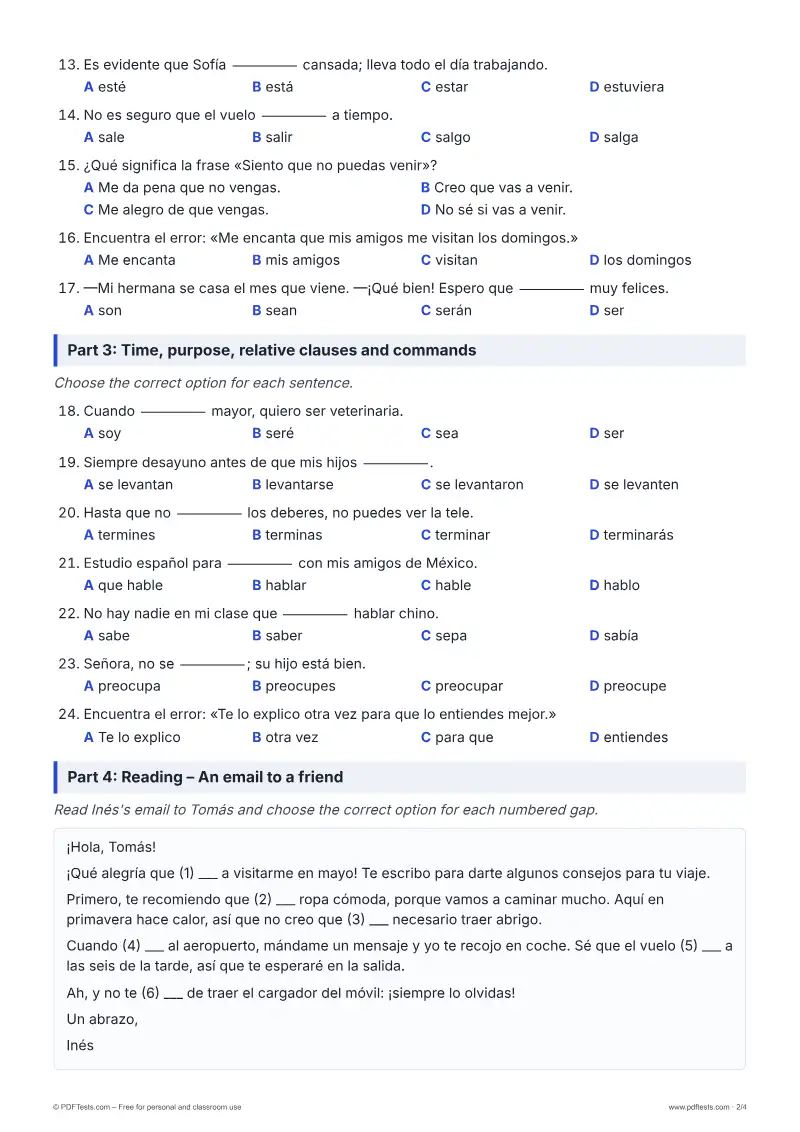
  1. Creo que Daniel _____ razón en esta discusión.

  2. Dudo que la farmacia _____ abierta a medianoche.

  3. Me molesta que mis vecinos _____ música a las tres de la mañana.

  4. ¿Qué frase es correcta?

  5. Es evidente que Sofía _____ cansada; lleva todo el día trabajando.

  6. No es seguro que el vuelo _____ a tiempo.

  7. ¿Qué significa la frase «Siento que no puedas venir»?

  8. Encuentra el error: «Me encanta que mis amigos me visitan los domingos.»

  9. —Mi hermana se casa el mes que viene. —¡Qué bien! Espero que _____ muy felices.

Part 3: Time, purpose, relative clauses and commands

Choose the correct option for each sentence.

  1. Cuando _____ mayor, quiero ser veterinaria.

  2. Siempre desayuno antes de que mis hijos _____.

  3. Hasta que no _____ los deberes, no puedes ver la tele.

  4. Estudio español para _____ con mis amigos de México.

  5. No hay nadie en mi clase que _____ hablar chino.

  6. Señora, no se _____; su hijo está bien.

  7. Encuentra el error: «Te lo explico otra vez para que lo entiendes mejor.»

Part 4: Reading – An email to a friend

Read Inés's email to Tomás and choose the correct option for each numbered gap.

¡Hola, Tomás!

¡Qué alegría que (1) ___ a visitarme en mayo! Te escribo para darte algunos consejos para tu viaje.

Primero, te recomiendo que (2) ___ ropa cómoda, porque vamos a caminar mucho. Aquí en primavera hace calor, así que no creo que (3) ___ necesario traer abrigo.

Cuando (4) ___ al aeropuerto, mándame un mensaje y yo te recojo en coche. Sé que el vuelo (5) ___ a las seis de la tarde, así que te esperaré en la salida.

Ah, y no te (6) ___ de traer el cargador del móvil: ¡siempre lo olvidas!

Un abrazo,

Inés

  1. (1) ¡Qué alegría que _____ a visitarme en mayo!

  2. (2) Te recomiendo que _____ ropa cómoda.

  3. (3) No creo que _____ necesario traer abrigo.

  4. (4) Cuando _____ al aeropuerto, mándame un mensaje.

  5. (5) Sé que el vuelo _____ a las seis de la tarde.

  6. (6) No te _____ de traer el cargador del móvil.

Was this page helpful?

Report a mistake

Spotted a wrong answer, a typo or an unclear explanation? Tell us and we will fix it.

Practise with a worksheet: Present Subjunctive – Worksheet 1

Preview

About this test

This B1 test checks your control of the Spanish present subjunctive, from regular, stem-changing and irregular forms to choosing between subjunctive, indicative and infinitive. It also covers time and purpose clauses, relative clauses, negative commands and a short email with gaps. It suits intermediate learners and teachers who want a ready-to-print review.

Topics covered

Present subjunctive formsStem-changing and irregular verbsWishes, emotions and doubtSubjunctive vs indicativeInfinitive vs que + subjunctiveTime and purpose clausesRelative clausesNegative commands

How to use this test

  1. Download the PDF and print it, or take the test online below.
  2. Answer every question without a dictionary or time pressure.
  3. Check your answers and note the topics you need to review.

Notes for teachers

Use this test after teaching the main subjunctive triggers, or as a diagnostic before revision. It targets common B1 errors: using the indicative after expressions of emotion, doubt and purpose, using que + subjunctive when both subjects are the same, spelling changes (llegue, empecemos), and the indicative after creer, saber and es evidente. As a follow-up, ask students to write their own email of advice to a visiting friend, using at least five subjunctive triggers.