PDFTests Originals

Common Spanish Idioms – Worksheet 1

B2 Upper-intermediate WorksheetSpanish

This worksheet practises common Spanish idioms such as 'meter la pata', 'tomar el pelo' and 'estar en las nubes'. Learners match each idiom to its meaning, complete fixed expressions, conjugate verbs in context, correct mistakes and build sentences. It is designed for B2 learners who want to sound more natural in everyday Spanish.
items
37
Time
35 min
PDF
5 pages
Answer key
Included
  • 100% free
  • No sign-up or email
  • Print-ready A4 PDF
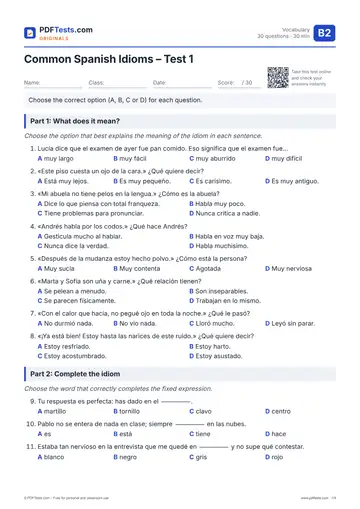
Preview of page 1 of Common Spanish Idioms – Worksheet 1 Open PDF

Do the worksheet online

Type your answers, then press “Check my answers”. Alternative correct answers are accepted.

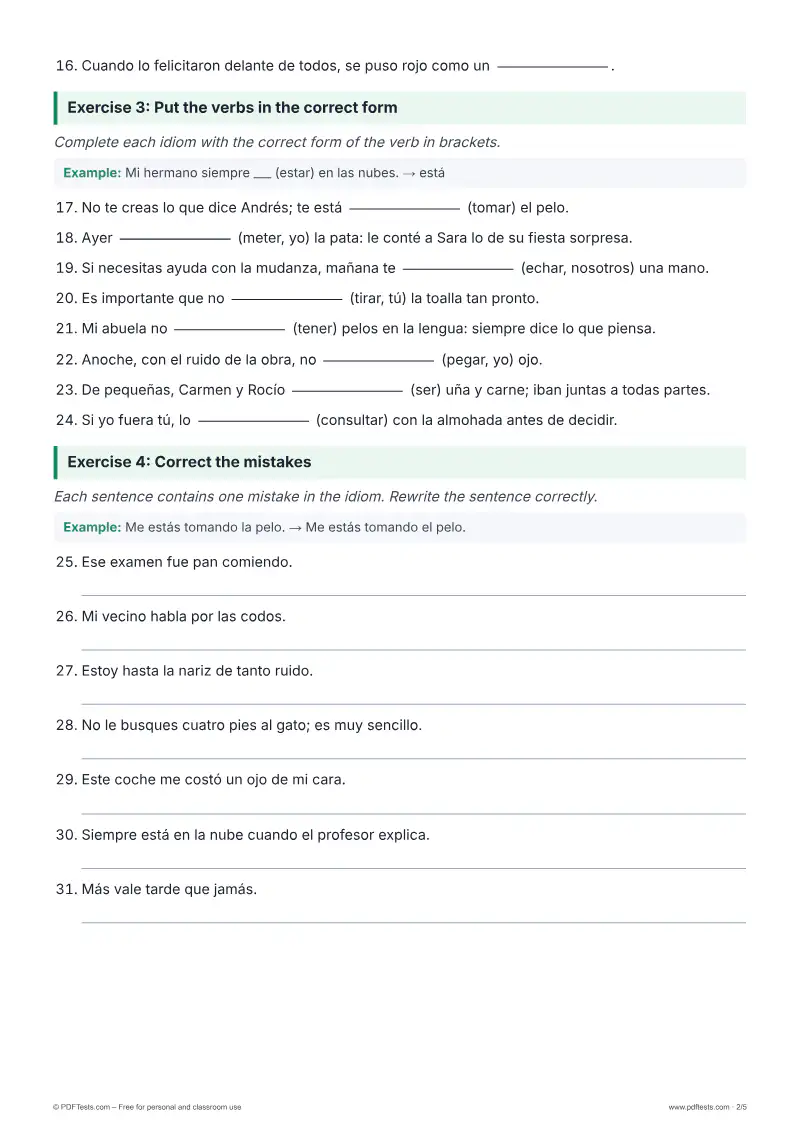
Exercise 1: Match the idioms with their meanings

Match each idiom with its meaning from the box. There are two extra meanings you do not need.

Example: costar un ojo de la cara → costar mucho dinero

Word box ser muy fácilequivocarse o decir algo inoportunoayudarrendirsehablar muchísimono poder dormirser inseparablesestar hartoestar muy distraídocostar mucho dinero

  1. ser pan comido

  2. meter la pata

  3. echar una mano

  4. tirar la toalla

  5. hablar por los codos

  6. no pegar ojo

  7. ser uña y carne

  8. estar hasta las narices

Exercise 2: Complete the idioms

Complete each sentence with a word from the box. There are two extra words.

Example: Ese examen fue pan ___. → comido

Word box caracántarosblanconubesaguaclavotroncotomatepelomano

  1. Este abrigo me ha costado un ojo de la .

  2. Está lloviendo a ; coge el paraguas.

  3. Cuando el profesor me preguntó, me quedé en y no supe qué decir.

  4. Pablo está en las ; no ha escuchado nada de la reunión.

  5. Desde que empezó a trabajar en la radio, Lucía está como pez en el .

  6. Con tu comentario has dado en el : ese es exactamente el problema.

  7. Ayer estaba tan cansado que dormí como un .

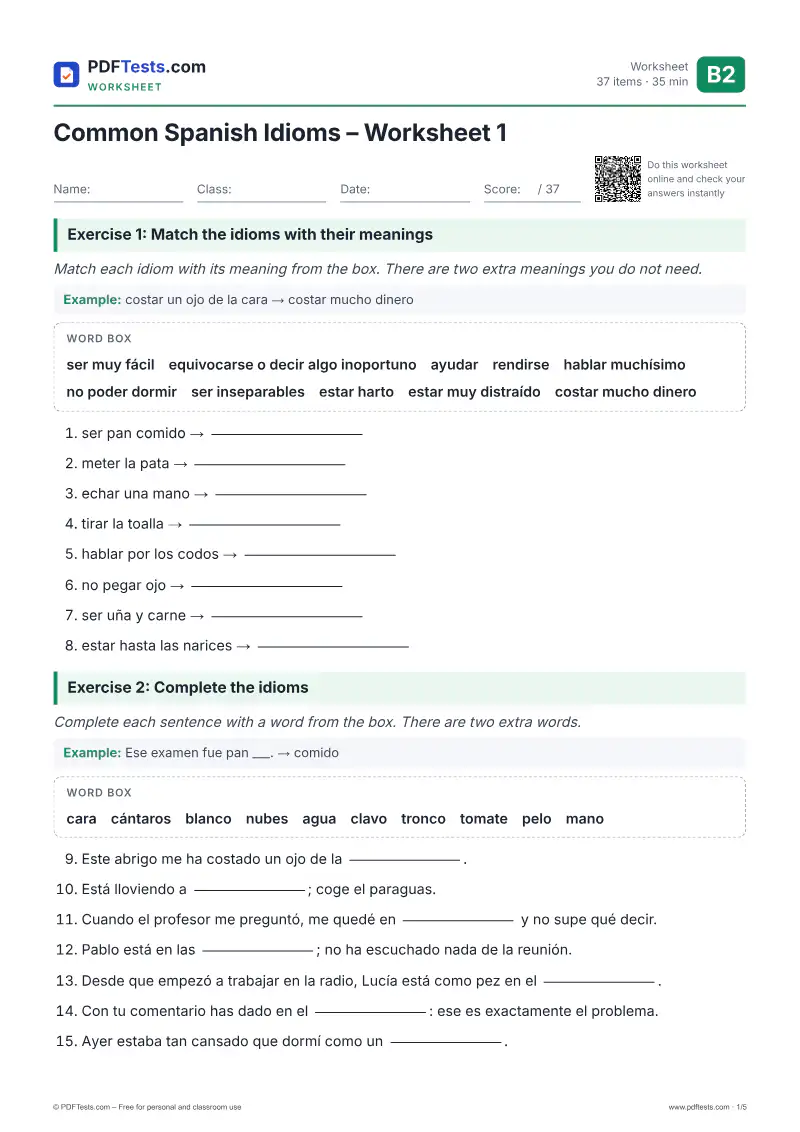
  8. Cuando lo felicitaron delante de todos, se puso rojo como un .

Exercise 3: Put the verbs in the correct form

Complete each idiom with the correct form of the verb in brackets.

Example: Mi hermano siempre ___ (estar) en las nubes. → está

  1. No te creas lo que dice Andrés; te está (tomar) el pelo.

  2. Ayer (meter, yo) la pata: le conté a Sara lo de su fiesta sorpresa.

  3. Si necesitas ayuda con la mudanza, mañana te (echar, nosotros) una mano.

  4. Es importante que no (tirar, tú) la toalla tan pronto.

  5. Mi abuela no (tener) pelos en la lengua: siempre dice lo que piensa.

  6. Anoche, con el ruido de la obra, no (pegar, yo) ojo.

  7. De pequeñas, Carmen y Rocío (ser) uña y carne; iban juntas a todas partes.

  8. Si yo fuera tú, lo (consultar) con la almohada antes de decidir.

Exercise 4: Correct the mistakes

Each sentence contains one mistake in the idiom. Rewrite the sentence correctly.

Example: Me estás tomando la pelo. → Me estás tomando el pelo.

  1. Ese examen fue pan comiendo.

  2. Mi vecino habla por las codos.

  3. Estoy hasta la nariz de tanto ruido.

  4. No le busques cuatro pies al gato; es muy sencillo.

  5. Este coche me costó un ojo de mi cara.

  6. Siempre está en la nube cuando el profesor explica.

  7. Más vale tarde que jamás.

Exercise 5: Put the words in order

Put the words in the correct order to make sentences with idioms.

Example: pan / es / comido / Esto → Esto es pan comido.

  1. una / ¿Puedes / mano? / echarme

  2. Nunca / la / tires / toalla

  3. pelo / Me / estás / el / tomando

  4. Lleva / lloviendo / a / cántaros / toda / la / mañana

  5. en / Ana / blanco / se / quedó / examen / el / en

  6. su / Raúl / está / nuevo / como / trabajo / en / pez / el / agua / en

Was this page helpful?

Report a mistake

Spotted a wrong answer, a typo or an unclear explanation? Tell us and we will fix it.

Preview

About this test

Printable B2 Spanish worksheet on common idioms: meanings, fixed words, verb forms and word order, with answers for class or self-study.

Topics covered

Spanish idiomsFixed expressionsVocabulary in contextVerb forms in idiomsB2 vocabulary

Notes for teachers

Start with the matching exercise so learners understand the idioms before using them in context. Learners often change fixed elements of an idiom, for example 'en la nube' instead of 'en las nubes' or 'hasta la nariz' instead of 'hasta las narices', so stress that idioms are fixed chunks. Many also translate English idioms word for word. As a follow-up, ask pairs to write a short dialogue using at least five idioms and act it out for the class.

All Spanish B2 tests →