Por and para can both translate as for in English, which is why they are one of the most confusing pairs in Spanish. The basic difference is simple: para points forward to a goal, destination, deadline or recipient, while por explains the cause, or describes the route, means, exchange or approximate time and place. Once you know which question each one answers, most choices become easy.
The big idea
Think of para as an arrow pointing at a target. Think of por as the road you travel along, or the reason that pushed you to act.
| Para | Por | |
|---|---|---|
| Direction | towards a goal or end point | through, around, because of |
| Key questions | What for? Where to? By when? For whom? | Why? Through where? How? In exchange for what? |
| Typical English | in order to, by (deadline), towards, intended for | because of, through, around, per, by means of, in exchange for |
Uses of para
1. Purpose (in order to)
Use para + infinitive to say why you do something, meaning in order to.
- Estudio español para trabajar en México. I study Spanish (in order) to work in Mexico.
- Este cuchillo es para el pan. This knife is for bread.
2. Destination
- Mañana salimos para Barcelona. Tomorrow we leave for Barcelona.
- Ya voy para casa. I’m on my way home.
3. Deadline
- Los deberes son para el lunes. The homework is due on Monday.
- Necesito el informe para las cinco. I need the report by five.
4. Recipient
- Estas flores son para ti. These flowers are for you.
- Hay un mensaje para tu jefa. There’s a message for your boss.
5. Employer
- Trabaja para una empresa de software. She works for a software company.
6. Opinion
- Para mí, el examen fue fácil. In my opinion, the exam was easy.
7. Comparison with what is expected
- Para ser febrero, hace mucho calor. For February, it’s very hot.
- Habla muy bien inglés para su edad. He speaks English very well for his age.
Uses of por
1. Cause or reason
Use por for the reason behind something, meaning because of or due to. This includes thanking, apologising and being punished or rewarded for something.
- Cancelaron el partido por la lluvia. They cancelled the match because of the rain.
- Gracias por tu ayuda. Thanks for your help.
- Me multaron por aparcar mal. I got fined for parking badly.
2. Movement through or along
- Paseamos por el centro. We walked around the town centre.
- El tren pasa por Zaragoza. The train goes through Zaragoza.
- Entraron por la ventana. They came in through the window.
3. Approximate place or time of day
- ¿Hay una farmacia por aquí? Is there a pharmacy around here?
- Nos vemos por la tarde. See you in the afternoon.
Por la mañana, por la tarde and por la noche are the standard forms in Spain. In many Latin American countries en la mañana is also common.
4. Duration
- Viví en Lima por tres años. I lived in Lima for three years.
This use is common in Latin America. In Spain, speakers usually say durante tres años or simply Viví tres años en Lima.
5. Exchange and price
- Pagué quince euros por la entrada. I paid fifteen euros for the ticket.
- Te cambio mi bocadillo por tu pizza. I’ll swap my sandwich for your pizza.
6. Means of communication
- Te mando las fotos por WhatsApp. I’ll send you the photos on WhatsApp.
- Lo hablamos por teléfono. We’ll talk about it on the phone.
For transport, Spanish normally uses en: Voy en tren (I’m going by train).
7. On behalf of or instead of
- Hoy hago yo el turno por ti. Today I’ll do the shift for you (in your place).
- ¿Puedes firmar por mí? Can you sign on my behalf?
8. Rate, frequency and multiplication
- Voy al gimnasio tres veces por semana. I go to the gym three times a week.
- El límite es 120 kilómetros por hora. The limit is 120 kilometres per hour.
- Dos por tres son seis. Two times three is six.
9. The agent in a passive sentence
- Cien años de soledad fue escrita por Gabriel García Márquez. One Hundred Years of Solitude was written by Gabriel García Márquez.
You can see more of this in our guide to the passive voice and passive se.
Same sentence, different meaning
Sometimes both prepositions are grammatically possible, but the meaning changes completely.
| Por | Para |
|---|---|
| Lo hice por ti. I did it because of you / for your sake. | Lo hice para ti. I made it for you (it’s a gift). |
| Trabajo por mi hermano. I’m working in my brother’s place. | Trabajo para mi hermano. My brother is my employer. |
| Salimos por Madrid. We leave via Madrid. | Salimos para Madrid. We leave for Madrid (destination). |
| Lo tengo por la tarde. I have it in the afternoon. | Lo tengo para la tarde. I’ll have it ready by the afternoon. |
| Estudia por sus padres. He studies because of his parents (they push him). | Estudia para sus padres. He studies to please his parents (they are the goal). |
¿Por qué? vs ¿Para qué?
¿Por qué? asks for the reason (looking back). ¿Para qué? asks for the purpose (looking forward).
- ¿Por qué estudias español? — Porque mi pareja es colombiana. Why do you study Spanish? — Because my partner is Colombian.
- ¿Para qué estudias español? — Para viajar por Sudamérica. What do you study Spanish for? — To travel around South America.
Note the spelling: por qué (two words, accent) asks the question; porque (one word) gives the answer.
Para + infinitive or para que + subjunctive
When the subject of both actions is the same person, use para + infinitive. When the subjects are different, use para que + subjunctive.
- Ahorro para comprar un coche. I’m saving to buy a car. (I save, I buy)
- Ahorro para que mis hijos puedan estudiar. I’m saving so that my children can study. (I save, they study)
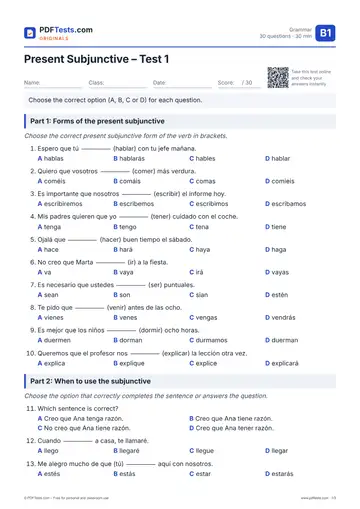
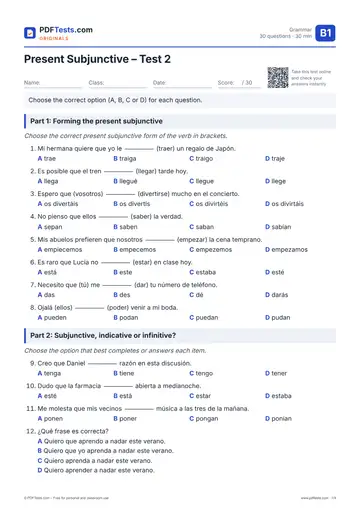
If the subjunctive forms are still new to you, review our present subjunctive guide.
Fixed expressions
Many common expressions simply have to be learned as chunks.
| Expression | Meaning |
|---|---|
| por favor | please |
| por fin | finally, at last |
| por supuesto | of course |
| por ejemplo | for example |
| por lo menos | at least |
| por eso | that’s why |
| por cierto | by the way |
| por si acaso | just in case |
| por casualidad | by chance |
| para siempre | forever |
| para nada | not at all |
| no es para tanto | it’s not a big deal |
- Por fin es viernes. Finally, it’s Friday.
- Llévate un paraguas por si acaso. Take an umbrella just in case.
- ¿Te molesta? — Para nada. Does it bother you? — Not at all.
Quick decision guide
When you hesitate, try replacing for with a more precise English word:
- in order to, intended for, heading to, by (a deadline), in my opinion, considering → para
- because of, thanks to, through, around, per, by means of, in exchange for, instead of, by (in the passive) → por
Signal words that often go with para: an infinitive of purpose, deadlines (el lunes, mañana, las ocho), mí / ti after ser (es para ti), city names after salir.
Signal words that often go with por: gracias, perdón, prices, semana, hora, día (as rates), teléfono, correo, internet, aquí, ahí, la zona, and parts of the day (la mañana, la noche).
Common mistakes
- ✗ Gracias para tu ayuda. → ✓ Gracias por tu ayuda. Thanks for your help. Gratitude is expressed with por.
- ✗ Estudio por aprobar el examen. → ✓ Estudio para aprobar el examen. I study to pass the exam. Purpose takes para.
- ✗ Pagué diez euros para la camiseta. → ✓ Pagué diez euros por la camiseta. I paid ten euros for the T-shirt. Price and exchange take por.
- ✗ Necesito el informe por el lunes. → ✓ Necesito el informe para el lunes. I need the report by Monday. Deadlines take para.
- ✗ Te llamo para teléfono. → ✓ Te llamo por teléfono. I’ll call you on the phone. Means of communication take por.
- ✗ ¿Por qué sirve esto? → ✓ ¿Para qué sirve esto? What is this for? The question is about function, not cause.
- ✗ Para la mañana voy al gimnasio. → ✓ Por la mañana voy al gimnasio. I go to the gym in the morning. Parts of the day use por.
- ✗ Voy por tren. → ✓ Voy en tren. I’m going by train. Transport normally uses en.
- ✗ Te lo explico para que lo entiendes. → ✓ Te lo explico para que lo entiendas. I’m explaining it so that you understand. Para que needs the subjunctive.
Quick check
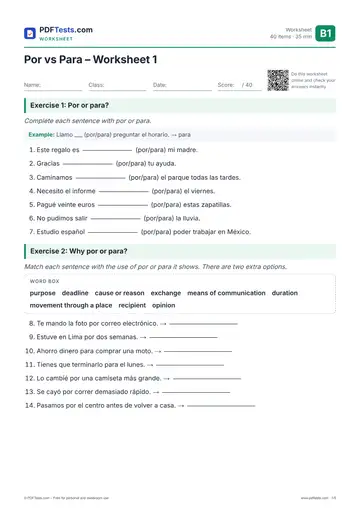
Complete each sentence with por or para.
- Este café es ___ mi madre. This coffee is for my mother.
- Gracias ___ la invitación. Thanks for the invitation.
- Caminamos ___ la playa al atardecer. We walked along the beach at sunset.
- Tengo que terminar el proyecto ___ el jueves. I have to finish the project by Thursday.
- Cambié mi bici ___ una guitarra. I swapped my bike for a guitar.
Answers
- para – recipient
- por – gratitude
- por – movement along a place
- para – deadline
- por – exchange
Next step
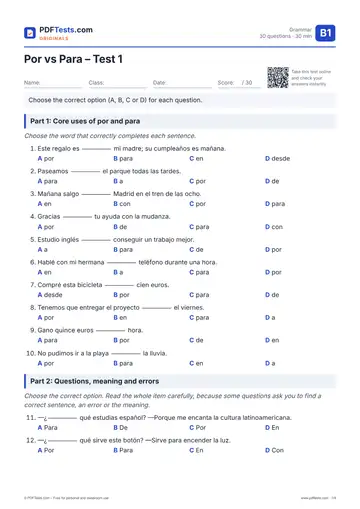
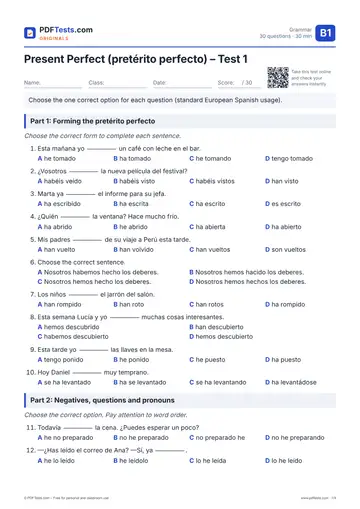
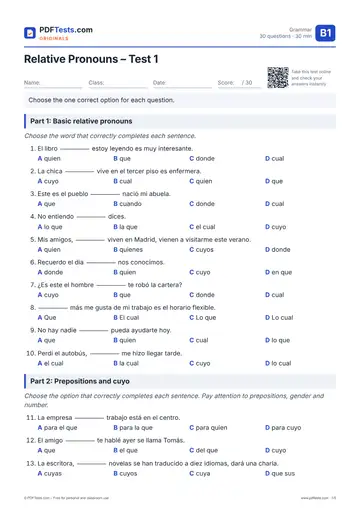
The best way to make por and para automatic is to practise them in context, sentence after sentence. Test yourself now with our B1 Por vs Para test, and check each wrong answer against the uses above. If you also struggle with other tricky pairs, revisit our Ser and Estar guide, then explore the full range of Spanish B1 tests to build confidence at this level.
Was this page helpful?
What was the problem?
Thank you for your feedback!