PDFTests Originals

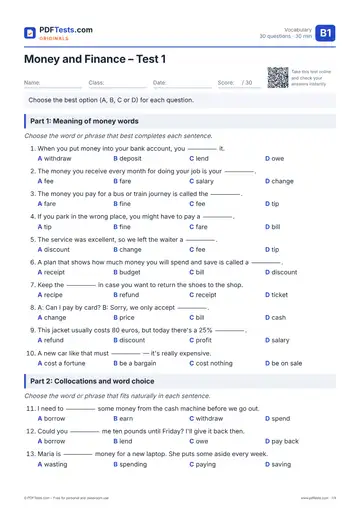
Money and Finance – Worksheet 1

B1 Intermediate WorksheetEnglish

This worksheet practises everyday money and finance vocabulary at B1 level, such as borrow, lend, afford, refund, discount and savings. Learners work on word meaning, common collocations and word forms through matching, gap-fill, word order, error correction and word formation tasks. It suits teenage and adult learners in class or at home.
items
40
Time
35 min
PDF
5 pages
Answer key
Included
  • 100% free
  • No sign-up or email
  • Print-ready A4 PDF
Preview of page 1 of Money and Finance – Worksheet 1 Open PDF

Do the worksheet online

Type your answers, then press “Check my answers”. Alternative correct answers are accepted.

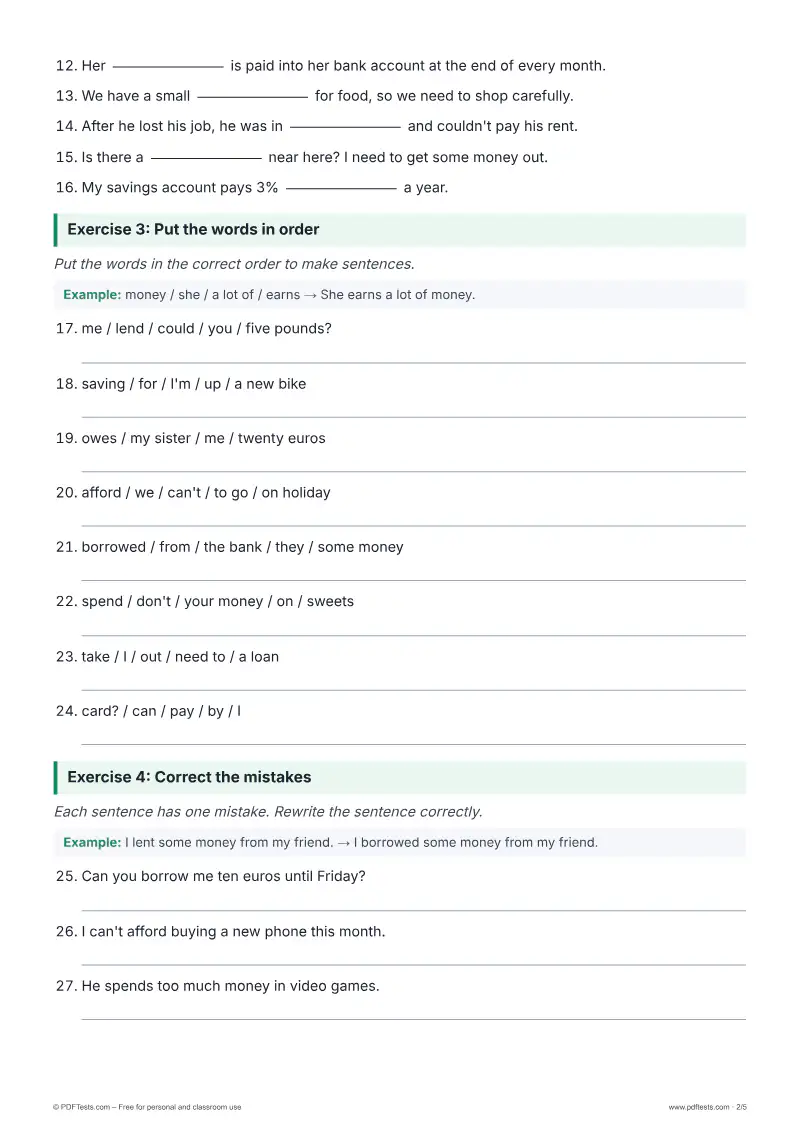
Exercise 1: Match the words with their meanings

Match each word with the correct meaning from the box. There are two extra meanings you do not need.

Example: spend → to use money to buy things

Word box to get money for work you doto have to pay back money to someoneto have enough money to buy somethingto use money badly or on things you don't needto give someone money that they will pay back laterto take money from someone and pay it back latersomething you buy for less than its usual pricemoney you keep and don't spendto put money into a bank accounta paper that shows how much you must pay

  1. earn

  2. owe

  3. afford

  4. waste

  5. lend

  6. borrow

  7. bargain

  8. savings

Exercise 2: Complete the sentences

Complete each sentence with a word from the box. There are two extra words you do not need.

Example: I paid in ___ because the shop didn't accept cards. → cash

Word box salaryreceiptdiscountdebtbudgetcash machineinterestrefundcoinsbill

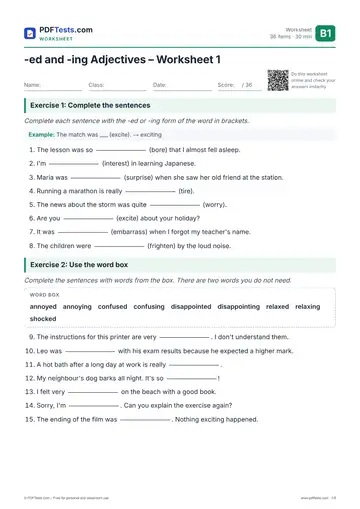
  1. Keep the in case you want to return the shoes.

  2. Students get a 20% on train tickets.

  3. The jacket had a hole in it, so the shop gave me a full .

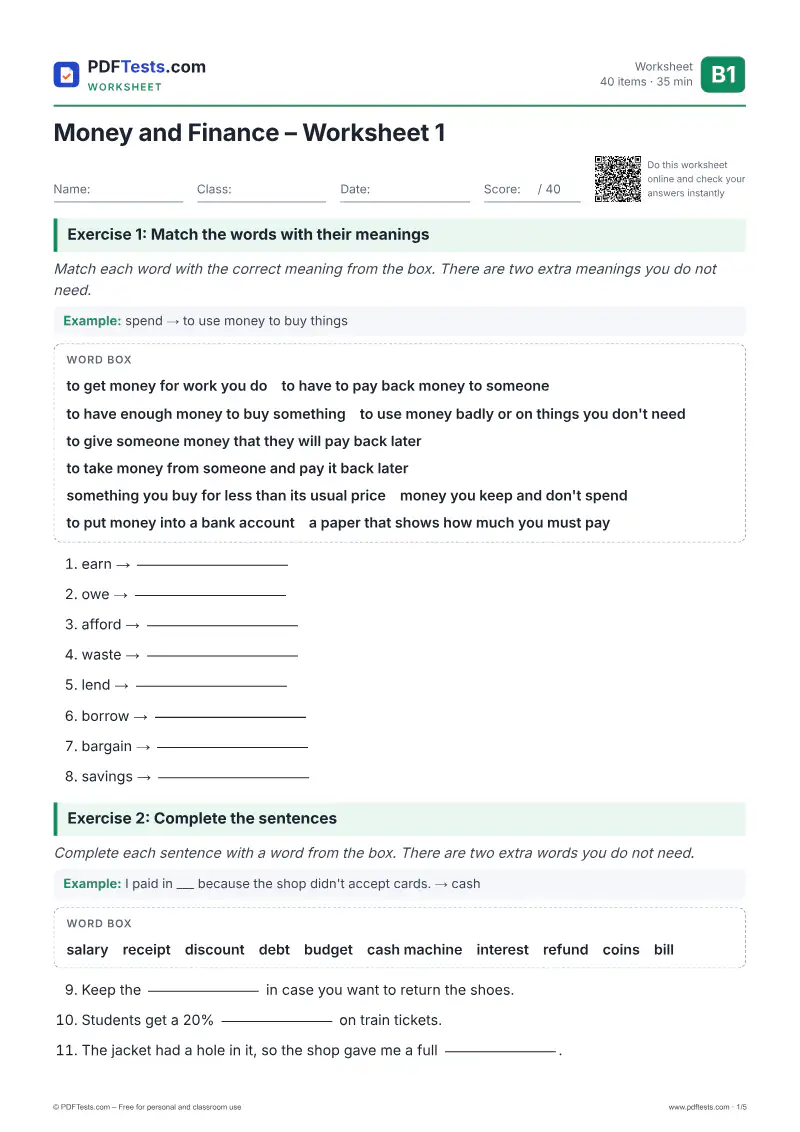
  4. Her is paid into her bank account at the end of every month.

  5. We have a small for food, so we need to shop carefully.

  6. After he lost his job, he was in and couldn't pay his rent.

  7. Is there a near here? I need to get some money out.

  8. My savings account pays 3% a year.

Exercise 3: Put the words in order

Put the words in the correct order to make sentences.

Example: money / she / a lot of / earns → She earns a lot of money.

  1. me / lend / could / you / five pounds?

  2. saving / for / I'm / up / a new bike

  3. owes / my sister / me / twenty euros

  4. afford / we / can't / to go / on holiday

  5. borrowed / from / the bank / they / some money

  6. spend / don't / your money / on / sweets

  7. take / I / out / need to / a loan

  8. card? / can / pay / by / I

Exercise 4: Correct the mistakes

Each sentence has one mistake. Rewrite the sentence correctly.

Example: I lent some money from my friend. → I borrowed some money from my friend.

  1. Can you borrow me ten euros until Friday?

  2. I can't afford buying a new phone this month.

  3. He spends too much money in video games.

  4. How much did you pay the concert tickets?

  5. I'm saving up to a new laptop.

  6. We paid the bill by cash.

  7. I need to withdraw some money of my account.

  8. The jacket was a real bargain because it was very expensive.

Exercise 5: Form the correct word

Use the word in capitals to form a word that fits the gap.

Example: He is a very ___ businessman. (SUCCESS) → successful

  1. Thanks to her , she could buy a car without a loan. (SAVE)

  2. Rents in the city centre are not very for young people. (AFFORD)

  3. The company is having problems and may close. (FINANCE)

  4. You can make the online or at the bank. (PAY)

  5. His grandparents were very and owned three houses. (WEALTH)

  6. Eating in restaurants every day is too . (EXPENSE)

  7. Buying a flat can be a good . (INVEST)

  8. You can travel very if you book your tickets early. (CHEAP)

Was this page helpful?

Report a mistake

Spotted a wrong answer, a typo or an unclear explanation? Tell us and we will fix it.

Preview

About this test

Printable B1 English worksheet on money and finance vocabulary: meanings, collocations like pay for and save up for, and word forms. Answers included.

Topics covered

Money vocabularyBorrow vs lendCollocations with moneyWord formationShopping and banking

Notes for teachers

Start with Exercise 1 to check meaning before moving to the collocation and word-form tasks. Learners often confuse borrow and lend, say afford doing instead of afford to do, and use the wrong prepositions in spend on, pay for, save up for and pay in cash. As a follow-up, ask pairs to write a short dialogue about planning a monthly budget using at least eight words from the worksheet.

All English B1 tests →