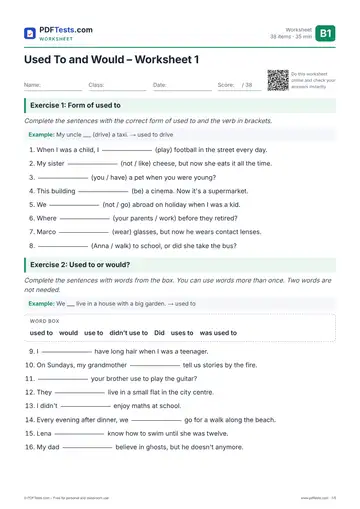
Used to and would describe things that happened regularly in the past but don’t happen now. Use used to for both past habits and past states (I used to live in Leeds). Use would only for repeated past actions, usually when you tell a story about the past (Every summer we would go camping).
Used to: past habits and past states
Uses
1. Past habits (repeated actions that have stopped)
- I used to play football every Saturday.
- We used to go to the cinema a lot before we had kids.
- She used to call her grandmother every Sunday.
2. Past states (situations, feelings, possessions that are no longer true)
- My parents used to have a small shop.
- I used to be really shy at school.
- He used to love horror films, but now he can’t watch them.
3. Contrast between the past and now
Used to tells the listener that something has changed. You don’t need to add “but not now”; it is already understood.
- There used to be a bank on this corner. (There isn’t one now.)
- I used to eat meat, but I’ve been vegetarian for three years.
Form
Used to has the same form for every person: no -s, no change for he/she/it. It is always followed by the base form of the verb.
| Type | Structure | Example |
|---|---|---|
| Affirmative | subject + used to + base verb | I used to walk to school. |
| Negative | subject + didn’t use to + base verb | She didn’t use to like coffee. |
| Question | Did + subject + use to + base verb? | Did you use to walk to school? |
| Wh- question | Wh- word + did + subject + use to + base verb? | Where did you use to live? |
| Short answers | Yes, subject + did. / No, subject + didn’t. | Yes, I did. / No, I didn’t. |
You can also make the negative with never: I never used to eat breakfast. This is very common in speech and sounds a little stronger than didn’t use to.
Spelling and pronunciation
- In negatives and questions, write use to without -d, because did already shows the past: Did you use to…?, I didn’t use to…. You will sometimes see didn’t used to in informal writing, but in exams and careful writing use didn’t use to.
- Used to and use to sound the same: /ˈjuːs tə/, like “yoos-tuh”. The s is soft, as in juice, not /z/ as in the verb use (I use a laptop).
- The d of used is not pronounced separately; it joins with the t of to.
Would for past habits
Uses
Would (often contracted to ’d) describes repeated actions in the past. It is typical of storytelling and memories, and it often sounds nostalgic.
- When I was little, my dad would read to me every night.
- On Fridays we**’d order** pizza and watch a film together.
- My grandmother would make pancakes whenever we visited.
Speakers often start with used to to set the scene, then continue with would:
My grandparents used to live by the sea. Every August we**’d stay** with them for two weeks. Grandpa would wake us up early, and we**’d go** swimming before breakfast.
Form
| Type | Structure | Example |
|---|---|---|
| Affirmative | subject + would / ’d + base verb | We would / We’d go to the beach every weekend. |
| Negative | subject + wouldn’t + base verb | (rare for habits; see below) |
| Question | Would + subject + base verb? | (rare for habits; use Did you use to…? ) |
Two important limits
1. Would is for actions, not states. With state verbs such as be, have (possess), live, like, love, hate, know, believe, understand, want, own, you must use used to.
- ✓ We used to have a dog called Max.
- ✗ We would have a dog called Max.
- ✓ I used to know all their songs by heart.
- ✗ I would know all their songs by heart.
2. Would needs a clear past context. On its own, I would play tennis sounds like a conditional (I would play tennis if I had time). Make the past time clear first: When I was at university, I would play tennis twice a week.
Also note that wouldn’t in the past usually means refused to, not didn’t have the habit of:
- My little brother wouldn’t eat vegetables. (He refused.)
- The car wouldn’t start this morning. (It refused to work.)
For negative habits, use didn’t use to or never used to instead.
Used to vs would: summary
| used to | would | |
|---|---|---|
| Past habits (repeated actions) | ✓ I used to cycle to work. | ✓ I’d cycle to work. |
| Past states | ✓ I used to live in Rome. | ✗ |
| Needs a past time already mentioned | No | Usually yes |
| Negatives and questions | Common | Rare (wouldn’t = refused) |
| Style | Neutral, very common in speech | Storytelling, memories, writing |
Quick rule: if you can use would, you can always use used to. The opposite is not true.
Used to vs past simple
The past simple can also describe past habits: I walked to school every day. This is correct. Used to simply puts more emphasis on the fact that the habit has stopped.
However, only the past simple is possible in these cases:
Single events
- ✓ I went to Paris in 2019.
- ✗ I used to go to Paris in 2019.
A specific number of times
- ✓ We visited her three times last year.
- ✗ We used to visit her three times last year.
A specific length of time
- ✓ He lived in Canada for five years.
- ✗ He used to live in Canada for five years.
If you need to review regular and irregular forms, see our guide to the Past Simple.
Present habits: no “use to”
Used to only exists in the past. For habits in the present, use the present simple, often with an adverb like usually:
- ✓ I usually get up at seven.
- ✗ I use to get up at seven.
For more on this, see our guide to Adverbs of Frequency.
Don’t confuse it with be used to / get used to
These look similar but mean something different.
- be used to + noun / -ing = be familiar with something, find it normal
- get used to + noun / -ing = become familiar with something
Compare:
- I used to work at night. (In the past I worked at night; I don’t now.)
- I**’m used to working** at night. (Working at night is normal for me now.)
- Don’t worry, you’ll soon get used to the cold.
In be/get used to, to is a preposition, so it is followed by a noun or an -ing form, never the base verb. Our guide to Gerunds and Infinitives explains this pattern in more detail.
Signal words and word order
These expressions often appear with used to and would:
- when I was a child / young / a teenager
- in those days, back then, at school, at university
- every summer, on Sundays, whenever…
- not any more / anymore, no longer (to show contrast with now)
Example: I used to smoke, but I don’t any more.
Frequency adverbs go before used to but after would:
- We always used to spend Christmas at home.
- We would often stay up late talking.
Common mistakes
- ✗ When I was young, I use to play tennis. → ✓ When I was young, I used to play tennis. The affirmative form needs -d.
- ✗ Did you used to live here? → ✓ Did you use to live here? After did, use the form without -d.
- ✗ I use to drink coffee every morning. → ✓ I usually drink coffee every morning. There is no present form of used to.
- ✗ As a child, I would have long hair. → ✓ As a child, I used to have long hair. Would can’t be used with state verbs.
- ✗ She used to visit Spain three times. → ✓ She visited Spain three times. Use the past simple when you say how many times.
- ✗ I used to living in a small town. → ✓ I used to live in a small town. Used to is followed by the base verb.
- ✗ I’m used to get up early. → ✓ I’m used to getting up early. After be used to, use -ing.
- ✗ He didn’t would go out much. → ✓ He didn’t use to go out much. For negative habits, use didn’t use to or never used to.
Quick check
- Complete with used to or would: When I was ten, I ___ have a pet rabbit.
- Make a question: you / walk to school when you were a child?
- Correct the sentence: My grandfather would be a teacher.
- Choose the correct form: I visited / used to visit London twice last year.
- Make the sentence negative using use to: She used to like vegetables.
Answers
- used to (have = possession, a state, so would is not possible)
- Did you use to walk to school when you were a child?
- My grandfather used to be a teacher. (be is a state verb)
- visited (a specific number of times needs the past simple)
- She didn’t use to like vegetables.
Next step
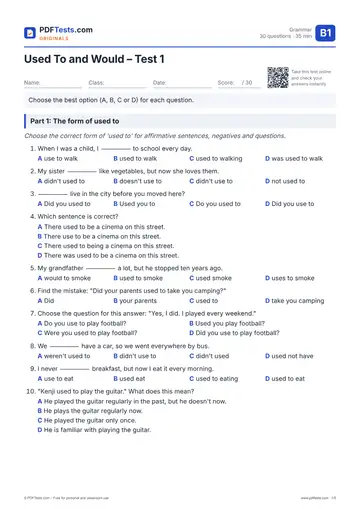
Now put the rules into practice: test yourself with our B1 Used To and Would test, which mixes habits, states and past simple contrasts. Pay special attention to state verbs and to the use / used spelling in questions and negatives, as these cause the most errors. When you’re confident, explore more grammar at the same level in our English B1 tests.
Practise this topic: Used To and Would
Was this page helpful?
What was the problem?
Thank you for your feedback!