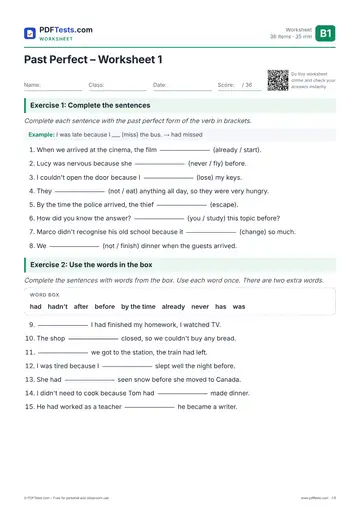
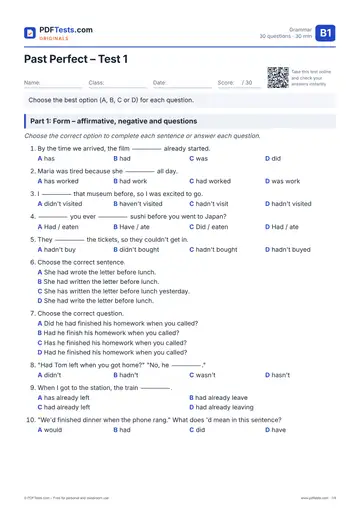
The past perfect is had + past participle (I had finished, she had left). We use it to show that one past action happened before another past action or before a point in the past. Think of it as the ‘past of the past’. It makes the order of events clear when you tell a story or explain a past situation.
When we got to the station, the train had already left.
First the train left, then we arrived. The past perfect marks the earlier action.
When to use the past perfect
1. An earlier action before a past moment
This is the main use. You are already talking about the past (usually in the past simple), and you need to go further back in time.
- I didn’t recognise him at first. He had shaved off his beard.
- She was upset because someone had taken her bike.
- We weren’t hungry at dinner because we had eaten a big lunch.
In each sentence, the past simple sets the main time (didn’t recognise, was upset, weren’t hungry). The past perfect explains what happened before that.
2. With time words: when, after, before, by the time, as soon as
The past perfect often appears with time conjunctions that connect two past events.
- By the time the police arrived, the thieves had escaped.
- After she had finished her shift, she went straight home.
- I had never heard of the band before I saw them live.
- As soon as they had signed the contract, they started work.
By the time almost always needs the past perfect in the other clause, because it means ‘at or before that moment’.
3. Experience or duration up to a point in the past
Just as the present perfect connects the past to now, the past perfect connects an earlier time to a moment in the past.
- She was nervous on the plane because she had never flown before.
- It was the best meal I had ever had.
- We had known each other for ten years when we got married.
- He had lived in Madrid since 2015, so he spoke excellent Spanish.
4. Reported speech
When you report something in the past, a past simple or present perfect verb often moves back to the past perfect.
- ‘I lost my keys.’ → She said she had lost her keys.
- ‘I’ve already seen it.’ → He told me he had already seen it.
You can read more in our guide to reported speech (statements and questions).
You will also meet the past perfect later in the third conditional (If I had known, I would have helped) and after wish (I wish I had studied more). These are B2 structures, but the form is the same.
Form
The past perfect is the same for every person: had + past participle. There is no change for he, she or it.
Affirmative
| Subject | had | Past participle | Example |
|---|---|---|---|
| I / you / we / they | had (’d) | worked, gone | I’d already gone to bed. |
| he / she / it | had (’d) | worked, gone | She had worked there for years. |
Negative
| Subject | had not | Past participle | Example |
|---|---|---|---|
| I / you / we / they | had not (hadn’t) | seen, finished | They hadn’t finished the report. |
| he / she / it | had not (hadn’t) | seen, finished | He hadn’t seen the email. |
Questions and short answers
| Had | Subject | Past participle | Short answers |
|---|---|---|---|
| Had | you | met her before? | Yes, I had. / No, I hadn’t. |
| Had | the film | started? | Yes, it had. / No, it hadn’t. |
With question words, put the question word first: Where had you put the tickets? How long had they been married?
The contraction ’d
In speech and informal writing, had usually becomes ’d: I’d, you’d, she’d, we’d, they’d.
Be careful: ’d can also mean would. Look at the next word:
- She’d left → past participle → she had left
- She’d leave → base form → she would leave
Past participles
Regular verbs add -ed, exactly like the past simple: work → worked, arrive → arrived, stop → stopped, study → studied.
Irregular verbs must be learned. Many have a past participle that is different from the past simple form, and these cause most mistakes.
| Base form | Past simple | Past participle |
|---|---|---|
| go | went | gone |
| see | saw | seen |
| eat | ate | eaten |
| take | took | taken |
| write | wrote | written |
| forget | forgot | forgotten |
| begin | began | begun |
| fly | flew | flown |
| break | broke | broken |
| leave | left | left |
| buy | bought | bought |
Note that have becomes had had in the past perfect: I had had a long day, so I went to bed early. This is correct and common.
Signal words
These words often appear with the past perfect. They are clues, not strict rules.
| Word | Example |
|---|---|
| already | The meeting had already started when I logged in. |
| just | They had just left when we called. |
| never / ever | I had never tried sushi before that trip. |
| by the time | By the time I got there, everyone had gone. |
| before / after | After we had paid, we realised the mistake. |
| until | She hadn’t driven a car until she was 30. |
| for / since | He had worked there for six months. |
Already, just, never and ever go between had and the past participle.
Past perfect vs past simple
The past simple tells events in the order they happened. The past perfect lets you step back to an earlier event.
- I got home, made dinner and watched a film. (three actions in order: past simple)
- When I got home, my flatmate had already made dinner. (her action came first: past perfect)
When the meaning changes
With when, the choice of tense changes the meaning:
- When I arrived, the film started. (I arrived, then the film started.)
- When I arrived, the film had started. (The film started first; I missed the beginning.)
When the past perfect is optional
With before and after, the order is already clear from the conjunction, so many speakers use the past simple in both clauses:
- After she finished her shift, she went home. ✓
- After she had finished her shift, she went home. ✓
Both are correct. The past perfect simply adds emphasis on the order or completion.
Don’t overuse it
You do not need the past perfect in every sentence of a story. Use it once or twice to set up the earlier background, then go back to the past simple. For more practice combining tenses in stories, see our guides to the past continuous vs past simple and narrative tenses.
Past perfect vs present perfect
The two tenses work in the same way, but their reference point is different.
| Present perfect | Past perfect |
|---|---|
| Connects the past to now | Connects an earlier past to a past moment |
| I have never been to Japan. (up to now) | Before 2020, I had never been to Japan. (up to 2020) |
| She’s tired because she has worked all day. | She was tired because she had worked all day. |
If you are unsure about the present perfect itself, review our guide to the present perfect vs past simple first.
Common mistakes
✗ When I arrived, the film already started. → ✓ When I arrived, the film had already started. The film started before I arrived, so you need the earlier tense.
✗ I had bought a new phone yesterday. → ✓ I bought a new phone yesterday. There is no later past event to compare with, so use the past simple.
✗ She had went home early. → ✓ She had gone home early. Use the past participle (gone), not the past simple (went).
✗ Did you had eaten before the meeting? → ✓ Had you eaten before the meeting? Make questions by moving had before the subject; don’t use did.
✗ I have already eaten when they arrived. → ✓ I had already eaten when they arrived. The reference point (they arrived) is in the past, so use had, not have.
✗ He hadn’t never seen snow. → ✓ He had never seen snow. / He hadn’t ever seen snow. English uses only one negative word in a clause.
✗ By the time we got there, the shop closed. → ✓ By the time we got there, the shop had closed. By the time means ‘at or before that moment’, so the other action needs the past perfect.
Quick check
Complete the sentences or correct the mistake.
- When I got home, my brother ______ (eat) all the pizza.
- ______ you ever ______ (meet) her before the party?
- She ______ (not / see) the sea until she was eighteen.
- By the time we arrived, the concert ______ (start).
- Correct the sentence: I had sent you the file this morning.
Answers
- had eaten – he ate the pizza before I got home.
- Had you ever met – experience up to a past moment (the party).
- hadn’t seen – negative experience up to a past point.
- had started – by the time signals the earlier action.
- I sent you the file this morning. – there is no later past event, so the past simple is correct.
Next step
Now put the rules into practice: test yourself with our B1 Past Perfect test and check which uses you already control. Pay special attention to irregular past participles and to sentences with when and by the time, because that is where most errors happen. Once you feel confident, practise using the past perfect alongside the past simple and past continuous when you tell short stories about your own experiences.
Was this page helpful?
What was the problem?
Thank you for your feedback!