Linking words (also called connectors) join ideas inside a sentence or between sentences. They show the relationship between ideas: contrast (although, however, despite), reason (because, because of), result (so, therefore) or addition (also, in addition).
At B1, the key skill is knowing what comes after each linker: a full clause, a noun, or a new sentence.
The golden rule: what follows the linker?
Most mistakes with linking words come from using the wrong structure after them. English linkers fall into three groups.
| Group | Examples | What follows | Example |
|---|---|---|---|
| Conjunctions | although, even though, because, so, but, while, whereas | a clause (subject + verb) | Although it was cold, we went out. |
| Prepositions | despite, in spite of, because of, due to | a noun, pronoun or -ing form | Despite the cold, we went out. |
| Sentence adverbs | however, therefore, as a result, in addition, moreover | a new sentence or clause, usually after a full stop or semicolon | It was cold. However, we went out. |
Learn the group each linker belongs to. Then the grammar after it becomes automatic.
Contrast: although, even though, but, however, despite
Use these linkers when the second idea is surprising or different from the first.
Although, even though and though
Although and even though are conjunctions, so they are followed by a clause. The although clause can come first or second. When it comes first, use a comma.
- Although the flat is small, it’s very comfortable.
- The flat is very comfortable although it’s small.
- Even though I set two alarms, I overslept.
Even though is stronger than although. It emphasises that the result is very surprising.
Though means the same as although and is common in speech. It can also go at the end of a sentence, meaning however:
- The film was long. I enjoyed it, though.
But and however
But joins two clauses in one sentence. It usually comes after a comma, not at the start of the first clause.
- I like my job, but the pay isn’t great.
However links two separate sentences. It usually comes at the start of the second sentence, followed by a comma. It is more formal than but.
- I like my job. However, the pay isn’t great.
- I like my job; however, the pay isn’t great.
However can also go in the middle of the second sentence, between commas:
- The hotel was beautiful. The food, however, was disappointing.
Despite and in spite of
Despite and in spite of mean the same. They are prepositions, so they are followed by a noun, a pronoun or an -ing form, not a normal clause.
- Despite the traffic, we arrived on time.
- In spite of feeling tired, she finished the report.
- He failed the test despite studying for weeks.
Notice: despite has no of, but in spite of always has of.
Changing although into despite
You often need to rewrite a sentence with although using despite (a common exam task). There are three ways.
| Original | Rewritten |
|---|---|
| Although it was raining, we played. | Despite the rain, we played. (noun) |
| Although she was ill, she went to work. | Despite being ill, she went to work. (-ing, same subject) |
| Although he is rich, he isn’t happy. | Despite the fact that he is rich, he isn’t happy. (the fact that + clause) |
The -ing form works best when both parts of the sentence have the same subject.
Reason: because, as, since, because of, due to
Use these to explain why something happens.
Because, as and since
These are conjunctions, so a clause follows.
- I took a taxi because I was late.
- As it was a sunny day, we had lunch outside.
- Since you’re here, can you help me move this table?
As and since often come at the start of the sentence and describe a reason the listener already knows. Because gives more focus to the reason and is the most common choice in answers to why questions.
Because of and due to
These are prepositions, so a noun or -ing form follows.
- The match was cancelled because of the storm.
- Many flights were delayed due to bad weather.
- The delay was due to a technical problem.
Due to is more formal than because of and is common in announcements and written reports. It also works well after the verb be, as in the last example.
Result: so, therefore, as a result
These show the consequence of something.
So is a conjunction. It joins two clauses, usually after a comma.
- It started to rain, so we went inside.
Therefore and as a result are sentence adverbs. They start a new sentence and are more formal, so they are typical in essays and emails at work.
- The company lost several big clients. As a result, it had to cut jobs.
- The road is closed. Therefore, all buses will use Station Street.
Do not confuse so (result) with so + adjective for emphasis (so tired). For that use, see our guide to so, such, too and enough.
Adding information: also, too, in addition, as well as
Use these to add another point.
- She speaks French. She also speaks a little Japanese.
- She speaks a little Japanese too.
- The course is cheap. In addition, it includes free materials.
- Moreover, the teachers are very experienced. (formal)
Also normally goes before the main verb but after be: She also speaks…, He is also a doctor. Too and as well go at the end of the clause.
As well as is followed by a noun or -ing form, like a preposition:
- As well as working full-time, he’s studying for a degree.
Comparing: while and whereas
While and whereas compare two different facts. Both are conjunctions, followed by a clause.
- My brother loves football, whereas I prefer tennis.
- While some people enjoy city life, others find it stressful.
Whereas is slightly more formal. While can also mean during the time that (I read while I eat), so the context tells you which meaning it has.
Quick punctuation guide
| Linker | Typical punctuation |
|---|---|
| although / because / as (at the start) | comma after the first clause: Although it was late, we stayed. |
| although / because (in the middle) | usually no comma: We stayed because it was fun. |
| but / so | comma before: It was late, but we stayed. |
| however / therefore / as a result | full stop or semicolon before, comma after: It was late. However, we stayed. |
| despite / in spite of (at the start) | comma after the phrase: Despite the time, we stayed. |
Common mistakes
-
✗ Despite it was raining, we went out. → ✓ Despite the rain, we went out. / ✓ Although it was raining, we went out.
Despite is a preposition and cannot be followed by subject + verb. -
✗ Despite of the noise, I slept well. → ✓ Despite the noise, I slept well.
Despite never takes of; only in spite of does. -
✗ I stayed at home because of I was ill. → ✓ I stayed at home because I was ill.
Because of needs a noun; use because before a clause. -
✗ Although it was expensive, but we bought it. → ✓ Although it was expensive, we bought it.
Use only one contrast linker; although and but together is wrong. -
✗ The food was good, however the service was slow. → ✓ The food was good. However, the service was slow.
However starts a new sentence (or follows a semicolon), not a comma. -
✗ Because it was late. We went home. → ✓ Because it was late, we went home.
A because clause is not a complete sentence on its own in writing. -
✗ He’s tired, therefore he goes to bed. → ✓ He’s tired, so he goes to bed. / ✓ He’s tired. Therefore, he goes to bed.
Use so to join clauses with a comma; therefore normally begins a new sentence. -
✗ In spite of she is young, she is very wise. → ✓ In spite of being young, she is very wise.
In spite of needs a noun, -ing form, or the fact that + clause.
Quick check
Choose the correct option.
- ___ the rain, we played tennis. (Although / Despite)
- I stayed at home ___ I had a cold. (because / because of)
- The tickets were expensive. ___, we bought them. (However / Although)
- She passed the exam ___ studying very little. (in spite of / although)
- The train was late. ___, I missed the meeting. (As a result / Because)
Answers
- Despite – the rain is a noun, so a preposition is needed.
- because – I had a cold is a clause.
- However – it starts a new sentence and is followed by a comma.
- in spite of – studying is an -ing form.
- As a result – it introduces the consequence in a new sentence.
Next step
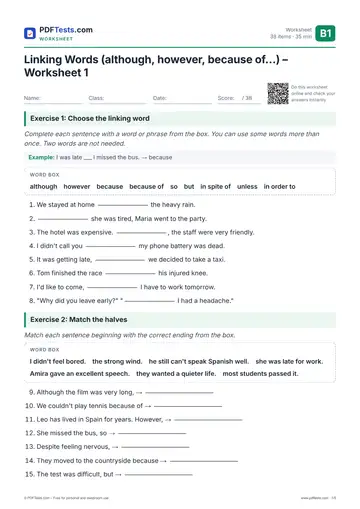
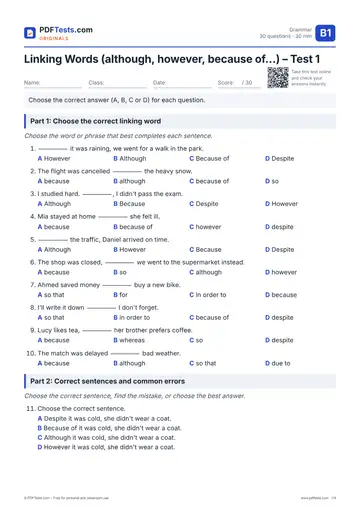
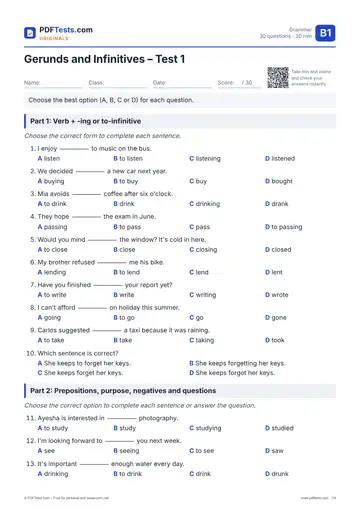
Now put the rules into practice: test yourself with our B1 Linking Words test and pay special attention to what follows each linker. Many linkers, such as despite and as well as, are followed by an -ing form, so our guide to gerunds and infinitives is a useful companion. To build longer, more connected sentences, look at relative clauses next, and when you feel confident, check your overall progress with the English Level Test B1.
Practise this topic: Linking Words (although, however, because of…)
Was this page helpful?
What was the problem?
Thank you for your feedback!