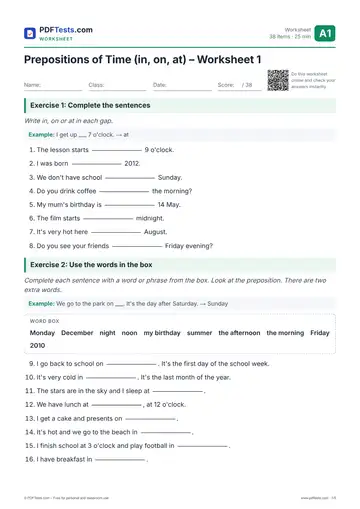
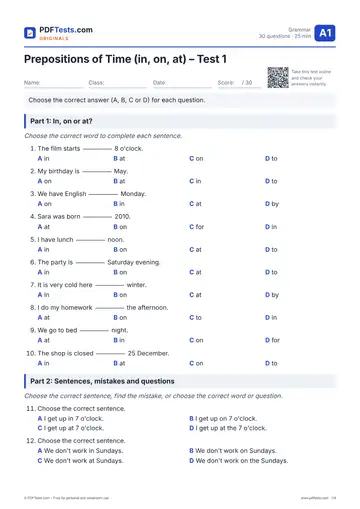
We use the prepositions of time in, on and at to say when something happens. The basic rule is simple. Use at for exact times, on for days and dates, and in for longer periods like months, years and seasons.
- I get up at 7 o’clock.
- My English class is on Tuesday.
- My birthday is in June.
The basic rule: from big to small
Think of a triangle. In is for big periods of time. On is for days. At is for small, exact points in time.
| Preposition | Used for | Examples |
|---|---|---|
| in | months, years, seasons, centuries, parts of the day | in May, in 2024, in winter, in the morning |
| on | days of the week, dates, special days | on Monday, on 3 April, on my birthday |
| at | clock times, exact moments, some fixed expressions | at 6:30, at midnight, at night, at the weekend |
At: exact times
Use at with clock times and other exact points in the day.
Clock times
- The film starts at eight o’clock.
- I finish work at half past five.
- The train leaves at 9:15.
Exact moments of the day
- at midnight
- at noon / at midday
- at lunchtime
- at dinnertime
- at sunrise / at sunset
Example: We have a break at lunchtime.
Fixed expressions with at
Some expressions use at and you need to learn them:
- at night: I sleep well at night.
- at the weekend (British English): We go to the park at the weekend.
- at Christmas / at Easter (the holiday period): We visit my grandparents at Christmas.
- at the moment (= now): She’s busy at the moment.
In American English, people usually say on the weekend. Both are correct.
On: days and dates
Use on with days of the week, dates and special days.
Days of the week
- I play football on Saturday.
- The shop is closed on Sunday.
With a plural day (on Mondays), the meaning is every Monday:
- I go swimming on Mondays. (= every Monday)
Dates
- My exam is on 12 May.
- She was born on 3 October 2010.
We write on 12 May but we usually say on the twelfth of May (British) or on May twelfth (American).
Special days
- on my birthday
- on Christmas Day
- on New Year’s Day
- on Valentine’s Day
Compare: at Christmas (the holiday period) and on Christmas Day (the day, 25 December).
A day + part of the day
When you say the day and the part of the day, use on:
- on Monday morning
- on Friday evening
- on Saturday night
In: longer periods
Use in with months, years, seasons and parts of the day.
Months
- It’s very hot here in August.
- School starts in September.
Years, decades and centuries
- I was born in 2005.
- My parents met in the 1990s.
- People didn’t have phones in the 18th century.
Seasons
- We go skiing in winter.
- The garden is beautiful in the spring.
You can say in summer or in the summer. Both are correct.
Parts of the day
- in the morning
- in the afternoon
- in the evening
Example: I drink coffee in the morning.
But remember: at night, not in the night for a normal habit.
In + a period of time (from now)
In can also mean after a period of time from now:
- The bus comes in five minutes.
- I’ll call you back in an hour.
Morning, afternoon, evening and night
This is the most confusing part for many learners. Look at the table.
| Correct | Not correct |
|---|---|
| in the morning | |
| in the afternoon | |
| in the evening | |
| at night | |
| on Monday morning | |
| on Sunday night |
The rule: a part of the day alone takes in (except at night). A day + a part of the day takes on.
No preposition: this, next, last, every
Do not use in, on or at before these words:
| Word | Example |
|---|---|
| this | I’m busy this week. |
| next | We go on holiday next month. |
| last | I saw her last Friday. |
| every | He runs every morning. |
| today / tomorrow / yesterday | I have a test tomorrow. |
| tonight | Let’s watch a film tonight. |
- ✓ See you next Monday. (not on next Monday)
- ✓ I went to Rome last summer. (not in last summer)
Asking and answering questions
Use What time…? to ask about clock times. The answer uses at:
- What time does the lesson start? – At ten o’clock.
Use When…? for any time. The answer can use in, on or at:
- When is your birthday? – It’s on 14 July.
- When do you study? – In the evening.
- When is the party? – At eight.
In informal speech, people sometimes say What day is it? – It’s Monday with no preposition, because Monday is the answer, not a time phrase.
Word order: more than one time phrase
Time phrases usually go at the end of the sentence. When you use two or more, put the small one first:
- The meeting is at 10 a.m. on Friday.
- She was born on 5 March in 2012. (more often: on 5 March 2012)
- I often read in the evening.
You can also put the time phrase at the start for emphasis:
- On Saturdays, we have pancakes for breakfast.
Prepositions of time often appear with the present simple and with words like always and usually. For more on this, read our guide to adverbs of frequency.
In, on, at for time and for place
The same three words are also prepositions of place: in the kitchen, on the table, at the bus stop. The rules for place are different, so learn them separately. See our guide to prepositions of place when you are ready.
Common mistakes
✗ I get up in 7 o’clock. → ✓ I get up at 7 o’clock. Clock times always take at.
✗ See you in Monday. → ✓ See you on Monday. Days of the week take on.
✗ My birthday is on June. → ✓ My birthday is in June. Months take in. Use on only with a full date: on 10 June.
✗ I was born on 2008. → ✓ I was born in 2008. Years take in.
✗ I study at the evening. → ✓ I study in the evening. Morning, afternoon and evening take in the.
✗ I can’t sleep in night. → ✓ I can’t sleep at night. Night is the exception: at night.
✗ We have a party on next Saturday. → ✓ We have a party next Saturday. No preposition before next, last, this or every.
✗ I’ll see you in tomorrow. → ✓ I’ll see you tomorrow. No preposition before today, tomorrow, yesterday or tonight.
✗ The concert is in Friday evening. → ✓ The concert is on Friday evening. A day + part of the day takes on.
Quick check
Complete with in, on, at or – (no preposition).
- The museum opens ___ 9 a.m.
- We go to the beach ___ summer.
- My sister’s wedding is ___ 20 August.
- I visit my grandma ___ every Sunday.
- I usually watch TV ___ the evening and go to bed ___ midnight.
Answers
- at – an exact clock time.
- in – a season.
- on – a date.
- – – no preposition before every.
- in the evening (part of the day), at midnight (an exact moment).
Next step
Now practise the rules with real questions: test yourself with our A1 Prepositions of Time test. Because you use these prepositions with dates and clock times, the A1 Numbers, Dates and Telling the Time test is a useful follow-up. When you are confident, try more grammar and vocabulary practice in our English A1 tests.
Was this page helpful?
What was the problem?
Thank you for your feedback!