Articles are the small words a, an and the that come before a noun. Use a/an for one thing when the listener doesn’t know which one, or when it is the first time you mention it. Use the when the listener knows exactly which thing you mean. Sometimes you use no article at all.
Articles at a glance
| Article | Use it with | Meaning | Example |
|---|---|---|---|
| a | singular countable nouns (consonant sound) | one, any one, not specific | I have a dog. |
| an | singular countable nouns (vowel sound) | one, any one, not specific | She eats an apple every day. |
| the | singular, plural and uncountable nouns | this one, we both know which | The dog is in the garden. |
| no article | plural and uncountable nouns in general, names | things in general | I like dogs. Coffee is hot. |
The most important question is: Does the listener know which one? If not, use a/an. If yes, use the.
A or an: the sound rule
The choice between a and an depends on the first sound of the next word, not the first letter.
- a + consonant sound: a book, a car, a house, a teacher
- an + vowel sound (a, e, i, o, u): an egg, an orange, an idea, an umbrella
| Word | First sound | Article |
|---|---|---|
| hour | /aʊ/ (the h is silent) | an hour |
| honest man | /ɒ/ (the h is silent) | an honest man |
| university | /juː/ (sounds like ‘you’) | a university |
| uniform | /juː/ | a uniform |
| European city | /jʊə/ | a European city |
| umbrella | /ʌ/ | an umbrella |
The article goes with the next word, even if it is an adjective:
- a apple ✗ → an apple ✓
- an old car (old starts with a vowel sound)
- a big apple (big starts with a consonant sound)
When to use a / an
Remember: a and an mean ‘one’. You can only use them with singular countable nouns. You can’t say a books or an water.
1. The first time you mention something
- I’ve got a new phone.
- There’s a café near my house.
2. Jobs
In English, you need a/an before a job.
- My brother is a doctor.
- She works as an engineer.
3. One of many, or any one
- Can I have a sandwich, please? (any sandwich, not a special one)
- I need a pen.
4. Saying what something is
- What’s that? It’s a cat.
- London is a big city.
5. Frequency and prices
- I go to the gym twice a week.
- The apples are two euros a kilo.
When to use the
The is the same for singular, plural and uncountable nouns: the book, the books, the water.
1. The second time you mention something
First you say a, then you say the, because now the listener knows which one.
- I saw a film last night. The film was very funny.
- There’s a man at the door. The man wants to talk to you.
2. When you and the listener both know which one
- Can you close the window? (the window in this room)
- Where are the keys? (our keys)
3. When there is only one
- The sun is very hot today.
- I read the news on the internet.
- She wants to travel around the world.
4. When other words tell us which one
- The girl in the red coat is my sister.
- The bag on the table is mine.
5. Some places in a town
We often say the with places we all know and use.
- I’m going to the cinema / the bank / the station / the doctor’s.
6. Musical instruments and parts of the day
- He plays the guitar.
- I study in the morning and relax in the evening. (but: at night)
7. Some countries and with first, last, same, best
- the USA, the UK, the Netherlands
- It’s the first day of the holiday. We’re in the same class. She’s the best student.
When to use no article
This is where many learners make mistakes. Use no article in these cases:
| Situation | Example |
|---|---|
| Plural nouns in general | I love cats. Children like sweets. |
| Uncountable nouns in general | I don’t drink coffee. Music makes me happy. |
| Names of people | Anna lives in Rome. |
| Most countries, cities and streets | I’m from Spain. She lives in Oxford Street. |
| Meals | We have breakfast at eight. |
| Sports and games | They play football on Saturdays. |
| Languages and school subjects | I speak English. I like maths. |
| Days, months and years | See you on Monday. My birthday is in May. |
| Fixed phrases | go home, at home, go to work, go to school, go to bed, by bus |
| With my, your, this, that | My car is red. This book is good. |
Compare general and specific:
- I like music. (music in general)
- I like the music in this café. (specific music)
For more on which nouns are countable, read our guide to some and any, countable and uncountable nouns. For plural forms like children or boxes, see the plural nouns guide.
How articles work with different nouns
| Noun type | Not specific / general | Specific |
|---|---|---|
| Singular countable (car) | a car | the car |
| Plural countable (cars) | cars (or some cars) | the cars |
| Uncountable (water) | water (or some water) | the water |
A singular countable noun almost always needs a word before it: a, an, the, my, this, etc. I have car is wrong.
A/an vs the: side by side
| a / an | the |
|---|---|
| New information | Known information |
| I bought a jacket. | The jacket is blue. |
| Any one | This specific one |
| Is there a bank near here? | Is the bank open on Sundays? |
| One of many | The only one |
| She’s a teacher at my school. | She’s the head teacher. |
Signal words
These phrases often come before a/an: There is…, I’ve got…, It’s…, He’s…, What…! (What a nice day!)
These words often come with the: first, last, next, same, only, best, and phrases like in the middle, at the end, on the left.
Pronunciation notes
- a is usually pronounced /ə/, a short weak sound: a cup /ə kʌp/.
- an is usually /ən/: an egg /ən eɡ/.
- the has two pronunciations:
- /ðə/ before a consonant sound: the book, the university
- /ðiː/ before a vowel sound: the apple, the hour
In normal speech, articles are short and quiet. Stress the noun, not the article.
Common mistakes
✗ She is doctor. → ✓ She is a doctor. Jobs need a/an in English.
✗ I have a apple. → ✓ I have an apple. Use an before a vowel sound.
✗ She studies at an university. → ✓ She studies at a university. University starts with a ‘you’ sound, which is a consonant sound.
✗ I waited a hour. → ✓ I waited an hour. The h in hour is silent, so it starts with a vowel sound.
✗ I like the dogs. (all dogs) → ✓ I like dogs. Use no article for plural nouns in general.
✗ The life is beautiful. → ✓ Life is beautiful. Use no article for uncountable nouns in general.
✗ I live in the London. → ✓ I live in London. Most cities and countries have no article.
✗ I play the tennis. → ✓ I play tennis. Sports have no article (but instruments do: the piano).
✗ We have a lunch at one. → ✓ We have lunch at one. Meals normally have no article.
✗ Can you open window? → ✓ Can you open the window? A singular countable noun needs an article; here we both know which window.
✗ I need an information. → ✓ I need some information. Information is uncountable, so you can’t use a/an.
✗ This is a my friend. → ✓ This is my friend. Don’t use a/an/the together with my, your, his, etc.
✗ I go to the home at six. → ✓ I go home at six. Go home is a fixed phrase with no article.
Quick check
Choose a, an, the or no article (–).
- My sister is ___ nurse.
- I eat ___ egg every morning.
- There’s a cat in our garden. ___ cat is black.
- I don’t like ___ coffee.
- Look at ___ moon. It’s beautiful tonight.
Answers
- a – jobs need a/an, and nurse starts with a consonant sound.
- an – egg starts with a vowel sound.
- The – second mention; we know which cat.
- – – coffee in general, uncountable, no article.
- the – there is only one moon.
Next step
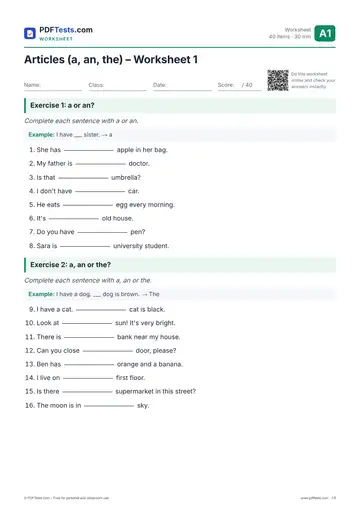
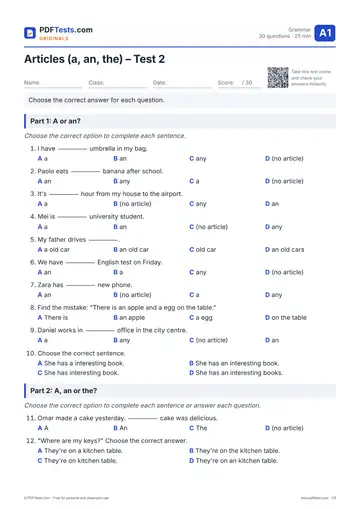
Now practise what you’ve learned: test yourself with our A1 Articles (a, an, the) test, and check any mistakes against the tables above. Articles appear in almost every sentence, so they work well together with There is / There are: There’s a park. The park is big. When you feel confident, browse more English A1 tests, and later move on to the advanced articles guide for rules with institutions, geography and abstract nouns.
Was this page helpful?
What was the problem?
Thank you for your feedback!