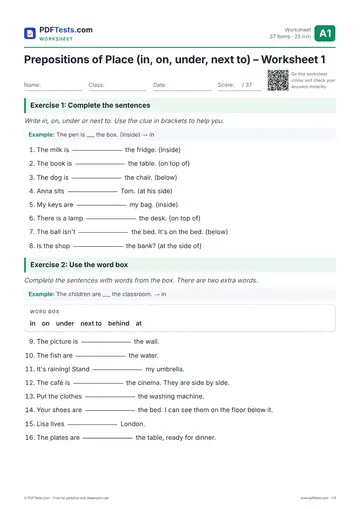
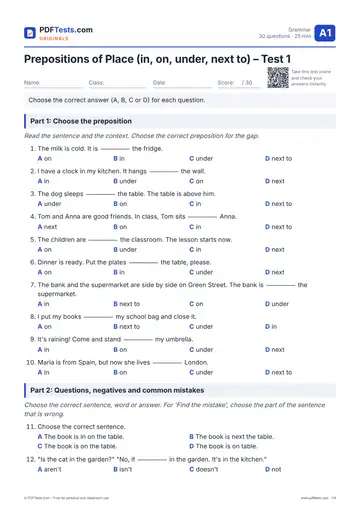
Prepositions of place are small words like in, on, under and next to. They tell us where something or someone is. We use them to describe a room, give directions in town and answer the question Where is…?
The main prepositions of place
At A1 level, you need about ten prepositions of place. Here are the most important ones.
| Preposition | Meaning | Example |
|---|---|---|
| in | inside something | The milk is in the fridge. |
| on | touching the top or side of something | Your phone is on the table. |
| under | below something | The cat is under the bed. |
| next to | at the side of something, very close | The bank is next to the café. |
| near | not far from something | I live near the station. |
| behind | at the back of something | The garden is behind the house. |
| in front of | before something, facing the front | There’s a car in front of the school. |
| between | in the middle of two things | The shop is between the bank and the café. |
| opposite | on the other side, facing something | The park is opposite my flat. |
| at | at a point or a place for an activity | She’s at home. / He’s at work. |
How to use each preposition
In
Use in when something is inside a box, a room, a building or an area.
- The keys are in my bag.
- My brother is in the kitchen.
- We live in London.
- There are two people in the photo.
Use in with rooms, towns, cities and countries: in the bathroom, in Paris, in Spain. We also say in a car and in a taxi.
On
Use on when something touches a surface, like a table, a floor or a wall.
- The book is on the desk.
- There’s a picture on the wall.
- Your shoes are on the floor.
We also say on the bus, on the train and on a plane.
- I’m on the bus now.
Under
Use under when something is below another thing.
- The dog is sleeping under the table.
- My bag is under the chair.
Next to and near
Next to means “very close, at the side”. There is usually nothing between the two things.
- I sit next to Anna in class.
- The supermarket is next to the post office.
Near means “not far”. It can be a few minutes away.
- My school is near my house. I walk there in five minutes.
Behind and in front of
These two are opposites.
- The bike is behind the door.
- The bus stop is in front of the cinema.
Remember: in front of has three words. Don’t forget of.
Between
Use between for something in the middle of two things. The pattern is between A and B.
- The bathroom is between the kitchen and the bedroom.
- I’m sitting between my mum and my dad.
Opposite
Opposite means “on the other side of the street or room, facing”.
- The pharmacy is opposite the bank.
At
At A1, learn at in fixed phrases: at home, at work, at school, at the bus stop, at the door.
- Sorry, I can’t talk. I’m at work.
- Someone is at the door.
Form: building sentences
The most common pattern is subject + be + preposition + place.
| Type | Example |
|---|---|
| Affirmative | The keys are on the table. |
| Negative | The keys aren’t on the table. |
| Question | Are the keys on the table? |
| Short answers | Yes, they are. / No, they aren’t. |
With Where, the verb be comes before the subject:
| Question | Answer |
|---|---|
| Where is my phone? | It’s in your bag. |
| Where are the children? | They’re in the garden. |
| Where’s the bank? | It’s next to the café. |
You can learn more about Where and other question words in our guide to question words.
With there is / there are
Prepositions of place are very common with there is and there are, especially when you describe a room or a town.
- There’s a lamp next to the bed.
- There are some books under the desk.
- Is there a bank near here?
If you need to review this structure, read our There is / There are guide.
Pronouns after prepositions
After a preposition, use an object pronoun: me, you, him, her, it, us, them.
- Sit next to me.
- The shop is behind it.
- Tom is standing in front of her.
See our subject and object pronouns guide for the full list.
Word order
The preposition always comes before the noun. In English, we usually also need the, a, or a possessive like my before the noun.
- The cat is under the table. (not under table)
- My coat is on my chair.
With home, work and school we don’t use the: at home, at work, at school.
Signal words and questions
There are no special signal words for this topic, but these questions and phrases usually need a preposition of place in the answer:
- Where is…? / Where are…?
- Is there a… near here?
- Can you see the…?
- I can’t find my…
Prepositions that learners confuse
In or on?
- in = inside, with space all around: in the box, in the drawer, in the cupboard
- on = on the surface: on the box, on the shelf, on the wall
Compare: The pen is in the box (you open the box to find it) and The pen is on the box (it is on top).
Next to or near?
- next to = right at the side: My desk is next to the window.
- near = close, but maybe not touching: My flat is near the city centre.
Behind or in front of?
Imagine you are looking at a house. The car you can see is in front of the house. The garden you can’t see is behind the house.
In or at?
- in = inside a building or room: She’s in the kitchen.
- at = at a place for its usual activity: She’s at school. (She is a student there, maybe in the classroom or in the playground.)
Place or movement?
Prepositions of place describe where something is. Prepositions of movement describe where something goes, for example into, across or through. Compare The cat is in the box and The cat jumps into the box. You can study the difference later in our prepositions of movement guide.
Common mistakes
✗ The keys are in the table. → ✓ The keys are on the table. A table is a surface, so use on.
✗ The picture is in the wall. → ✓ The picture is on the wall. Things that hang on a wall are on it, not inside it.
✗ The bank is next the café. → ✓ The bank is next to the café. Next always needs to in this meaning.
✗ He’s waiting in front the cinema. → ✓ He’s waiting in front of the cinema. In front of has three words.
✗ The shop is between the bank. → ✓ The shop is between the bank and the café. Between needs two things: A and B.
✗ I’m in home now. → ✓ I’m at home now. We say at home, with no article.
✗ The cat is under table. → ✓ The cat is under the table. Use an article or possessive before most nouns.
✗ Where the toilet is? → ✓ Where is the toilet? In questions, is comes before the subject.
✗ Sit next to I. → ✓ Sit next to me. Use an object pronoun after a preposition.
✗ I’m in the bus. → ✓ I’m on the bus. We say on the bus and on the train, but in a car.
Quick check
Choose or correct.
- The milk is ___ the fridge. (in / on)
- There’s a clock ___ the wall. (in / on)
- The bank is ___ the café and the supermarket. (next to / between)
- Correct the mistake: The car is in front the school.
- I can’t go out tonight. I’m ___ home with my little sister. (in / at)
Answers
- in – the milk is inside the fridge.
- on – a clock hangs on the wall.
- between – there are two places, the café and the supermarket.
- The car is in front of the school.
- at – we say at home.
Next step
Now practise what you have learned: test yourself with our A1 Prepositions of Place test and check which prepositions you still mix up. Then look around your room and describe five things with in, on, under, next to and between. When you feel confident, move on to our guide to prepositions of time (in, on, at), because the same small words have different rules for days, months and times.
Was this page helpful?
What was the problem?
Thank you for your feedback!