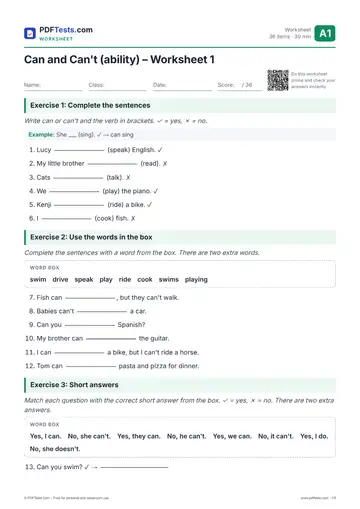
We use can to say that someone is able to do something, and can’t (cannot) to say that they are not able to do it: I can swim. She can’t drive. Can is a modal verb, so it has the same form for every person and is always followed by a verb in its base form (no to, no -s).
This guide shows you how to make sentences, negatives and questions with can, how to pronounce it, and which mistakes to avoid. When you finish, practise with our A1 Can and Can’t test.
When do we use can and can’t?
1. Skills and abilities
Use can and can’t to talk about skills: sports, languages, music, cooking, technology and other things people learn.
- I can speak Spanish.
- My brother can play the guitar.
- We can’t ski.
- Can you cook?
2. Physical or general ability
Use can for things your body or senses are able to do, or things that are possible for you now.
- Cats can see in the dark.
- I can’t hear you. The music is too loud.
- She can run 10 kilometres.
- I can’t open this bottle.
3. Other uses (for later)
Can has other meanings too, for example asking for permission (Can I sit here?) and making requests (Can you help me?). The grammar is exactly the same. In this guide we focus on ability, which is the first meaning you learn at A1.
Form
Can is very simple: it never changes. There is no cans, no canned and no do in questions or negatives.
Subject + can / can’t + base verb
Affirmative
| Subject | can | Base verb | Example |
|---|---|---|---|
| I | can | swim | I can swim. |
| You | can | dance | You can dance. |
| He / She / It | can | drive | She can drive. |
| We | can | sing | We can sing. |
| They | can | read | They can read music. |
Notice: he can, she can, it can – no -s on can and no -s on the verb. Compare this with the present simple, where we say she drives.
Negative
| Full form | Short form | Example |
|---|---|---|
| cannot | can’t | I can’t swim. |
| cannot | can’t | He can’t drive. |
| cannot | can’t | They can’t come today. |
- Can’t is the usual form in speaking and in informal writing.
- Cannot is the full form. It is written as one word, not can not.
Questions
To make a question, put can before the subject.
| Can | Subject | Base verb | Rest | Short answer (+) | Short answer (−) |
|---|---|---|---|---|---|
| Can | you | swim? | Yes, I can. | No, I can’t. | |
| Can | she | speak | French? | Yes, she can. | No, she can’t. |
| Can | they | play | tennis? | Yes, they can. | No, they can’t. |
| Can | it | fly? | Yes, it can. | No, it can’t. |
In short answers we repeat can or can’t – not the main verb.
- Can you ride a bike? – Yes, I can. (not Yes, I ride)
Wh- questions
Put the question word first, then can, then the subject and the verb.
| Question word | can | Subject | Verb | Example |
|---|---|---|---|---|
| What | can | you | cook? | What can you cook? |
| How many languages | can | she | speak? | How many languages can she speak? |
| How far | can | you | swim? | How far can you swim? |
| Who | can | drive? | Who can drive? |
In Who can drive? the question word is the subject, so there is no extra subject. For more on question words, read our guide to question words (what, where, who, when…).
Pronunciation
Pronunciation is very important with can and can’t, because the two words sound similar.
- In affirmative sentences, can is usually weak: /kən/. I can swim sounds like “I kn SWIM”. The stress is on the main verb.
- Can’t is always strong and stressed. In British English it is /kɑːnt/ (like “carnt” without the r). In American English it is /kænt/.
- In short answers, can is strong: Yes, I can /kæn/.
- At the start of a question, can is often weak: Can you swim? /kən jə SWIM/.
Tip: if you hear a stressed, long word before the verb, it is probably can’t. If the sound is short and the stress falls on the verb, it is probably can. The final t in can’t is often very soft, so listen for the stress and the vowel.
Saying how well you can do something
We often add words to show the level of ability. They usually go at the end of the sentence.
| Expression | Example |
|---|---|
| very well | She can sing very well. |
| well | I can swim well. |
| quite well | He can speak English quite well. |
| a little / a bit | I can speak a little Italian. / I can cook a bit. |
| not very well | I can’t dance very well. |
| at all | We can’t skate at all. |
Note: a little goes before a noun (a little Italian) or at the end (I can play the piano a little). At all is used with negatives to mean “zero ability”: I can’t swim at all.
Well is an adverb, so we say She can sing well (not good). You will learn more about this in our guide to adjectives and adverbs of manner.
Can vs other structures learners confuse
Can vs present simple
- Present simple talks about what you do (habits and facts): I play tennis every Saturday.
- Can talks about what you are able to do: I can play tennis. (I know how – but maybe I don’t play often.)
In the present simple, questions and negatives need do / does. With can, they never do.
| Present simple | Can |
|---|---|
| Do you swim? | Can you swim? |
| She doesn’t drive. | She can’t drive. |
| He speaks German. | He can speak German. |
Can vs be good at
Both talk about ability, but the grammar is different.
- She can draw. (can + verb)
- She is good at drawing. (be good at + verb-ing or noun)
Don’t mix them: ✗ She can good at drawing.
Can’t for the past: could
Can is present. For past ability, use could / couldn’t: I couldn’t swim when I was five, but I can swim now. At A1 you only need to recognise this; you will practise it at A2.
Common mistakes
✗ He cans swim. → ✓ He can swim. Can never takes -s, even with he, she and it.
✗ She can swims. → ✓ She can swim. The verb after can is always the base form – no -s.
✗ I can to speak English. → ✓ I can speak English. No to after can.
✗ Do you can cook? → ✓ Can you cook? Don’t use do in questions with can; just put can before the subject.
✗ I don’t can drive. → ✓ I can’t drive. Make the negative with can’t / cannot, not don’t.
✗ I can not ride a horse. → ✓ I cannot ride a horse. / I can’t ride a horse. The full negative is one word: cannot.
✗ Can you play chess? – Yes, I play. → ✓ Yes, I can. Short answers use can or can’t.
✗ She can speak French very good. → ✓ She can speak French very well. Use the adverb well to describe how you do something.
✗ I can speak very well English. → ✓ I can speak English very well. Put very well after the object, not between the verb and the object.
✗ What you can do? → ✓ What can you do? In questions, can comes before the subject.
Example dialogue
Read this short conversation at a job interview for a summer camp.
Anna: So, Tom, can you swim? Tom: Yes, I can. I can swim very well. Anna: Great. Can you speak any other languages? Tom: I can speak a little German, but I can’t speak French at all. Anna: That’s OK. What sports can you teach? Tom: I can teach football and basketball. I can’t play tennis very well. Anna: Can you drive? Tom: No, I can’t. Sorry.
Notice the short answers (Yes, I can / No, I can’t), the base verbs after can, and the position of very well, a little and at all.
Quick check
Choose or complete the correct form.
- My sister ___ (play) the piano. She is very good. (can)
- Make a question: you / can / ride / a horse
- Correct the mistake: He doesn’t can speak Chinese.
- Can your dad cook? – No, he ___.
- Correct the mistake: I can dance very good.
Answers
- My sister can play the piano.
- Can you ride a horse?
- He can’t (cannot) speak Chinese.
- No, he can’t.
- I can dance very well.
Next step
Now put the rules into practice: take our A1 Can and Can’t test and check your answers to see which forms you still need to review. Can works well with other basic verbs, so if you want to keep building your A1 grammar, try the full set of English A1 tests or revise the verb to be, another key structure with no do in questions and negatives.
Was this page helpful?
What was the problem?
Thank you for your feedback!