The past simple of to be has two forms: was and were. We use them to talk about feelings, places, descriptions and situations in the past, for example I was tired yesterday or We were at the beach last weekend. It is one of the first past forms you need in English, and it works differently from other past simple verbs.
When do we use was and were?
We use was and were in the same situations as am, is and are, but for the past.
Feelings and states
- I was hungry after the lesson.
- They were very happy at the wedding.
- Were you nervous before the exam?
Places
- We were at home last night.
- Where was my phone? It was in my bag.
- The kids were at their grandma’s house on Sunday.
Descriptions of people and things
- The film was really good.
- My grandparents were teachers.
- The hotel rooms were small but clean.
Age, weather and time
- She was ten in this photo.
- It was cold and rainy on Saturday.
- It was 11 o’clock when we got home.
Birth
In English we say be born, so we always use was or were:
- I was born in 2008.
- My parents were born in Brazil.
Form
The main rule is simple:
- I, he, she, it → was
- you, we, they → were
You always takes were, even when you talk to one person: You were great today.
Affirmative
| Subject | Verb | Example |
|---|---|---|
| I | was | I was at work. |
| You | were | You were late. |
| He / She / It | was | She was ill. |
| We | were | We were tired. |
| They | were | They were friends. |
With a noun as the subject, use was for one person or thing and were for more than one:
- My brother was at school.
- My brothers were at school.
- The pizza was cold. The drinks were warm.
There is no short form for affirmative was or were. We say I’m in the present, but in the past we always write I was.
Negative
Add not after was or were. In speaking and informal writing, we usually use the short forms wasn’t and weren’t.
| Full form | Short form | Example |
|---|---|---|
| I was not | I wasn’t | I wasn’t hungry. |
| You were not | You weren’t | You weren’t at the meeting. |
| He / She / It was not | He / She / It wasn’t | It wasn’t expensive. |
| We were not | We weren’t | We weren’t ready. |
| They were not | They weren’t | They weren’t at home. |
Questions
To make a question, put was or were before the subject.
| Was / Were | Subject | Rest of the question |
|---|---|---|
| Was | I | late? |
| Were | you | at the party? |
| Was | he / she / it | nice? |
| Were | we | right? |
| Were | they | at school? |
Short answers
We often answer yes/no questions with a short answer. Use the subject + was/were or wasn’t/weren’t. Do not repeat the rest of the sentence.
| Question | Yes | No |
|---|---|---|
| Was she at home? | Yes, she was. | No, she wasn’t. |
| Were you tired? | Yes, I was. | No, I wasn’t. |
| Were they late? | Yes, they were. | No, they weren’t. |
| Was it good? | Yes, it was. | No, it wasn’t. |
Notice the change in the second example: the question is Were you…?, but the answer is I was because now you are talking about yourself. If you means a group, answer Yes, we were.
Wh- questions
For questions with question words, use this order: question word + was/were + subject.
- Where were you yesterday?
- What was the problem?
- Who was your first teacher?
- Why were they angry?
- How old was she in 2015?
How was…? is very common in everyday conversation:
- How was your weekend? It was great, thanks.
- How was the film? It wasn’t very good.
Pronunciation notes
In normal sentences and questions, was and were are usually weak and quick:
- was → /wəz/
- were → /wə/ (British English) or /wər/ (American English)
So I was at home sounds like /aɪ wəz ət həʊm/.
In short answers and at the end of a sentence, they are strong:
- Yes, I was. → /wɒz/ (British) or /wʌz/ (American)
- Yes, they were. → /wɜː/ (British) or /wɝː/ (American)
The negative forms are always strong: wasn’t /ˈwɒznt/ and weren’t /wɜːnt/.
Time expressions
These words and phrases often go with was and were because they show that we are talking about the past:
- yesterday, yesterday morning, yesterday evening
- last night / last week / last month / last summer
- two days ago, a week ago, a long time ago
- in 2019, in May
- on Monday, on my birthday
- when I was a child
- this morning (when it is now afternoon or evening)
Examples:
- I was in London last month.
- We weren’t at school yesterday.
- She was a student ten years ago.
- When I was a child, my favourite toy was a red car.
There was and there were
There was and there were are the past forms of there is and there are. Use there was with singular and uncountable nouns, and there were with plural nouns.
- There was a cat in the garden.
- There was some milk in the fridge.
- There were 30 students in the class.
- There wasn’t a bus, so we walked.
- There weren’t many people at the concert.
- Was there a problem? Yes, there was.
For the present forms, see our guide to there is and there are.
Present or past: am, is, are or was, were?
Learners sometimes mix up present and past forms. Compare:
| Present | Past |
|---|---|
| I am | I was |
| he / she / it is | he / she / it was |
| you / we / they are | you / we / they were |
- I’m at home now. I was at home yesterday too.
- The shop is open today. It was closed on Sunday.
- Are you OK? You were very quiet in class.
If you want to review the present forms first, read our guide to the verb to be (am, is, are).
Was and were or did?
This is the most important difference to remember. With the verb be, we do not use did in negatives and questions. With other verbs in the past simple, we do use did.
| Verb be | Other verbs |
|---|---|
| I wasn’t tired. | I didn’t sleep. |
| Were you at home? | Did you stay at home? |
| She wasn’t at work. | She didn’t go to work. |
Also, do not put was or were before another verb in its base form. I was go is wrong. Use the past simple of the verb: I went. You can learn more about other verbs in our guide to the past simple with regular and irregular verbs.
Common mistakes
-
✗ I were at home last night. → ✓ I was at home last night.
I always takes was. -
✗ They was late for the class. → ✓ They were late for the class.
They is plural, so use were. -
✗ Was you happy with the hotel? → ✓ Were you happy with the hotel?
You always takes were, for one person or many. -
✗ Did you be at school yesterday? → ✓ Were you at school yesterday?
Do not use did with be; put were before the subject. -
✗ I didn’t was tired. → ✓ I wasn’t tired.
The negative of was is wasn’t, without did. -
✗ I born in 2001. → ✓ I was born in 2001.
Born always needs was or were before it. -
✗ She was go to the cinema. → ✓ She went to the cinema.
Do not use was + base verb; use the past form of the verb. -
✗ Yes, I were. → ✓ Yes, I was.
In short answers, use the correct form for the new subject. -
✗ There were a problem with my phone. → ✓ There was a problem with my phone.
A problem is singular, so use there was. -
✗ Where you were yesterday? → ✓ Where were you yesterday?
In questions, was/were comes before the subject.
Quick check
Complete the sentences with was, were, wasn’t or weren’t, or correct the sentence.
- My sister ___ at the cinema last night.
- ___ you at work yesterday?
- We ___ at home on Saturday. We were at the park. (negative)
- I ___ born in 1999.
- Correct the mistake: Did they be happy at the party?
Answers
- was
- Were
- weren’t
- was
- Were they happy at the party?
Next step
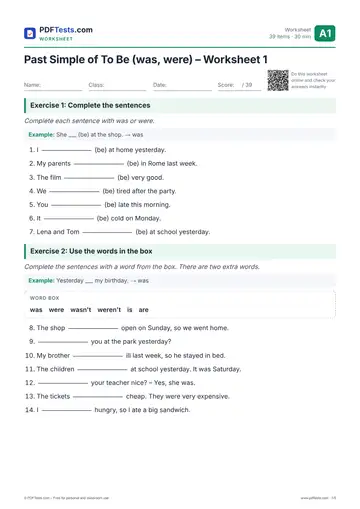
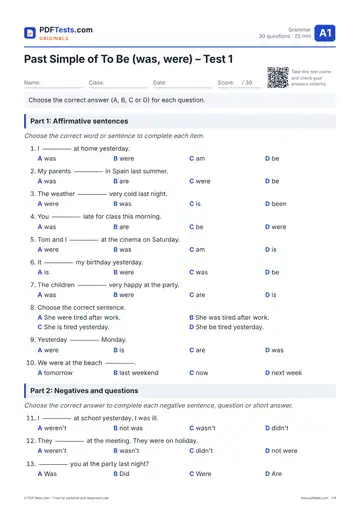
Now practise what you have learned: test yourself with our A1 Past Simple of To Be test, and check your answers carefully, especially the questions and short answers. If present forms still feel unclear, try the A1 Verb to be test first. When was and were feel easy, move on to other past verbs with our A2 Past Simple test.
Practise this topic: Past Simple of To Be (was, were)
Was this page helpful?
What was the problem?
Thank you for your feedback!