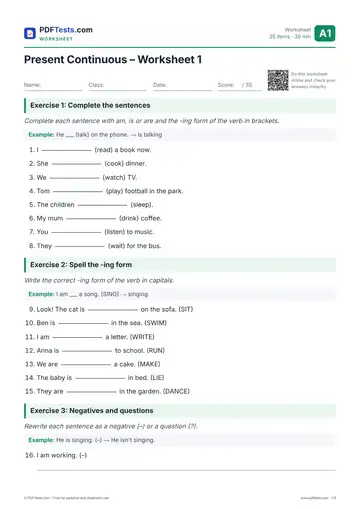
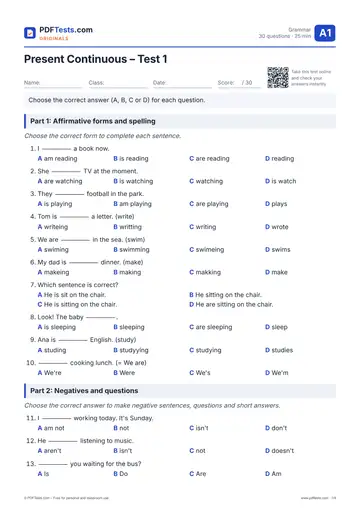
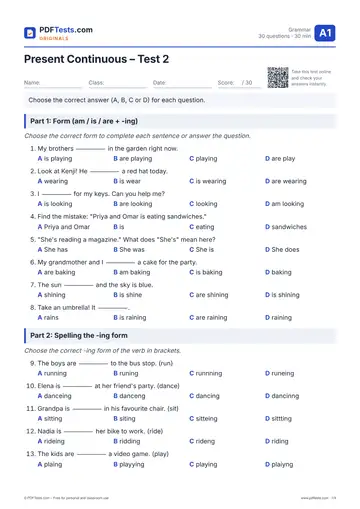
The present continuous describes actions that are happening now, at the moment of speaking, or around this time. We make it with am / is / are + verb-ing: I’m reading. She’s working today. Are you listening?
When do we use the present continuous?
1. Actions happening now
Use the present continuous for an action that is in progress right now. It started before this moment and it is not finished yet.
- I’m reading a book.
- Look! It’s raining.
- Be quiet, please. The baby is sleeping.
- “Where’s Tom?” “He’s in the kitchen. He’s cooking dinner.”
2. Temporary actions around now
Use it for an action that is happening in this period of time. The person may not be doing it at this exact second.
- I’m learning English this year.
- My cousin is staying with us this week.
- We’re working from home this month.
For example, you are at the supermarket now, but you can still say I’m reading a great book because it is true for this week.
A note on future plans
You will also hear sentences like I’m meeting Anna tomorrow. This is the present continuous for future arrangements. It is useful, but you will study it at a higher level. At A1, focus on now and around now.
Form: am / is / are + -ing
The present continuous has two parts:
- the verb be in the present: am, is or are
- the main verb with -ing: working, eating, playing
The form of be changes with the subject. The -ing form never changes. If am, is, are still feel new, review our guide to the verb to be first.
Affirmative
| Subject | be | verb-ing | Short form |
|---|---|---|---|
| I | am | working | I’m working |
| You | are | working | You’re working |
| He / She / It | is | working | He’s / She’s / It’s working |
| We | are | working | We’re working |
| They | are | working | They’re working |
In speaking and in messages, we usually use the short forms: I’m, you’re, she’s, we’re, they’re.
Negative
Add not after am / is / are.
| Full form | Short forms |
|---|---|
| I am not playing | I’m not playing |
| You are not playing | You aren’t playing / You’re not playing |
| He / She / It is not playing | He isn’t playing / He’s not playing |
| We are not playing | We aren’t playing / We’re not playing |
| They are not playing | They aren’t playing / They’re not playing |
There is no short form amn’t. Always say I’m not.
- I’m not watching TV. I’m doing my homework.
- She isn’t working today. She’s at home.
- They aren’t listening to the teacher.
Yes/No questions and short answers
Put am / is / are before the subject.
| Question | Yes | No |
|---|---|---|
| Am I talking too fast? | Yes, you are. | No, you aren’t. |
| Are you listening? | Yes, I am. | No, I’m not. |
| Is she working? | Yes, she is. | No, she isn’t. |
| Is it raining? | Yes, it is. | No, it isn’t. |
| Are we going the right way? | Yes, we are. | No, we aren’t. |
| Are they watching TV? | Yes, they are. | No, they aren’t. |
In positive short answers, use the full form: Yes, I am. (not Yes, I’m.)
Wh- questions
The word order is: question word + am / is / are + subject + verb-ing.
- What are you doing?
- Where is he going?
- Why are you laughing?
- Who is she talking to?
- What are they eating?
Spelling: how to add -ing
| Rule | Examples |
|---|---|
| Most verbs: add -ing | read → reading, play → playing, eat → eating, go → going |
| Verb ends in consonant + -e: remove e, add -ing | make → making, write → writing, dance → dancing, come → coming |
| Verb ends in -ee: just add -ing | see → seeing, agree → agreeing |
| One vowel + one consonant at the end (short verbs): double the consonant | sit → sitting, run → running, swim → swimming, stop → stopping, get → getting |
| Verb ends in -ie: change ie to y, add -ing | lie → lying, die → dying, tie → tying |
Two extra notes:
- Do not double w, x or y: snow → snowing, fix → fixing, play → playing.
- In longer verbs with the stress at the start, do not double: visit → visiting, open → opening, listen → listening.
Signal words
These words and expressions often appear with the present continuous:
- now, right now: I can’t talk right now. I’m driving.
- at the moment: At the moment, we’re living with my parents.
- today, this week, this month, this year: She’s studying for an exam this week.
- Look! / Listen!: Listen! Someone is singing.
Now and at the moment usually go at the end of the sentence, but they can also go at the start.
Verbs we don’t usually use in the continuous
Some verbs describe states (feelings, thoughts, possession), not actions. We normally use them in the present simple, even when we mean now.
Common state verbs: like, love, hate, want, need, know, understand, believe, remember, belong.
- ✓ I want a coffee. (not I’m wanting a coffee.)
- ✓ Do you understand? (not Are you understanding?)
- ✓ She knows the answer. (not She’s knowing the answer.)
Have is special. For possession, use the present simple: I have a car. For actions like eating or drinking, the continuous is fine: I’m having lunch. We’re having a party.
Present continuous or present simple?
This is the most common confusion. The present simple is for habits, routines and facts. The present continuous is for now and temporary situations.
| Present simple (habits, facts) | Present continuous (now, temporary) |
|---|---|
| I work in a bank. | I’m working at home today. |
| She drinks tea every morning. | She’s drinking coffee now. |
| It rains a lot in London. | It’s raining at the moment. |
| They play football on Saturdays. | They’re playing football right now. |
| He usually walks to school. | He’s taking the bus this week. |
Signal words help. Always, usually, often, every day point to the present simple. Now, at the moment, this week, Look! point to the present continuous. For more on the first tense, see our present simple guide, and for a full side-by-side explanation read Present Simple vs Present Continuous.
Common mistakes
- ✗ I working now. → ✓ I’m working now. — You need am / is / are before the -ing verb.
- ✗ She is work today. → ✓ She is working today. — The main verb needs -ing.
- ✗ He are playing. → ✓ He is playing. — He, she, it take is.
- ✗ I don’t working. → ✓ I’m not working. — Make the negative with be + not, not don’t.
- ✗ What you are doing? → ✓ What are you doing? — In questions, be goes before the subject.
- ✗ Is raining. → ✓ It’s raining. — English sentences need a subject, even for weather.
- ✗ Yes, I’m. → ✓ Yes, I am. — Don’t use short forms in positive short answers.
- ✗ I’m writeing an email. → ✓ I’m writing an email. — Remove the final -e before -ing.
- ✗ They’re siting on the sofa. → ✓ They’re sitting on the sofa. — Double the final consonant in sit.
- ✗ Are you liking this song? → ✓ Do you like this song? — Like is a state verb, so use the present simple.
- ✗ I’m going to school every day. → ✓ I go to school every day. — Routines need the present simple.
Quick check
Complete the sentences with the present continuous, or correct the mistake.
- Look! The children ___ (play) in the garden.
- She ___ (not / work) today. She’s on holiday.
- ___ you ___ (listen) to me?
- We ___ (sit) near the window.
- Correct the sentence: Is he understanding the lesson?
Answers
- are playing (or ’re playing)
- isn’t working (or is not working / ’s not working)
- Are you listening
- are sitting (or ’re sitting) — double the t
- Does he understand the lesson? — understand is a state verb, so we use the present simple.
Next step
Now practise the form, spelling and questions with our A1 Present Continuous test. When you feel confident, check that you can choose between the two present tenses with the A2 Present Simple vs Present Continuous test. You can find more practice for your level in our English A1 tests.
Was this page helpful?
What was the problem?
Thank you for your feedback!