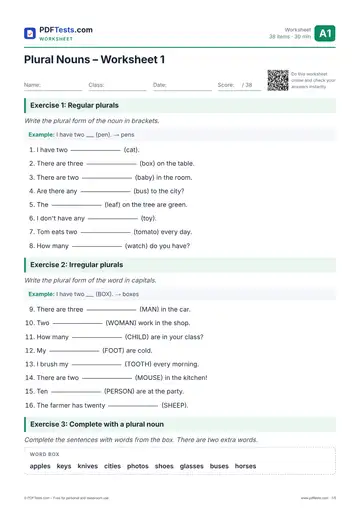
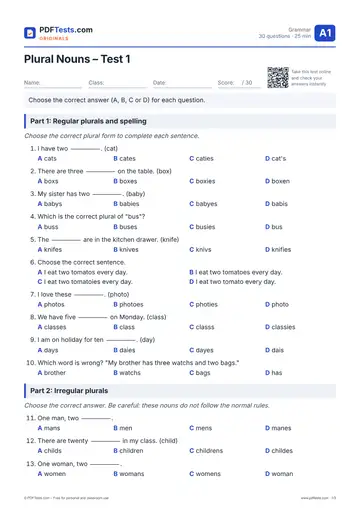
A plural noun means more than one person, animal or thing: one book → two books. Most English nouns make the plural by adding -s, but some need -es, -ies or -ves, and a few common words change completely (man → men, child → children). You use plural nouns with numbers, with words like these, many and some, and with there are.
When do we use plural nouns?
Use the plural when you talk about two or more of something:
- I have two brothers.
- There are three cats in the garden.
- These shoes are new.
Use the plural to talk about things in general:
- I like dogs.
- Apples are good for you.
- Teachers work very hard.
Use the singular for one thing. A singular countable noun usually needs a, an, the, my, this etc. before it:
- I have a brother. (not I have brother.)
- The cat is black.
Remember: a and an mean “one”, so they never go before a plural noun. For more on this, see our guide to articles a, an and the.
Regular plurals: add -s
For most nouns, just add -s.
| Singular | Plural |
|---|---|
| book | books |
| car | cars |
| friend | friends |
| apple | apples |
| house | houses |
| day | days |
- My friends live in London.
- We have two cars.
Spelling rules
Some nouns change their spelling in the plural. Look at the last letters of the word.
Nouns ending in -s, -ss, -sh, -ch, -x, -z: add -es
| Ending | Singular | Plural |
|---|---|---|
| -s | bus | buses |
| -ss | glass | glasses |
| -sh | dish | dishes |
| -ch | watch | watches |
| -x | box | boxes |
| -z | quiz | quizzes |
We add -es because these words are difficult to say with only -s. Try saying boxs — it is not easy.
- The buses are late today.
- Can you wash the dishes, please?
Note: quiz doubles the z: quizzes.
Consonant + y: change y to -ies
If the word ends in a consonant + y, remove the y and add -ies.
| Singular | Plural |
|---|---|
| city | cities |
| baby | babies |
| country | countries |
| family | families |
| party | parties |
Vowel + y: add -s
If the word ends in a vowel (a, e, o, u) + y, just add -s.
| Singular | Plural |
|---|---|
| day | days |
| boy | boys |
| key | keys |
| toy | toys |
- I visit two cities every summer.
- Where are my keys?
Nouns ending in -f or -fe: change to -ves
Many nouns ending in -f or -fe change to -ves.
| Singular | Plural |
|---|---|
| knife | knives |
| wife | wives |
| life | lives |
| leaf | leaves |
| half | halves |
| shelf | shelves |
| wolf | wolves |
Some common words just add -s: roof → roofs, chef → chefs, cliff → cliffs.
Nouns ending in -o: -s or -es
Some nouns ending in -o add -es. Learn these common ones:
| -es | -s |
|---|---|
| tomato → tomatoes | photo → photos |
| potato → potatoes | piano → pianos |
| hero → heroes | radio → radios |
| video → videos | |
| zoo → zoos |
- I need three potatoes and two tomatoes.
- Look at these photos.
Irregular plurals
Some very common nouns do not follow the rules. You need to learn them.
| Singular | Plural |
|---|---|
| man | men |
| woman | women |
| child | children |
| person | people |
| foot | feet |
| tooth | teeth |
| mouse | mice |
| goose | geese |
- There are twenty children in my class.
- I brush my teeth every morning.
- How many people are in your family?
Women has a different pronunciation from woman: /ˈwɪmɪn/ (“wim-in”).
Same in singular and plural
A few animal nouns do not change:
| Singular | Plural |
|---|---|
| sheep | sheep |
| fish | fish |
| deer | deer |
- There is one sheep in the field. There are ten sheep in the field.
Always plural
Some nouns are always plural because they have two parts:
trousers, jeans, shorts, glasses (for your eyes), scissors, pyjamas
- My jeans are blue. (not My jean is blue.)
- Where are my glasses?
To talk about one, say a pair of: a pair of jeans, two pairs of scissors.
Pronunciation of -s and -es
The plural ending has three sounds.
| Sound | After… | Examples |
|---|---|---|
| /s/ | p, t, k, f sounds | cups, cats, books, chefs |
| /z/ | most other sounds, and vowels | dogs, bags, days, cities |
| /ɪz/ | s, z, sh, ch, x, ge sounds | buses, boxes, watches, pages |
The /ɪz/ ending adds an extra syllable: box (one syllable) → box-es (two syllables). Page → pag-es. House → hous-es (and the s sounds like /z/: /ˈhaʊzɪz/).
Words that go with plural nouns
These words are signals that you need a plural noun:
- Numbers (two, three, ten…): five minutes, two sisters
- these / those: these books, those houses
- many / a lot of / some: many students, some eggs
- How many…?: How many brothers have you got?
- there are: There are four chairs.
The verb also changes. Use are, not is, with plural nouns, and use the verb without -s in the present simple:
- The apple is red. → The apples are red.
- My brother lives in Paris. → My brothers live in Paris.
- People are friendly here. (people is plural)
Read more in our guides to this, that, these, those and there is and there are.
Adjectives do not change
In English, adjectives have no plural form:
- a big house → two big houses (not bigs houses)
- a new phone → new phones
Plural nouns vs uncountable nouns
Some nouns are uncountable: we cannot count them, so they have no plural. Common examples:
water, milk, bread, rice, money, music, information, advice, homework, furniture, weather
- I need some money. (not moneys)
- Can you give me some information? (not informations)
- I have a lot of homework. (not homeworks)
Use a singular verb with uncountable nouns: The water is cold.
To count them, use a container or unit: a glass of water, two bottles of milk, a piece of advice.
This topic is explained in detail in our guide to some and any, countable and uncountable nouns.
Common mistakes
✗ I have two brother. → ✓ I have two brothers. After a number bigger than one, use the plural.
✗ I have a books. → ✓ I have a book. / I have books. Do not use a or an with plural nouns.
✗ There are three childrens. → ✓ There are three children. Children is already plural; do not add -s.
✗ The peoples are nice. → ✓ The people are nice. People is the plural of person.
✗ I love babys. → ✓ I love babies. Consonant + y changes to -ies.
✗ Where are my keies? → ✓ Where are my keys? Vowel + y: just add -s.
✗ I need two knifes. → ✓ I need two knives. Knife changes -fe to -ves.
✗ These are my news shoes. → ✓ These are my new shoes. Adjectives do not have a plural form.
✗ Can you give me some advices? → ✓ Can you give me some advice? Advice is uncountable, so it has no plural.
✗ My jean is old. → ✓ My jeans are old. Jeans is always plural.
✗ The boxes is heavy. → ✓ The boxes are heavy. A plural noun needs a plural verb.
Quick check
Write the correct plural.
- one watch → two ______
- one lady → three ______
- one man → four ______
- one leaf → many ______
- one photo → some ______
Answers: 1. watches 2. ladies 3. men 4. leaves 5. photos
Next step
Now practise what you have learned: test yourself with our A1 Plural Nouns test, which checks spelling rules, irregular forms and singular vs plural in short sentences. If any answers surprise you, come back to the tables above, especially the lists of irregular nouns and -o words. When you feel confident, try more practice from our English A1 tests.
Was this page helpful?
What was the problem?
Thank you for your feedback!