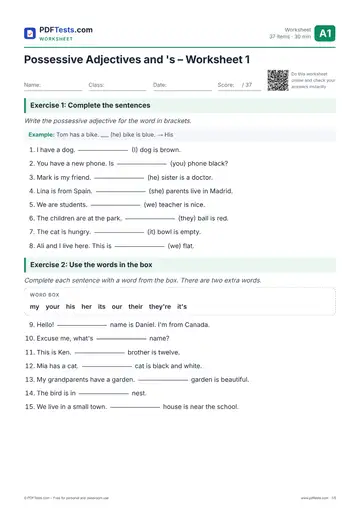
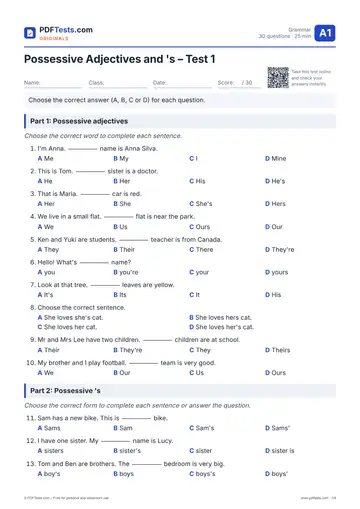
Possessive adjectives (my, your, his, her, its, our, their) and possessive ’s show who something belongs to. We use them to talk about family, friends, things we own and parts of the body: my sister, Tom’s phone, their house. You will use them in almost every conversation, so they are worth learning well from the start.
Possessive adjectives
A possessive adjective goes before a noun and tells us who the owner is. Each subject pronoun has its own possessive adjective.
| Subject pronoun | Possessive adjective | Example |
|---|---|---|
| I | my | This is my bag. |
| you | your | Is this your coat? |
| he | his | His name is Daniel. |
| she | her | Her brother is a doctor. |
| it | its | The cat is eating its food. |
| we | our | Our flat is quite small. |
| you (plural) | your | Open your books, everyone. |
| they | their | Their children are at school. |
Rule 1: Always before a noun
A possessive adjective cannot stand alone. It always needs a noun after it. If there is another adjective, it goes between the possessive and the noun.
- My phone is new.
- What’s your email address?
- I love our new kitchen.
Rule 2: The form never changes
Possessive adjectives are the same for one thing or many things. English adjectives do not have plural forms.
- my brother → my brothers
- their car → their cars
Rule 3: No article
Do not use a, an or the together with a possessive adjective. Say my car, not the my car.
His or her?
In English, we choose his or her by looking at the owner, not at the thing. Some languages do it differently, so this is a very common problem.
- Anna is with her father. (Anna is a woman → her)
- Tom is with his mother. (Tom is a man → his)
- Tom loves his daughter. (the owner is Tom → his)
Its
Use its for animals and things. There is no apostrophe.
- The dog wants its ball.
- The hotel has its own restaurant.
Body parts and clothes
English uses possessive adjectives with parts of the body and with clothes, where some languages use the.
- I wash my hands before dinner.
- She’s wearing her new jacket.
- He broke his arm last year.
Possessive ’s
We add ’s to a noun to show that something belongs to a person or an animal. The owner comes first, then the thing.
| Owner | Rule | Example |
|---|---|---|
| singular noun | + ’s | my sister**’s** car |
| name | + ’s | Maria**’s** phone |
| plural noun ending in -s | + ’ | my parents**’** house |
| irregular plural (no -s) | + ’s | the children**’s** toys |
| name ending in -s | + ’s or + ’ | James**‘s** bike / James**’** bike |
More examples:
- Emma’s dog is very friendly.
- This is my brother’s room.
- The student’s book is on the table. (one student)
- The students’ books are on the table. (more than one student)
- The women’s toilets are upstairs.
If you are not sure about plural forms like children, women and people, see our guide to plural nouns.
Word order
The owner always comes before the thing. Do not put the before a name with ’s.
- ✓ Sara’s bag
- ✗ the bag of Sara
- ✗ the Sara’s bag
Two owners
When two people share one thing, add ’s only to the second name.
- Tom and Lucy’s house is near the park. (one house, they live there together)
Family words with ’s
Possessive ’s is very useful for describing your family.
- My mother’s sister is my aunt.
- My uncle’s son is my cousin.
- My parents’ names are Ana and Luis.
Whose…? and short answers
To ask about the owner, use whose. In the answer, you can use a name + ’s without repeating the noun.
- Whose bag is this? – It’s Peter’s.
- Whose keys are these? – They’re my dad’s.
People or things?
We usually use ’s for people and animals. For things and places, we usually use of or put two nouns together.
- the name of the street
- the end of the film
- the kitchen door
Pronunciation of ’s
The possessive ’s has three sounds, just like plural -s:
- /s/ after the sounds p, t, k, f: Mark’s, Kate’s, Jeff’s
- /z/ after vowels and most other sounds: John’s, Anna’s, Tom’s
- /ɪz/ after s, z, sh, ch and soft g sounds: Alice’s, Liz’s, George’s
’s: possessive, is or has?
The same ending ’s can mean three different things. Look at what comes after it.
| Sentence | Meaning | Clue |
|---|---|---|
| Sam’s car is red. | the car of Sam | a noun follows |
| Sam’s tired. | Sam is tired | an adjective follows |
| Sam’s at home. | Sam is at home | a place follows |
| Sam’s got two cats. | Sam has got two cats | got follows |
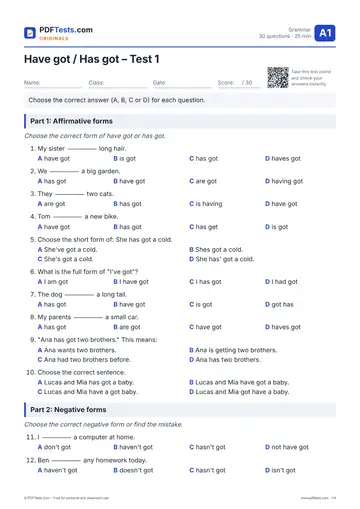
For more on the has meaning, see our guide to have got / has got.
its or it’s?
This pair confuses many learners, and native speakers too.
- its = possessive: The hotel is great. Its rooms are big.
- it’s = it is / it has: It’s a nice hotel. It’s got a pool.
Tip: if you can say it is or it has, write it’s. If not, write its.
their, they’re or there?
These words sound the same but have different meanings.
- their = possessive: This is their house.
- they’re = they are: They’re at home.
- there = place or there is/are: The bus stop is over there.
My or me? Subject, object and possessive
Learners often mix up the three types of words below. Possessive adjectives always come before a noun.
| Subject | Object | Possessive adjective |
|---|---|---|
| I | me | my |
| you | you | your |
| he | him | his |
| she | her | her |
| it | it | its |
| we | us | our |
| they | them | their |
- I know him. His name is Leo.
- She is my friend. I see her every day. Her car is blue.
Notice that her is both an object pronoun and a possessive adjective. For a full explanation of the first two columns, read our guide to subject and object pronouns.
My or mine?
My, your, his and so on need a noun. Mine, yours, his, hers, ours, theirs replace the noun. These are possessive pronouns, which you will study more at A2.
- This is my pen. → This pen is mine.
- Is this your coat? → Is this coat yours?
When you are ready, our guide to possessive pronouns explains them in detail.
Common mistakes
- ✗ This is the my book. → ✓ This is my book. — Don’t use an article with a possessive adjective.
- ✗ Anna loves his dog. → ✓ Anna loves her dog. — Choose his/her by the owner (Anna), not the thing.
- ✗ They are with they friends. → ✓ They are with their friends. — They is a subject; before a noun use their.
- ✗ Is this you phone? → ✓ Is this your phone? — You is a pronoun; the possessive is your.
- ✗ The dog is eating it’s food. → ✓ The dog is eating its food. — It’s means it is; the possessive has no apostrophe.
- ✗ Their at home. → ✓ They’re at home. — They’re = they are.
- ✗ the car of my father → ✓ my father’s car — For people, use ’s.
- ✗ my parent’s house (two parents) → ✓ my parents’ house — For a plural ending in -s, put the apostrophe after the s.
- ✗ the childrens’ room → ✓ the children’s room — Children has no -s, so add ’s.
- ✗ I brush the teeth every morning. → ✓ I brush my teeth every morning. — Use a possessive with body parts.
- ✗ Whose bag is this? It’s of Maria. → ✓ It’s Maria’s. — Use name + ’s.
Quick check
Choose or correct the words.
- This is Ben. ___ sister is a nurse. (His / Her)
- We live in London. ___ flat is near the station. (We / Our)
- The cat is playing with ___ toy. (its / it’s)
- My two brothers share a room. It’s my ___ room. (brother’s / brothers’)
- Correct the sentence: That is the car of Mr Brown.
Answers
- His — the owner is Ben, a man.
- Our — before a noun, use the possessive adjective.
- its — possessive, no apostrophe.
- brothers’ — two brothers, plural ending in -s.
- That is Mr Brown’s car. — Use ’s for people.
Next step
Now put the rules into practice: test yourself with our A1 Possessive Adjectives and ’s test and check which forms you still mix up, especially his/her, its/it’s and the position of the apostrophe. Then keep building your basics with more English A1 tests, where possessives appear again in sentences about family, home and daily life.
Practise this topic: Possessive Adjectives and 's
Was this page helpful?
What was the problem?
Thank you for your feedback!