The present perfect is formed with have/has + past participle (I have seen, she has finished). It connects the past to the present. We use it for life experiences and for recent actions that matter now, without saying exactly when they happened.
The words ever, never, just, already and yet often go with the present perfect. This guide shows you how to form the tense, where to put these words and how to avoid the most common mistakes.
When do we use the present perfect?
1. Life experiences
Use the present perfect to talk about things that have or haven’t happened in your life up to now. The exact time is not important.
- I have visited Japan twice.
- She has never eaten sushi.
- Have you ever met a famous person?
2. Recent actions with a result now
Use it for something that happened a short time ago when the result is important now.
- I**’ve lost** my keys. (I can’t open the door now.)
- He**’s just finished** his homework. (He’s free now.)
- The film has already started. (We’re late.)
3. Things we expect to happen
With yet, we talk about actions we expect, but which haven’t happened up to now.
- Have you done your homework yet?
- The bus hasn’t arrived yet.
Form
The present perfect has two parts: have or has + the past participle of the main verb. Use has with he, she, it and singular nouns. Use have with I, you, we, they and plural nouns.
Affirmative
| Subject | have / has | Past participle | Short form |
|---|---|---|---|
| I / You / We / They | have | worked | I’ve worked |
| He / She / It | has | worked | She’s worked |
Negative
| Subject | have not / has not | Past participle | Short form |
|---|---|---|---|
| I / You / We / They | have not | seen | They haven’t seen |
| He / She / It | has not | seen | He hasn’t seen |
Questions and short answers
| have / has | Subject | Past participle | Short answers |
|---|---|---|---|
| Have | you | finished? | Yes, I have. / No, I haven’t. |
| Has | she | called? | Yes, she has. / No, she hasn’t. |
Note: in short answers, we don’t repeat the participle. Say Yes, I have, not Yes, I have finished (that is correct but sounds long), and never Yes, I’ve.
Careful with ’s: She’s can mean she is or she has. Look at the next word. She’s tired = she is. She’s finished = she has.
Past participles
Regular verbs
Regular verbs add -ed, just like the past simple: work → worked, play → played, visit → visited.
The spelling rules are the same as in the past simple:
- verb ends in -e: add -d → live → lived
- consonant + y: change y to i → study → studied
- one vowel + one consonant (stressed): double the consonant → stop → stopped
Irregular verbs
Many common verbs are irregular. Sometimes the past participle is the same as the past simple, sometimes it is different. Learn all three forms together.
| Verb | Past simple | Past participle |
|---|---|---|
| be | was / were | been |
| do | did | done |
| go | went | gone / been |
| see | saw | seen |
| eat | ate | eaten |
| write | wrote | written |
| take | took | taken |
| buy | bought | bought |
| make | made | made |
| have | had | had |
| meet | met | met |
| lose | lost | lost |
For a full review of past forms, read our guide to the Past Simple with regular and irregular verbs.
Been or gone?
- been = went and came back. She’s been to Paris. (She visited Paris and is home now.)
- gone = went and is still there. She’s gone to Paris. (She is in Paris now.)
For experiences, use been: Have you ever been to Canada?
Ever and never
Ever means at any time in your life. We use it mainly in questions.
- Have you ever tried Indian food?
- Has he ever driven a truck?
Never means at no time in your life. It already has a negative meaning, so use it with a positive verb (have/has, not haven’t/hasn’t).
- I’ve never seen snow.
- My parents have never flown in a plane.
Position: ever and never go between have/has and the past participle.
A typical conversation:
A: Have you ever been to Italy? B: Yes, I have. I went there last summer. A: I’ve never been, but I’d love to go.
Just
Just means a very short time ago. Use it in affirmative sentences. It goes between have/has and the past participle.
- I’ve just had lunch, so I’m not hungry.
- The train has just left. We need to wait for the next one.
- Look. It’s just started to rain.
Already
Already means before now or earlier than expected. It is common in affirmative sentences and also goes between have/has and the past participle.
- I’ve already paid for the tickets.
- Shall I call Tom? — No need. I’ve already called him.
- Wow, you’ve already finished. That was fast.
Already can also go at the end for emphasis: Have you finished already? This often shows surprise.
Yet
Yet means up to now. Use it in negative sentences and questions. It usually goes at the end of the sentence.
- I haven’t decided yet. (negative: I will decide soon)
- Have you booked the hotel yet? (question: I expect you to book it)
- The parcel hasn’t arrived yet.
Not yet is a common short answer: Have you read the book? — Not yet.
Word order summary
| Word | Sentence type | Position | Example |
|---|---|---|---|
| ever | questions | before the participle | Have you ever been to Spain? |
| never | affirmative verb, negative meaning | before the participle | I’ve never been to Spain. |
| just | affirmative | before the participle | She’s just arrived. |
| already | affirmative (and questions) | before the participle (or at the end) | We’ve already eaten. |
| yet | negatives and questions | at the end | They haven’t eaten yet. |
Present perfect or past simple?
Learners often confuse these two tenses. The key question is: do you say or ask when?
- Present perfect: no finished time. I’ve seen that film. (sometime in my life)
- Past simple: a finished time is said or clear. I saw that film last week.
Words like yesterday, last year, in 2019, two days ago and when I was a child need the past simple, not the present perfect.
We often start with the present perfect and then change to the past simple when we give details:
- Have you ever been to London? — Yes, I went there in 2022. It was great.
American English note: in American English, people often use the past simple with just, already and yet: I just ate. Did you finish yet? In British English, the present perfect is more usual. Both are correct in their own variety, but in exams based on British English, use the present perfect.
For more detail and practice, see our guide to Present Perfect vs Past Simple.
Common mistakes
- ✗ I have saw that film. → ✓ I have seen that film. Use the past participle, not the past simple form.
- ✗ She have finished. → ✓ She has finished. Use has with he, she, it.
- ✗ I’ve been to the cinema yesterday. → ✓ I went to the cinema yesterday. A finished time (yesterday) needs the past simple.
- ✗ I haven’t never been to Mexico. → ✓ I’ve never been to Mexico. Never is already negative; don’t use two negatives.
- ✗ I’ve finished yet my work. → ✓ I’ve already finished my work. / I haven’t finished my work yet. Yet goes in negatives and questions, usually at the end.
- ✗ Have you been ever to Rome? → ✓ Have you ever been to Rome? Ever goes before the past participle.
- ✗ He’s gone to Australia three times. → ✓ He’s been to Australia three times. For experiences (went and came back), use been.
- ✗ Yes, I’ve. → ✓ Yes, I have. Don’t use contractions in positive short answers.
Quick check
Choose or write the correct form.
- Have you ___ been to a concert? (ever / never)
- I’m not hungry. I’ve ___ eaten. (just / yet)
- We haven’t finished the project ___. (already / yet)
- She ___ (write) three emails this morning — and it’s still morning.
- Correct the mistake: I have lost my phone last night.
Answers
- ever — ever is used in questions about experiences.
- just — just goes before the participle in affirmative sentences.
- yet — yet goes at the end of negative sentences.
- has written — has for she, and written is the irregular past participle of write.
- I lost my phone last night. — last night is a finished time, so use the past simple.
Next step
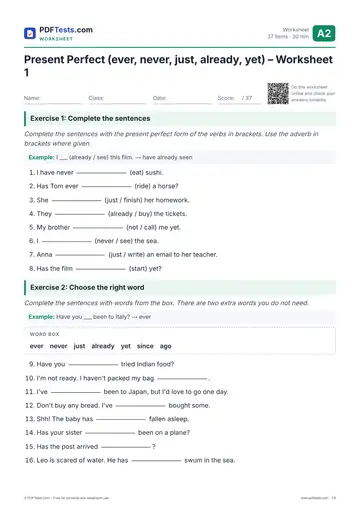
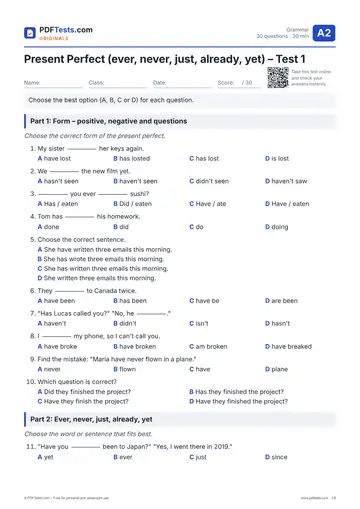
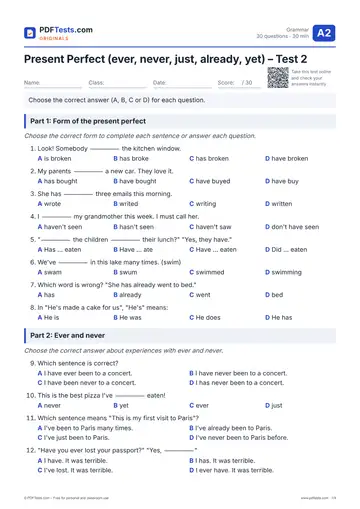
Now put the rules into practice: test yourself with our A2 Present Perfect test, which focuses on ever, never, just, already and yet. If irregular past forms still cause problems, review them with the A2 Past Simple test. When you feel confident, move on to the Present Perfect vs Past Simple test to practise choosing between the two tenses.
Was this page helpful?
What was the problem?
Thank you for your feedback!