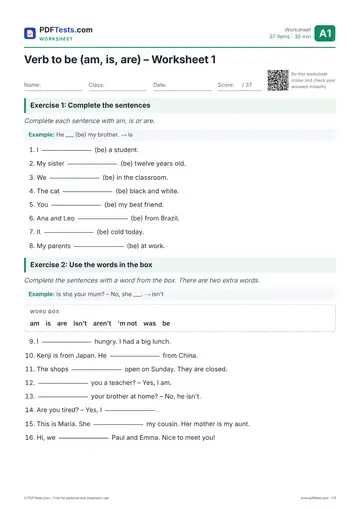
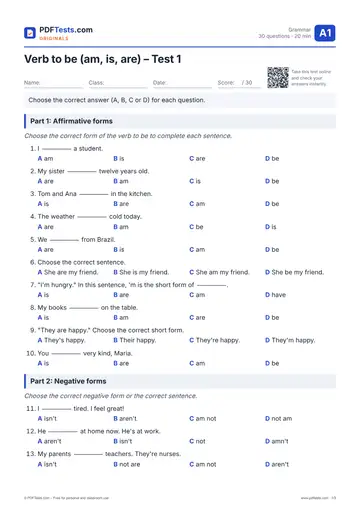
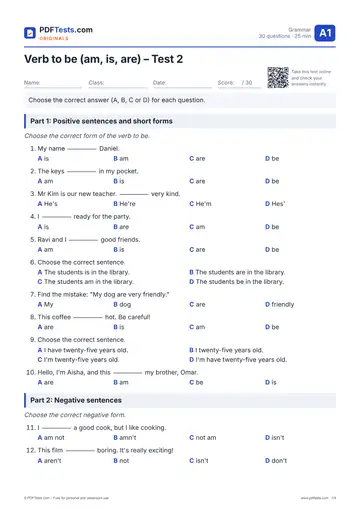
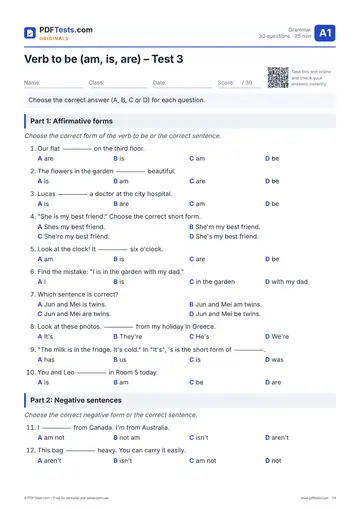
The verb to be has three present forms: am, is and are. We use it to say who or what something is, to describe people and things, and to talk about age, jobs, places and feelings. It is the first verb most learners need. It also works differently from other English verbs in negatives and questions.
Am, is or are: the basic rule
The form depends on the subject.
| Subject | Verb to be |
|---|---|
| I | am |
| he, she, it | is |
| you, we, they | are |
The same rule works with nouns. A singular noun (one person or thing) takes is. A plural noun, or two subjects joined with and, takes are.
- My sister is a nurse.
- The children are at school.
- Tom and I are friends.
- This coffee is hot.
You always takes are, for one person or for many people: You are late, Anna. / You are all welcome.
When do we use the verb to be?
Names and identity
- I**’m** Daniel.
- This is my brother, Leo.
Age
- I**’m** 25 (years old).
- My grandmother is 80.
Nationality and origin
- We**’re** from Brazil.
- She**’s** Japanese.
Jobs
- He**’s** a teacher.
- They**’re** doctors.
Use a or an with a singular job: She’s an engineer, not She’s engineer.
Descriptions
- The flat is small but nice.
- Your eyes are blue.
Feelings and states
- I**’m** tired.
- Are you hungry?
- We**’re** ready.
Place
- The keys are on the table.
- Mum is at work.
Time, days, weather and prices
- It**’s** seven o’clock.
- It**’s** Monday today.
- It**’s** sunny.
- How much is this T-shirt? It**’s** £15.
Affirmative: full forms and contractions
In speaking and informal writing (messages, emails to friends) we usually use contractions, or short forms. In formal writing, full forms are more common.
| Full form | Contraction | Example |
|---|---|---|
| I am | I’m | I’m a student. |
| you are | you’re | You’re right. |
| he is | he’s | He’s from Italy. |
| she is | she’s | She’s my manager. |
| it is | it’s | It’s cold today. |
| we are | we’re | We’re at home. |
| they are | they’re | They’re very kind. |
You can also contract is after nouns and question words: My phone’s in my bag. Where’s the station? What’s your name?
Spelling note: it’s or its?
It’s means it is: It’s late. Its (no apostrophe) shows possession: The cat is eating its food. In the same way, they’re = they are, their = possessive (their house), and there = a place (over there).
Negative: am not, isn’t, aren’t
To make the negative, put not after am, is or are. Do not use don’t or doesn’t.
| Full form | Short form 1 | Short form 2 |
|---|---|---|
| I am not | I’m not | – |
| you are not | you’re not | you aren’t |
| he is not | he’s not | he isn’t |
| she is not | she’s not | she isn’t |
| it is not | it’s not | it isn’t |
| we are not | we’re not | we aren’t |
| they are not | they’re not | they aren’t |
Both short forms are correct and common. With I there is only one: I’m not. (I amn’t is not standard English.)
- I’m not ready yet.
- It isn’t expensive.
- My parents aren’t at home.
Questions and short answers
To make a yes/no question, put am, is or are before the subject. Again, there is no do or does.
| Statement | Question |
|---|---|
| You are tired. | Are you tired? |
| She is a doctor. | Is she a doctor? |
| They are from Spain. | Are they from Spain? |
| I am late. | Am I late? |
Short answers
In conversation we often answer with Yes or No + subject + be.
| Question | Yes | No |
|---|---|---|
| Am I late? | Yes, you are. | No, you aren’t. / No, you’re not. |
| Are you tired? | Yes, I am. | No, I’m not. |
| Is he here? | Yes, he is. | No, he isn’t. / No, he’s not. |
| Is it open? | Yes, it is. | No, it isn’t. |
| Are they ready? | Yes, they are. | No, they aren’t. |
Do not contract a positive short answer. Say Yes, I am, not Yes, I’m, and Yes, she is, not Yes, she’s.
Wh- questions
Put the question word first, then am/is/are, then the subject.
| Question word | be | Subject + rest |
|---|---|---|
| Where | is | the bathroom? |
| How old | are | you? |
| What | is | your job? |
| Who | is | that man? |
| Why | are | they late? |
Useful everyday questions: What’s your name? Where are you from? How are you? How old is your son? What time is it?
Be and the structures learners confuse it with
Be, not have, for age and feelings
In many languages you have years, hunger or cold. In English, use be.
- I’m 30. (not I have 30)
- She’s hungry. (not She has hunger)
- Are you cold? (not Do you have cold?)
To talk about things you own, family and appearance, use have or have got: I’ve got a brother. She’s got long hair. See our guide to have got and has got.
Be vs other present simple verbs
Do not put am/is/are in front of another verb in the present simple.
- I work in a bank. (not I am work)
- She likes pizza. (not She is like pizza)
With other verbs, negatives and questions use do/does: Do you work here? She doesn’t like tea. With be, they never do: Are you a student? She isn’t at home. Read more in our Present Simple guide.
It is vs there is
Use there is / there are to say that something exists. Use it is to describe it or say where it is.
- There’s a café near my house. It’s small and quiet.
For more examples, see our guide to there is and there are.
Don’t drop the verb or the subject
Some languages don’t need a verb in sentences like She happy. English always needs one: She is happy. English also needs a subject, so say It’s hot, not Is hot.
Common mistakes
- ✗ I is a student. → ✓ I am a student. — I always takes am.
- ✗ She are my friend. → ✓ She is my friend. — he, she, it take is.
- ✗ My friends is nice. → ✓ My friends are nice. — plural nouns take are.
- ✗ I have 20 years. → ✓ I’m 20. — use be for age.
- ✗ I don’t am hungry. → ✓ I’m not hungry. — the negative of be uses not, not don’t.
- ✗ Do you are from Spain? → ✓ Are you from Spain? — questions with be don’t use do.
- ✗ You are ready? → ✓ Are you ready? — in a question, be goes before the subject.
- ✗ Yes, I’m. → ✓ Yes, I am. — no contraction at the end of a positive short answer.
- ✗ He’s doctor. → ✓ He’s a doctor. — a singular job needs a or an.
- ✗ Is very cold today. → ✓ It’s very cold today. — an English sentence needs a subject.
- ✗ My brother he is tall. → ✓ My brother is tall. — don’t repeat the subject with a pronoun.
- ✗ I am live in London. → ✓ I live in London. — don’t add am to another verb.
Quick check
Choose or write the correct form.
- My parents ___ teachers. (am / is / are)
- ___ she from Canada? — Yes, she ___.
- I ___ hungry. (negative)
- How old ___ your sister?
- Correct the mistake: He have 12 years.
Answers
- are
- Is / is
- ’m not (am not)
- is
- He’s 12. / He is 12 (years old).
Next step
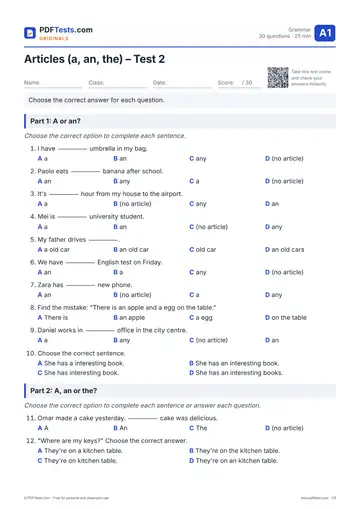
Now put the rules into practice. Start with our A1 Verb to be test 1, then try Verb to be test 2 for more practice with negatives, questions and short answers. If you make mistakes, check the tables above and try again. When you feel confident, move on to the past forms in our guide to the past simple of to be (was, were).
Was this page helpful?
What was the problem?
Thank you for your feedback!