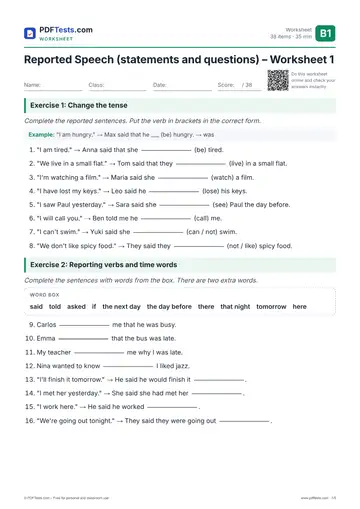
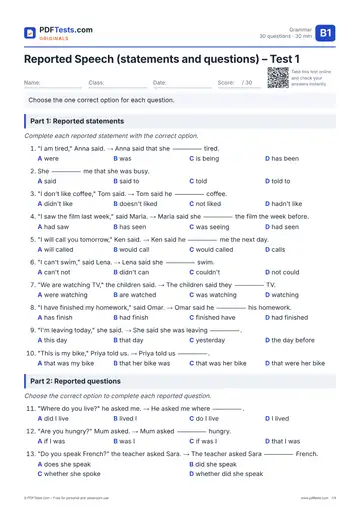
Reported speech, also called indirect speech, is how we tell someone what another person said or asked without repeating their exact words. We use it all the time in conversations, messages and stories: She said she was running late, He asked if I was free. At B1 there are four key skills: choosing say or tell, moving the tense back, changing pronouns and time words, and using normal word order in reported questions.
Direct speech vs reported speech
Direct speech repeats the exact words, usually in quotation marks. Reported speech gives the meaning in your own sentence.
- Direct: Maya said, “I’m tired.”
- Reported: Maya said (that) she was tired.
Several things change in the reported version:
- the tense (am → was)
- the pronoun (I → she)
- often time and place words (today → that day)
The word that is optional after say and tell. In everyday English people often leave it out: He told me he was busy.
Say or tell
Both verbs introduce reported statements, but the grammar after them is different.
| Verb | Pattern | Example |
|---|---|---|
| say | say (that) + clause | She said (that) she was late. |
| say | say to + person (that) + clause | She said to me that she was late. |
| tell | tell + person (that) + clause | She told me (that) she was late. |
The simple rule: tell needs a person directly after it (told me, told Sarah, told the class). Say does not take a person directly after it; if you mention the listener, use to.
- ✓ He told us he had a new job.
- ✓ He said he had a new job.
- ✗ He said us he had a new job.
Tense changes (backshift)
When the reporting verb is in the past (said, told, asked), we usually move the tense of the original words one step back into the past. This is called backshift.
| Direct speech | Reported speech | Example |
|---|---|---|
| present simple | past simple | “I live in Leeds.” → He said he lived in Leeds. |
| present continuous | past continuous | “I’m working.” → She said she was working. |
| past simple | past perfect | “I saw the film.” → He said he had seen the film. |
| present perfect | past perfect | “We’ve finished.” → They said they had finished. |
| past continuous | past perfect continuous | “I was waiting.” → She said she had been waiting. |
| will | would | “I’ll help.” → He said he would help. |
| am/is/are going to | was/were going to | “It’s going to rain.” → She said it was going to rain. |
| can | could | “I can drive.” → He said he could drive. |
| may | might | “I may be late.” → She said she might be late. |
| must | had to (or must) | “I must go.” → He said he had to go. |
Some forms do not change because they cannot move further back: past perfect, would, could, should, might and ought to.
- “I had already eaten.” → She said she had already eaten.
- “You should rest.” → The doctor said I should rest.
If you need to review how the past perfect is formed, see our Past Perfect grammar guide.
Past simple: past perfect or no change
In spoken English, the past simple often stays the same, especially when the order of events is clear:
- “I bought it last year.” → She said she bought it last year. / She said she had bought it the year before.
Both are acceptable. In exams and formal writing, the past perfect is the safer choice.
When the tense does not need to change
Backshift is not automatic. There are two common situations where you can keep the original tense.
1. The reporting verb is in the present. If you use says, has said or will say, keep the original tense.
- “I’m tired.” → Maya says she is tired.
- “The meeting starts at ten.” → The email says the meeting starts at ten.
2. The information is still true. If the situation has not changed, you can keep the present tense.
- “I live in Leeds.” → He said he lives in Leeds. (He still lives there.)
- “Water boils at 100°C.” → Our teacher told us water boils at 100°C.
In both cases backshift is also correct (He said he lived in Leeds). If you are unsure, backshift is never wrong after a past reporting verb.
Pronouns and possessives
Change pronouns and possessives so they make sense from the point of view of the person reporting.
- “I love my job,” Tom said. → Tom said he loved his job.
- “We’ll call you,” they told me. → They told me they would call me.
- “Is this your bag?” she asked me. → She asked me if that was my bag.
Think about who is speaking now and who you are talking about. If you are reporting your own words, I stays I: “I’m hungry.” → I said I was hungry.
Time and place words
If the report happens at a different time or place, words like today and here usually change.
| Direct speech | Reported speech |
|---|---|
| now | then / at that time |
| today | that day |
| tonight | that night |
| yesterday | the day before / the previous day |
| tomorrow | the next day / the following day |
| last week | the week before / the previous week |
| next month | the following month / the month after |
| two days ago | two days before |
| here | there |
| this (room, week) | that (room, week) |
- “I’m leaving tomorrow,” Jack said. → Jack said he was leaving the next day.
- “I met her here two years ago.” → He said he had met her there two years before.
Use common sense. If you report something on the same day, tomorrow is still tomorrow: “I’ll see you tomorrow,” Ella said this morning. → Ella said she’d see me tomorrow.
Reported questions
Reported questions follow the same rules for tense, pronouns and time words. The big difference is word order: a reported question is not a real question, so it uses statement word order (subject + verb) and has no question mark.
The usual reporting verbs are ask, want to know and wonder. Ask can take a person directly: She asked me… (not asked to me).
Yes/no questions: if or whether
For questions that can be answered with yes or no, use if or whether. They mean the same here; whether is slightly more formal.
- “Are you hungry?” → She asked if I was hungry.
- “Did you lock the door?” → He asked whether I had locked the door.
- “Can you swim?” → The instructor asked if we could swim.
Wh- questions
For questions with what, where, why, how, when and so on, keep the question word and use it as the linker. Our Question Words guide covers these words in detail.
- “Where do you work?” → She asked me where I worked.
- “What time does the train leave?” → He asked what time the train left.
- “Why are you laughing?” → They asked why I was laughing.
- “How long have you lived here?” → She wanted to know how long I had lived there.
Word order: no auxiliary inversion
In reported questions, remove do/does/did and put the subject before the verb.
| Direct question | ✗ Wrong | ✓ Reported |
|---|---|---|
| “Where do you live?” | She asked where did I live. | She asked where I lived. |
| “Is the shop open?” | He asked was the shop open. | He asked if the shop was open. |
| “What are you doing?” | Mum asked what was I doing. | Mum asked what I was doing. |
| “When will they arrive?” | I asked when would they arrive. | I asked when they would arrive. |
Subject questions
When who or what is the subject of the question, the word order is already the same as a statement. Just change the tense.
- “Who broke the window?” → She asked who had broken the window.
- “What happened?” → He asked what had happened.
Reported statements vs reported questions
| Statements | Yes/no questions | Wh- questions | |
|---|---|---|---|
| Reporting verb | say, tell | ask, want to know, wonder | ask, want to know, wonder |
| Linker | (that) | if / whether | what, where, why, how… |
| Word order | subject + verb | subject + verb | subject + verb |
| Example | He said (that) he was ready. | He asked if I was ready. | He asked when I would be ready. |
Notice that that is used only for statements. Never use that to introduce a reported question.
Common mistakes
- ✗ He said me that he was busy. → ✓ He told me that he was busy. — Say cannot take a person directly after it.
- ✗ She told that she was hungry. → ✓ She said that she was hungry. / She told me that she was hungry. — Tell needs a listener.
- ✗ He asked me where did I live. → ✓ He asked me where I lived. — No did and no inversion in reported questions.
- ✗ She asked me was I okay. → ✓ She asked me if I was okay. — Yes/no questions need if or whether.
- ✗ They asked what time is it. → ✓ They asked what time it was. — Use statement order and backshift.
- ✗ She asked me that I liked jazz. → ✓ She asked me if I liked jazz. — That is only for statements.
- ✗ He asked to me where the station was. → ✓ He asked me where the station was. — Ask takes the person directly, without to.
- ✗ (Last week) Leo said he will come tomorrow. → ✓ Leo said he would come the next day. — The time has passed, so change both the verb and the time word.
- ✗ She asked where was the bank? → ✓ She asked where the bank was. — Statement order, and no question mark.
Quick check
Rewrite or complete each sentence in reported speech.
- “I’m cooking dinner,” Sam said. → Sam said he ___ dinner.
- Choose the correct verb: She (said / told) me she was leaving.
- “Do you like sushi?” Anna asked me. → Anna asked me ___.
- “Where have you been?” my mum asked. → My mum asked where I ___.
- “I’ll call you tomorrow,” Leo said last week. → Leo said he ___ me ___.
Answers
- was cooking
- told (told me; said would need said to me or no person)
- if/whether I liked sushi
- had been
- would call … the next day / the following day
Next step
Now put the rules into practice with our B1 Reported Speech test, which mixes say and tell, tense changes and reported questions. When you feel confident, move on to reported commands, requests and verbs like suggest, advise and promise in our full Reported Speech grammar guide, and then challenge yourself with the B2 Reported Speech test.
Practise this topic: Reported Speech
Was this page helpful?
What was the problem?
Thank you for your feedback!