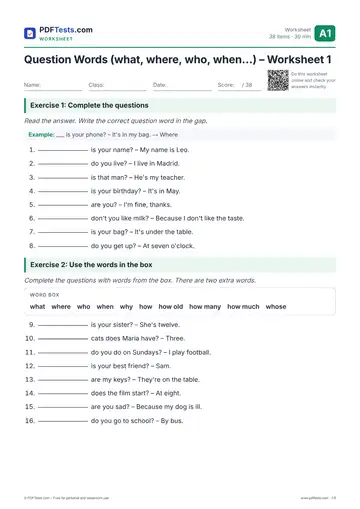
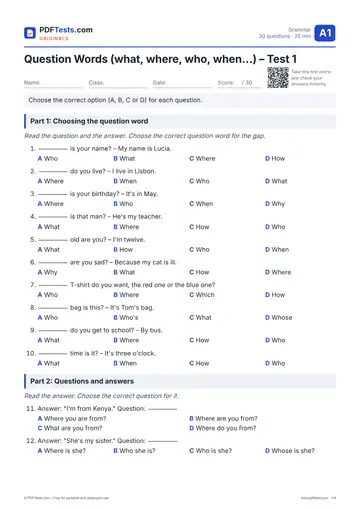
Question words (also called wh- words) go at the start of a question when you want information, not just yes or no. The main ones are what, where, when, who, why, how, which and whose. You use them every day to ask someone’s name, where they live, what time it is or how they are.
The main question words
| Question word | Asks about | Example | Possible answer |
|---|---|---|---|
| What | things, actions, information | What is your name? | Anna. |
| Where | places | Where do you live? | In Madrid. |
| When | time, days, dates | When is your birthday? | In May. |
| Who | people | Who is that man? | My teacher. |
| Why | reasons | Why are you tired? | Because I work at night. |
| How | the way something happens, how someone feels | How are you? | I’m fine, thanks. |
| Which | a choice from a small group | Which bag is yours? | The black one. |
| Whose | the owner of something | Whose phone is this? | It’s Tom’s. |
A wh- question asks for information, so the answer is never just yes or no.
How to use each question word
What
Use what for things, actions and general information.
- What is this?
- What do you do? (= What is your job?)
- What are you doing?
What often goes before a noun: what time, what colour, what day, what kind of.
- What time is it? – It’s half past three.
- What colour is your car? – It’s blue.
- What day is it today? – It’s Monday.
Where
Use where for places.
- Where is the bathroom? – It’s on the left.
- Where are you from? – I’m from Brazil.
- Where does your sister work? – In a hospital.
When
Use when for time: days, months, years, parts of the day.
- When is the meeting? – On Friday.
- When do you study? – In the evening.
Who
Use who for people.
- Who is your best friend? – Lucy.
- Who are those people? – My cousins.
- Who do you live with? – My parents.
Why
Use why to ask for a reason. The answer usually starts with because.
- Why are you happy? – Because it’s my birthday.
- Why do you study English? – Because I want a better job.
How
Use how to ask about the way something happens or how someone is.
- How are you? – Very well, thanks.
- How do you spell your name? – M-A-R-I-A.
- How do you get to work? – By bus.
How + another word makes very common questions:
| Phrase | Asks about | Example |
|---|---|---|
| How old | age | How old are you? – I’m 25. |
| How much | price, or amount with uncountable nouns | How much is this T-shirt? – It’s £12. |
| How many | number, with plural nouns | How many brothers do you have? – Two. |
| How often | frequency | How often do you go to the gym? – Twice a week. |
| How long | length of time | How long is the film? – Two hours. |
Which
Use which when there is a choice from a small, known group.
- Which is your bag, the red one or the blue one?
- Which bus goes to the station? – The number 12.
Whose
Use whose to ask who something belongs to.
- Whose keys are these? – They’re Maria’s.
- Whose is this coat? – It’s mine.
For the answers, you need possessive forms like my, your, Tom’s. See our guide to possessive adjectives and ’s.
Form: word order in wh- questions
Most wh- questions follow one pattern:
Question word + helping verb (am/is/are, do/does, can) + subject + rest of the question
The helping verb comes before the subject. This is the most important rule.
With the verb to be
Question word + am/is/are + subject
| Question word | be | Subject | Rest |
|---|---|---|---|
| Where | are | you | from? |
| What | is | your | name? |
| How old | is | your brother? | |
| Who | are | they? |
Statement: She is in the kitchen. → Question: Where is she?
In speaking, we often use short forms: What’s, Where’s, Who’s, How’s. For example: What’s your name? Where’s the station? If you need to review am, is, are, read our guide to the verb to be.
With other verbs in the present simple
Question word + do/does + subject + base verb
| Question word | do/does | Subject | Base verb | Rest |
|---|---|---|---|---|
| Where | do | you | live? | |
| What | does | she | eat | for breakfast? |
| When | do | they | finish | work? |
| How often | does | he | play | tennis? |
Use does with he, she, it. After does, the main verb has no -s: Where does he work? (not works). For more on do and does, see the Present Simple guide.
With can
Question word + can + subject + base verb
- What can you see?
- Where can I buy a ticket?
- How many languages can you speak?
You don’t use do with can. More examples are in our guide to can and can’t.
With the present continuous
Question word + am/is/are + subject + verb-ing
- What are you doing? – I’m cooking.
- Where is she going? – To the supermarket.
Prepositions go at the end
In everyday English, a preposition like from, with, at, about usually goes at the end of the question.
- Where are you from?
- Who do you work with?
- What are you looking at?
- What is the book about?
Who as the subject: no do or does
Sometimes who or what is the subject of the question. The answer is the person or thing that does the action. In this case, there is no do/does, and the verb takes -s like with he/she/it.
- Who lives here? – Sam lives here.
- Who wants coffee? – I do.
- What happens next?
Compare these two questions:
- Who do you love? – I love Jack. (you is the subject, so we use do)
- Who loves you? – Jack loves me. (who is the subject, so no do)
Questions learners often confuse
What or which?
Use what when there are many possible answers. Use which when the choice is from a small group you can see or name.
- What is your favourite film? (any film in the world)
- Which do you want, tea or coffee? (only two options)
Both can go before a noun: What music do you like? / Which bus do I take, the 12 or the 15?
Whose or who’s?
They sound the same (/huːz/), but they are different words.
- Whose = which person does it belong to: Whose bag is this?
- Who’s = who is: Who’s that girl?
When or what time?
What time asks for an exact time on the clock. When is more general.
- When do you have English? – On Tuesdays.
- What time? – At 6 pm.
How much or how many?
Use how many with plural nouns you can count (apples, people, brothers). Use how much with uncountable nouns (money, water, time) and for prices.
- How many apples do you need?
- How much water do you drink?
Pronunciation notes
- In what, where, when, why, which, the h is silent. They start with a /w/ sound: what /wɒt/, where /weə/, why /waɪ/.
- Who (/huː/) and whose (/huːz/) are different: they start with an /h/ sound, and the w is silent.
- In wh- questions, your voice usually goes down at the end: Where do you live? ↘. In yes/no questions, it often goes up: Do you live here? ↗.
Common mistakes
- ✗ Where you live? → ✓ Where do you live? — Present simple questions need do or does.
- ✗ What does she wants? → ✓ What does she want? — After does, use the base verb without -s.
- ✗ Where you are from? → ✓ Where are you from? — Put am/is/are before the subject.
- ✗ How old you have? → ✓ How old are you? — In English, we use be for age.
- ✗ How many money do you have? → ✓ How much money do you have? — Money is uncountable.
- ✗ Who’s car is this? → ✓ Whose car is this? — Who’s means who is; whose asks about the owner.
- ✗ Who does live here? → ✓ Who lives here? — When who is the subject, don’t use do/does.
- ✗ From where are you? → ✓ Where are you from? — In everyday English, the preposition goes at the end.
Quick check
- Complete: ___ is your birthday? – In July.
- Complete: ___ are you? – I’m 30.
- Correct the mistake: Where does your brother lives?
- Complete: ___ bag is this? – It’s Emma’s.
- Put the words in order: you / what / do / time / get up / ?
Answers
- When
- How old
- Where does your brother live?
- Whose
- What time do you get up?
Next step
Now practise with our A1 Question Words test. It checks the right question word, word order with be and do/does, and common mistakes like whose and who’s. When you finish, choose another topic from our English A1 tests to build your basic grammar step by step.
Was this page helpful?
What was the problem?
Thank you for your feedback!