Too and enough tell us if the amount or degree of something is right for a situation. Too means “more than we want or need” and usually describes a problem: This coffee is too hot to drink. Enough means “as much as we need”: She’s old enough to drive. Not enough means “less than we need.”
The quick rule
The most important thing to learn is word order. Too comes before adjectives, but enough comes after them.
| Word | Meaning | Position | Example |
|---|---|---|---|
| too | more than necessary | before an adjective or adverb | too expensive, too slowly |
| too much / too many | more than necessary | before a noun | too much noise, too many people |
| enough | the right amount | after an adjective or adverb | big enough, fast enough |
| enough | the right amount | before a noun | enough time, enough chairs |
| not … enough | less than necessary | negative verb + adjective + enough | It isn’t warm enough. |
Too
Too + adjective or adverb
Use too directly before an adjective or an adverb. It shows that something is a problem.
- This jacket is too small for me.
- You’re driving too fast. Slow down.
- It’s too late to call him now.
- I’m too tired to go out tonight.
In each sentence there is a negative result: I can’t wear the jacket, the driving is dangerous, I won’t call him, I’ll stay at home.
Too much and too many + noun
Before a noun, use too much or too many. The choice depends on the noun:
- too much + uncountable noun (sugar, money, noise, homework)
- too many + plural countable noun (cars, people, mistakes, emails)
Examples:
- There’s too much sugar in this tea.
- There are too many cars in the city centre.
- I spent too much money last weekend.
- I get too many emails at work.
If you are not sure which nouns are countable, see our guide to much, many, a lot of, a few and a little.
Verb + too much
Too much can also come after a verb, with no noun:
- You work too much. You need a holiday.
- He talks too much in class.
Much too and far too
To make too stronger, put much or far before it:
- The flat is much too expensive for us.
- We arrived far too early.
Do not put much after too before an adjective: too much expensive is wrong.
Too meaning “also”
Too has a second, different meaning: “also.” In this case it usually goes at the end of a sentence.
- I like jazz, and my sister likes it too.
- “I’m hungry.” “Me too.”
The context makes the meaning clear, but don’t confuse the two uses.
Enough
Adjective or adverb + enough
Put enough directly after an adjective or adverb.
- Is the room big enough for six people?
- He didn’t run fast enough to catch the bus.
- The water isn’t warm enough for swimming.
- Your English is good enough for this job.
Enough + noun
Put enough before a noun. It works with both plural countable nouns and uncountable nouns.
- We have enough chairs for everyone.
- Is there enough milk for breakfast?
- I didn’t have enough time to finish the test.
Verb + enough
Enough can come after a verb:
- I didn’t sleep enough last night.
- Are you eating enough?
Enough on its own
When the noun is clear, you can use enough alone:
- “Do you want more pasta?” “No, thanks. I’ve had enough.”
- That’s enough for today. Let’s stop.
Form: affirmative, negative and questions
| Too | Enough | |
|---|---|---|
| Affirmative | The bag is too heavy. | She’s tall enough. |
| Negative | The bag isn’t too heavy. | She isn’t tall enough. |
| Question | Is the bag too heavy? | Is she tall enough? |
Notice the meaning of the negatives:
- The bag isn’t too heavy = it’s OK, I can carry it. Not too is a polite or soft way to say something is acceptable: The test wasn’t too difficult.
- She isn’t tall enough = there is a problem; she needs to be taller.
Adding more information: to + verb and for + person
After too and enough we often explain the result. Use to + infinitive for an action and for + person or thing for who or what is affected.
| Structure | Example |
|---|---|
| too + adjective + to + verb | It’s too cold to swim. |
| too + adjective + for + person | These shoes are too small for me. |
| too + adjective + for + person + to + verb | This book is too difficult for children to read. |
| adjective + enough + to + verb | He’s old enough to vote. |
| enough + noun + for + person/thing | Is there enough cake for everyone? |
| enough + noun + to + verb | We have enough money to buy a car. |
Don’t repeat the object
When the subject of the sentence is also the thing the verb acts on, don’t add it or them at the end.
- The box is too heavy to carry. (not to carry it)
- This soup is too hot to eat.
- The questions were easy enough to answer.
The word box, soup and questions already tells us what we carry, eat or answer.
Too vs very
Learners often use too when they mean very. They are not the same.
- Very = a lot, but it isn’t necessarily a problem.
- Too = more than is good, so there is a problem.
Compare:
- The film was very long, but I enjoyed it.
- The film was too long. I fell asleep.
- This dress is very expensive. (a fact)
- This dress is too expensive. (I can’t or won’t buy it)
For positive things, use very: The weather is very nice today, not too nice.
Too vs not enough
You can often say the same idea in two ways: too + one adjective, or not + the opposite adjective + enough.
| With too | With not enough |
|---|---|
| The shelf is too high for me. | I’m not tall enough to reach the shelf. |
| It’s too cold to swim. | It isn’t warm enough to swim. |
| This room is too small for us. | This room isn’t big enough for us. |
| He’s too young to drive. | He isn’t old enough to drive. |
This is a common exercise in tests, so practise changing sentences from one form to the other.
Pronunciation and spelling
- enough is pronounced /ɪˈnʌf/. The letters gh sound like /f/, as in stuff. The stress is on the second syllable: e-NOUGH.
- too is pronounced /tuː/, like two. It is usually stressed in the sentence: It’s TOO expensive.
- Don’t confuse the spelling of too (more than necessary, also), to (preposition or infinitive) and two (the number 2): It’s too cold to go out with two children.
Common mistakes
✗ She isn’t enough old to drive. → ✓ She isn’t old enough to drive. Enough goes after adjectives.
✗ We don’t have money enough. → ✓ We don’t have enough money. Enough goes before nouns.
✗ There are too much people here. → ✓ There are too many people here. People is a plural countable noun, so use many.
✗ It’s too much expensive. → ✓ It’s too expensive. / It’s much too expensive. Use too alone before an adjective, or much too for emphasis.
✗ I’m to tired to study. → ✓ I’m too tired to study. The word meaning “more than necessary” is spelled with two o’s.
✗ The weather is too beautiful today. → ✓ The weather is very beautiful today. Too shows a problem; use very for something positive.
✗ This tea is too hot to drink it. → ✓ This tea is too hot to drink. Don’t repeat the object when it is already the subject.
✗ He’s too young for drive. → ✓ He’s too young to drive. Use to + verb for an action and for + person or noun.
Quick check
- I can’t buy this phone. It’s ___ expensive. (too / enough)
- Put the words in order: Is your brother / enough / old / to drive?
- There are too ___ tourists in the old town in summer. (much / many)
- We don’t have ___ to make a cake. (enough eggs / eggs enough)
- Correct the mistake: The bag is too heavy to carry it.
Answers
- too – It’s too expensive.
- Is your brother old enough to drive?
- many – tourists is a plural countable noun.
- enough eggs – enough comes before nouns.
- The bag is too heavy to carry. – Don’t repeat the object.
Next step
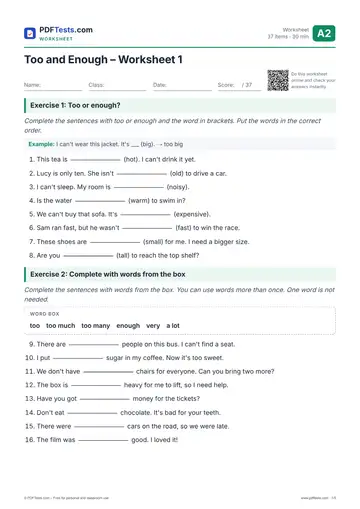
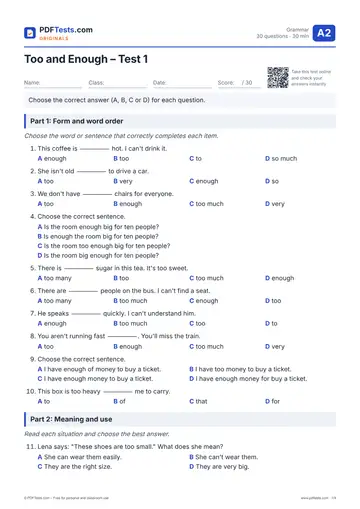
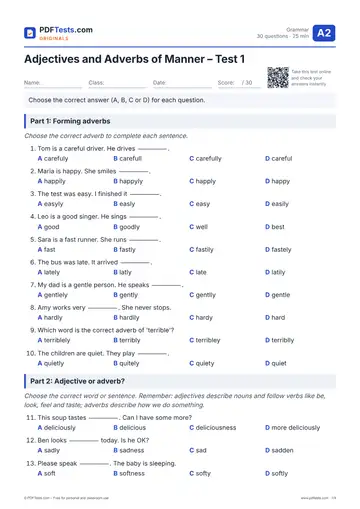
Now put the rules into practice: test yourself with our A2 Too and Enough test, and pay special attention to word order and to too much vs too many. If you want to describe actions with too and enough (too slowly, carefully enough), review our guide to adjectives and adverbs of manner. When you feel confident, move on to the B1 guide on so, such, too and enough and try the B1 So, Such, Too and Enough test to see how these words work together in more complex sentences.
Was this page helpful?
What was the problem?
Thank you for your feedback!