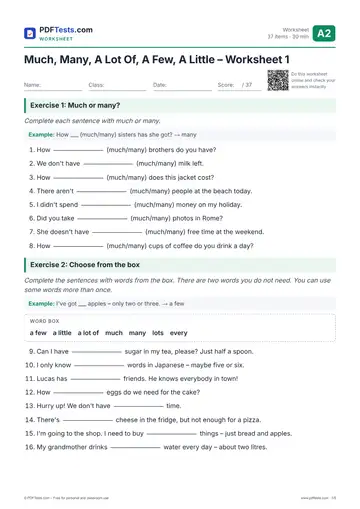
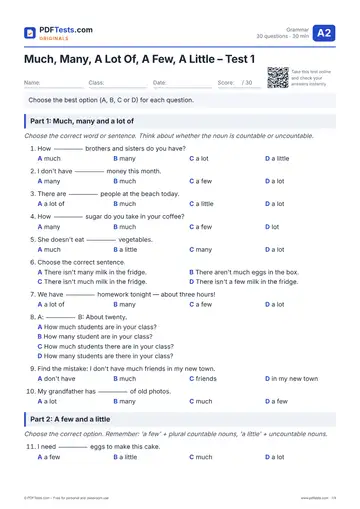
Much, many, a lot of, a few and a little are quantifiers. They tell us how much or how many of something there is. The right choice depends on two things: whether the noun is countable or uncountable, and whether the sentence is positive, negative or a question.
Step one: countable or uncountable?
Before you choose a quantifier, look at the noun.
Countable nouns are things you can count: one apple, two apples, three apples. They have a plural form.
Uncountable nouns are things you can’t count one by one, such as liquids, materials and ideas. They have no plural form, and they take a singular verb (is, was, has).
| Countable (plural) | Uncountable |
|---|---|
| apples, eggs, sandwiches | water, milk, bread |
| people, friends, children | money, time, music |
| chairs, tables | furniture |
| jobs, hours | work, homework |
| tips, facts | advice, information, news |
Be careful with nouns like information, advice, news, furniture, luggage and homework. They are uncountable in English, even if they are countable in your language. You can’t say an advice or informations.
For a full explanation, see our guide to some and any, countable and uncountable nouns. If you need help with plural spellings like boxes or children, read the plural nouns guide.
Overview: which word goes with which noun
| Quantifier | Countable nouns | Uncountable nouns | Typical use |
|---|---|---|---|
| many | ✓ | ✗ | questions and negatives |
| much | ✗ | ✓ | questions and negatives |
| a lot of / lots of | ✓ | ✓ | all sentences, especially positive |
| a few | ✓ | ✗ | a small number (positive idea) |
| a little | ✗ | ✓ | a small amount (positive idea) |
Many and much
Many + plural countable nouns
Use many with plural nouns.
- There aren’t many shops in my village.
- Do you have many friends at your new school?
- How many people are coming to the party?
Much + uncountable nouns
Use much with uncountable nouns.
- I don’t have much money this month.
- Is there much traffic in the city centre?
- How much sugar do you want in your tea?
Where we use much and many
In everyday English, much and many are most common in negative sentences and questions. In positive sentences, we usually say a lot of.
| Countable | Uncountable | |
|---|---|---|
| Affirmative (+) | I have a lot of friends. | I have a lot of free time. |
| Negative (−) | I don’t have many friends. | I don’t have much free time. |
| Question (?) | Do you have many friends? | Do you have much free time? |
I have much free time is not natural in conversation. It sounds old-fashioned or very formal.
Many in positive sentences is a little more common, especially in writing: Many people work from home now. But in speaking, a lot of people is more usual.
How much? and How many?
These are very common question patterns.
- How many + plural noun: How many brothers and sisters have you got?
- How much + uncountable noun: How much water do you drink every day?
We also use How much to ask about prices. You don’t need a noun after it:
- How much is this jacket?
- How much are the tickets?
- How much does it cost?
A lot of and lots of
A lot of and lots of work with both countable and uncountable nouns, in all types of sentences. That makes them very useful.
- There are a lot of tourists in Rome in summer.
- She drinks a lot of coffee.
- We don’t have a lot of time, so let’s be quick.
- Did you take lots of photos on holiday?
Lots of means the same as a lot of, but it is a little more informal.
Verb agreement
The verb agrees with the noun, not with a lot.
- A lot of people are waiting outside. (people = plural)
- A lot of water is on the floor. (water = uncountable)
A lot without a noun
When there is no noun after it, drop of and just say a lot.
- She travels a lot for work.
- I like this song a lot.
- Thanks a lot.
- Have we got any rice? – Yes, a lot.
A few and a little
A few and a little mean a small number or a small amount. They have a positive meaning: some, not many, but enough.
| Quantifier | Noun type | Examples |
|---|---|---|
| a few | plural countable | a few minutes, a few friends, a few questions |
| a little | uncountable | a little sugar, a little time, a little help |
- Can I ask you a few questions?
- I’m going to the shop. I need a few eggs.
- Could I have a little milk in my coffee, please?
- I speak a little Spanish.
A little can also go before an adjective, meaning slightly: I’m a little tired today.
In informal English, a bit of is a common alternative to a little: Can I have a bit of cake?
A few vs few, a little vs little
Without a, the meaning changes. Few and little have a negative meaning: not many / not much, not enough.
| Form | Meaning | Example |
|---|---|---|
| a few / a little | some, enough (positive) | I have a few friends here, so I’m happy. |
| few / little | not enough (negative) | I have few friends here, so I’m often lonely. |
| a little | some (positive) | There’s a little time. Let’s have a coffee. |
| little | almost none (negative) | There’s little time. We must hurry. |
Few and little alone can sound formal. In everyday speech, people often say not many, not much, very few or very little instead: There’s very little time.
Too much, too many, not much, not many
You can put too before much and many to say more than we want:
- There are too many cars in the city.
- I ate too much pizza.
The same countable/uncountable rule applies. Learn more in our guide to too and enough.
In short answers, not much, not many and a lot are very natural:
- How much homework have you got? – Not much.
- How many people were at the concert? – A lot.
- Do you eat much meat? – Not really, not much.
Signal words and patterns
These patterns help you choose quickly:
- How many…? → plural noun follows
- How much…? → uncountable noun follows, or a price question
- don’t / doesn’t / isn’t / aren’t + … → much or many is natural
- There is / There are + … → There is a lot of / a little, There are a lot of / a few
- at the end of a sentence, no noun → a lot
Common mistakes
✗ How many money do you have? → ✓ How much money do you have? Money is uncountable, so use much.
✗ How much people live here? → ✓ How many people live here? People is a plural countable noun.
✗ I have much friends. → ✓ I have a lot of friends. Much never goes with plural nouns, and in positive sentences a lot of is more natural.
✗ I have much time today. → ✓ I have a lot of time today. Much in positive sentences sounds formal or unnatural in conversation.
✗ There are a lot of informations. → ✓ There is a lot of information. Information is uncountable: no plural and a singular verb.
✗ She drinks a lot of. → ✓ She drinks a lot. Drop of when no noun follows.
✗ I’ve got a lots of homework. → ✓ I’ve got a lot of / lots of homework. Say a lot of or lots of, never a lots of.
✗ A lot of people is here. → ✓ A lot of people are here. The verb agrees with the noun, and people is plural.
✗ Can I have a few milk? → ✓ Can I have a little milk? Milk is uncountable, so use a little.
✗ I have a little questions. → ✓ I have a few questions. Questions is a plural countable noun, so use a few.
Quick check
Choose the correct word.
- How ___ eggs do we need for the cake? (much / many)
- I don’t have ___ time this morning. (much / many)
- Can you wait ___ minutes, please? (a few / a little)
- I’d like ___ milk in my coffee. (a few / a little)
- There ___ a lot of traffic on the roads today. (is / are)
Answers
- many – eggs is plural countable.
- much – time is uncountable, in a negative sentence.
- a few – minutes is plural countable.
- a little – milk is uncountable.
- is – traffic is uncountable, so the verb is singular.
Next step
Now put the rules into practice with our A2 Much, Many, A Lot Of, A Few, A Little test. While you do it, ask yourself two questions for every gap: is the noun countable or uncountable, and is the sentence positive, negative or a question? Food and drink words are a great way to practise this, because many of them are uncountable, so try the Food and Drink vocabulary test too and check which nouns take much and which take many.
Was this page helpful?
What was the problem?
Thank you for your feedback!