PDFTests Originals

Phrasal verbs courants – Fiche 1

B1 Intermédiaire FicheAnglais

Cette fiche permet de s'entraîner sur des phrasal verbs courants du quotidien comme give up, look after, find out et run out of. Les élèves associent les verbes à leur sens, choisissent la bonne particule, emploient le temps qui convient, forment des noms comme breakdown et workout, et corrigent des erreurs fréquentes. Elle s'adresse aux apprenants de niveau B1, en classe ou à la maison.
items
39
Durée
35 min
PDF
5 pages
Corrigé
Inclus
  • 100 % gratuit
  • Sans inscription
  • PDF A4 prêt à imprimer
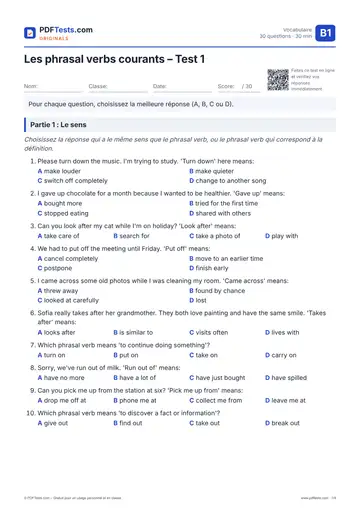
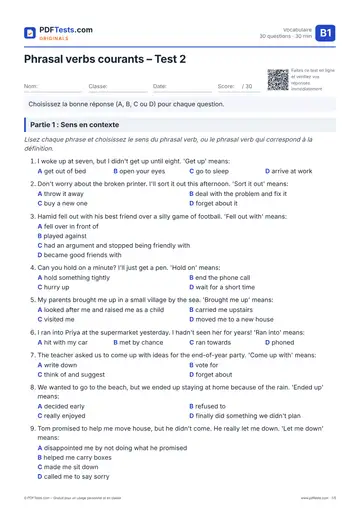
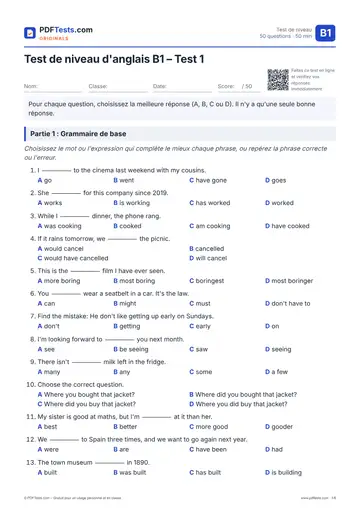
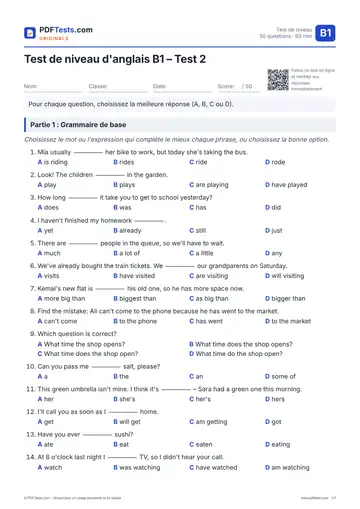
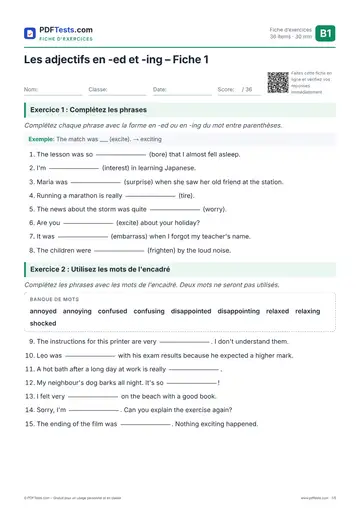
Aperçu de la page 1 : Phrasal verbs courants – Fiche 1 Ouvrir le PDF

Faire la fiche en ligne

Tapez vos réponses puis cliquez sur « Vérifier mes réponses ». Les autres réponses correctes sont acceptées.

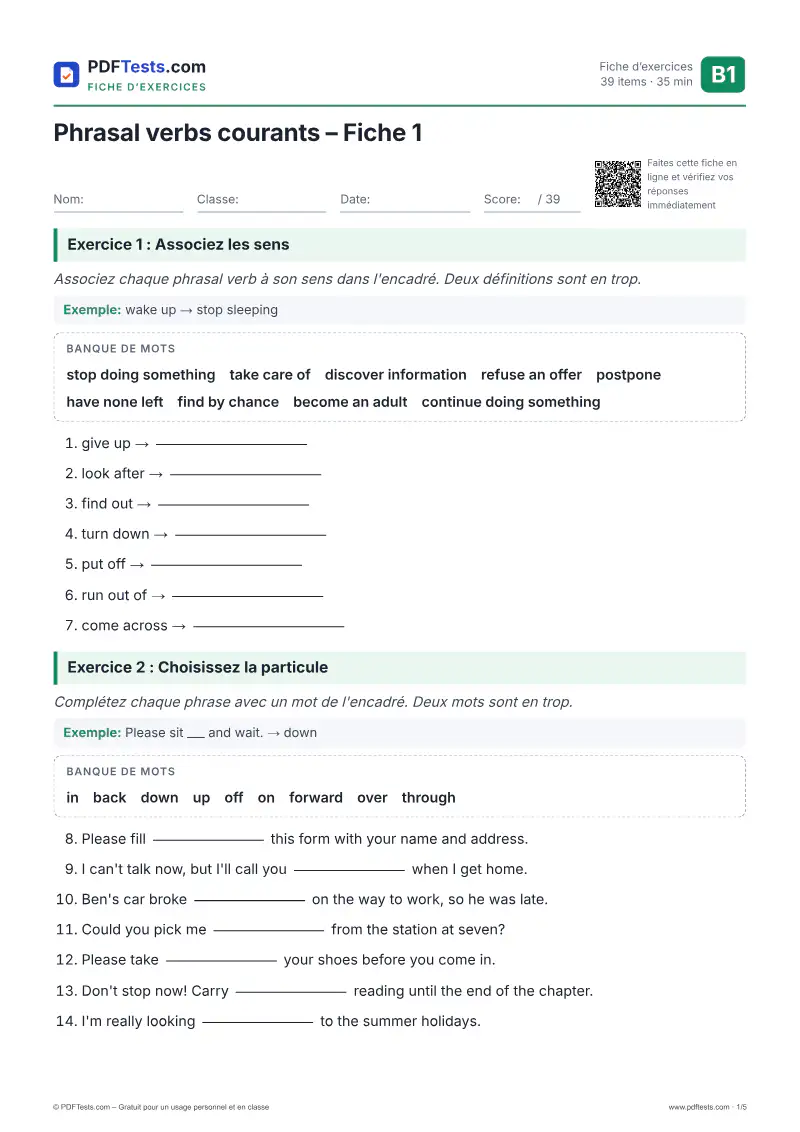
Exercice 1 : Associez les sens

Associez chaque phrasal verb à son sens dans l'encadré. Deux définitions sont en trop.

Exemple: wake up → stop sleeping

Banque de mots stop doing somethingtake care ofdiscover informationrefuse an offerpostponehave none leftfind by chancebecome an adultcontinue doing something

  1. give up

  2. look after

  3. find out

  4. turn down

  5. put off

  6. run out of

  7. come across

Exercice 2 : Choisissez la particule

Complétez chaque phrase avec un mot de l'encadré. Deux mots sont en trop.

Exemple: Please sit ___ and wait. → down

Banque de mots inbackdownupoffonforwardoverthrough

  1. Please fill this form with your name and address.

  2. I can't talk now, but I'll call you when I get home.

  3. Ben's car broke on the way to work, so he was late.

  4. Could you pick me from the station at seven?

  5. Please take your shoes before you come in.

  6. Don't stop now! Carry reading until the end of the chapter.

  7. I'm really looking to the summer holidays.

Exercice 3 : Employez la forme correcte

Complétez chaque phrase avec le phrasal verb entre parenthèses à la forme qui convient.

Exemple: I usually ___ (wake up) at seven. → wake up

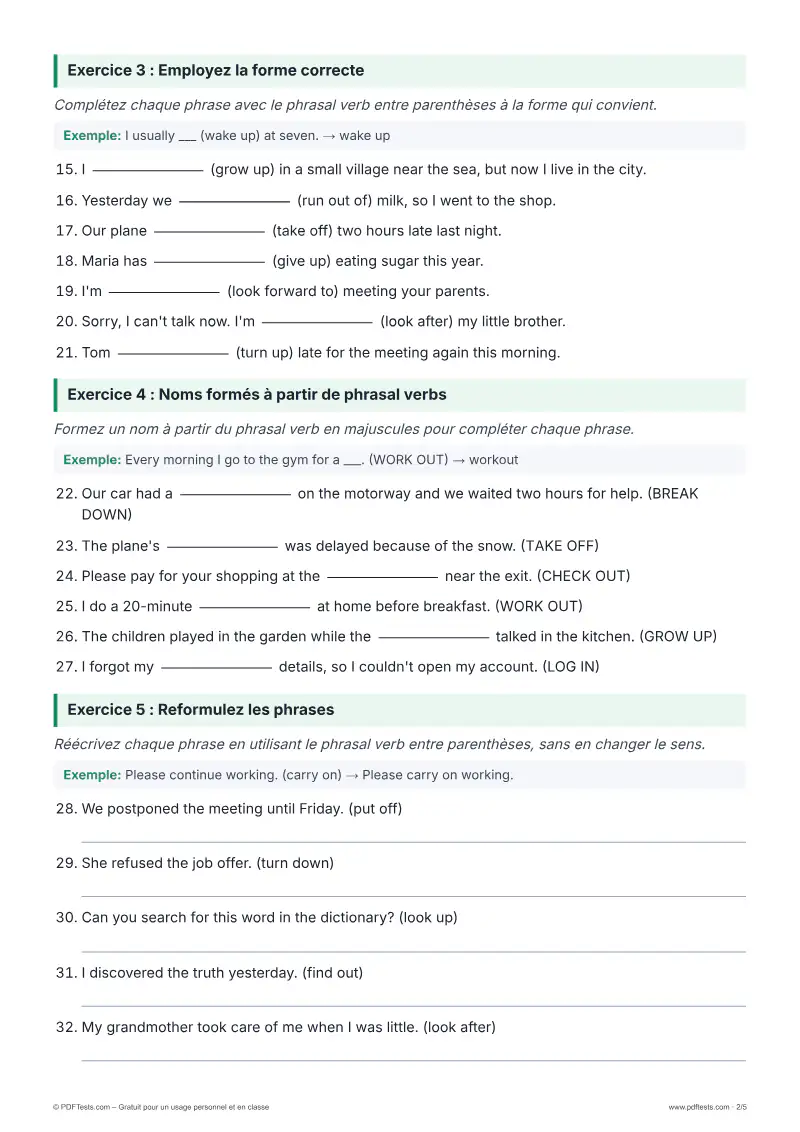
  1. I (grow up) in a small village near the sea, but now I live in the city.

  2. Yesterday we (run out of) milk, so I went to the shop.

  3. Our plane (take off) two hours late last night.

  4. Maria has (give up) eating sugar this year.

  5. I'm (look forward to) meeting your parents.

  6. Sorry, I can't talk now. I'm (look after) my little brother.

  7. Tom (turn up) late for the meeting again this morning.

Exercice 4 : Noms formés à partir de phrasal verbs

Formez un nom à partir du phrasal verb en majuscules pour compléter chaque phrase.

Exemple: Every morning I go to the gym for a ___. (WORK OUT) → workout

  1. Our car had a on the motorway and we waited two hours for help. (BREAK DOWN)

  2. The plane's was delayed because of the snow. (TAKE OFF)

  3. Please pay for your shopping at the near the exit. (CHECK OUT)

  4. I do a 20-minute at home before breakfast. (WORK OUT)

  5. The children played in the garden while the talked in the kitchen. (GROW UP)

  6. I forgot my details, so I couldn't open my account. (LOG IN)

Exercice 5 : Reformulez les phrases

Réécrivez chaque phrase en utilisant le phrasal verb entre parenthèses, sans en changer le sens.

Exemple: Please continue working. (carry on) → Please carry on working.

  1. We postponed the meeting until Friday. (put off)

  2. She refused the job offer. (turn down)

  3. Can you search for this word in the dictionary? (look up)

  4. I discovered the truth yesterday. (find out)

  5. My grandmother took care of me when I was little. (look after)

  6. I stopped smoking last year. (give up)

Exercice 6 : Corrigez les erreurs

Chaque phrase contient une erreur. Écrivez la phrase correcte.

Exemple: I wake on at six every day. → I wake up at six every day.

  1. Nobody is watching the TV. Can you turn off it, please?

  2. I'm looking forward to see you next week.

  3. We have run out coffee, so I'll buy some later.

  4. She gets on well to her colleagues.

  5. He woke out at six o'clock this morning.

  6. I looked after the word in the dictionary.

Cette page vous a-t-elle été utile ?

Signaler une erreur

Une mauvaise réponse, une faute de frappe ou une explication peu claire ? Dites-le-nous, nous corrigerons.

Aperçu

À propos de ce test

Fiche d'exercices d'anglais B1 en PDF sur les phrasal verbs courants : sens, particules, temps, noms dérivés, correction d'erreurs. Avec corrigé.

Thèmes abordés

Phrasal verbsSens en contexteParticulesPlace du complément d'objetNoms formés à partir de phrasal verbs

Notes pour l’enseignant

Commencez par l'exercice 1 pour vérifier que le sens des verbes est compris avant de les faire employer en contexte. Erreurs fréquentes : placer le pronom après la particule (turn off it au lieu de turn it off), employer l'infinitif après look forward to, et oublier la préposition dans les verbes à trois éléments comme run out of et get on with. En prolongement, demandez aux élèves d'écrire cinq phrases vraies sur leur semaine en utilisant des phrasal verbs de la fiche.

Tous les tests Anglais B1 →