PDFTests Originals

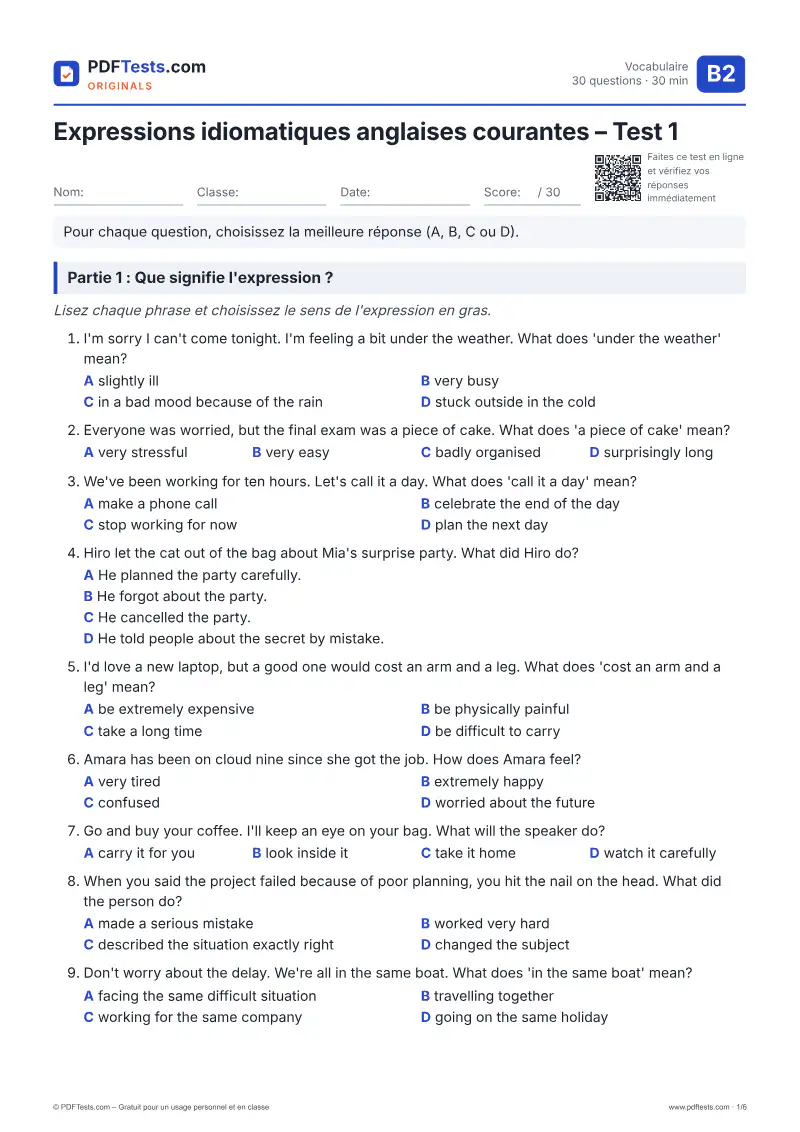
Expressions idiomatiques anglaises courantes – Test 1

B2 Intermédiaire avancé VocabulaireAnglais

Ce test de vocabulaire de niveau B2 évalue votre connaissance des expressions idiomatiques anglaises les plus courantes, utilisées dans la conversation de tous les jours comme au travail. Il porte sur le sens des expressions, la complétion d'expressions figées, leur emploi correct en contexte et leur compréhension dans un court texte. Il s'adresse aux apprenants de niveau intermédiaire avancé ainsi qu'aux enseignants à la recherche d'un test d'entraînement ou de révision prêt à l'emploi.
Questions
30
Durée
30 min
PDF
6 pages
Corrigé
Inclus
  • 100 % gratuit
  • Sans inscription
  • PDF A4 prêt à imprimer
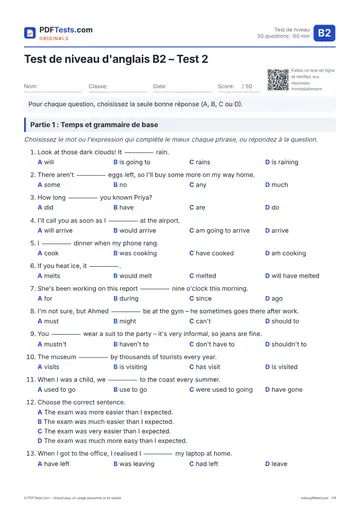
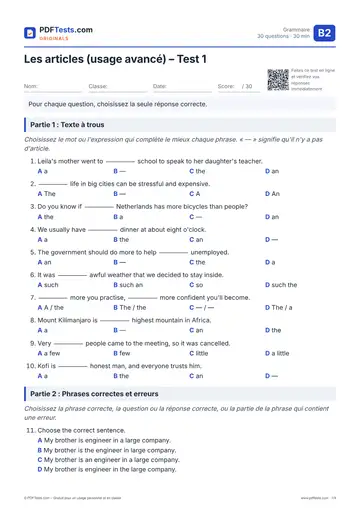
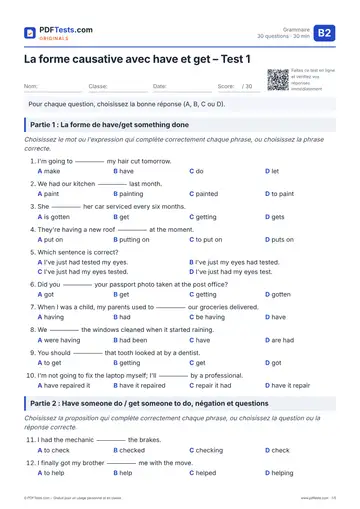
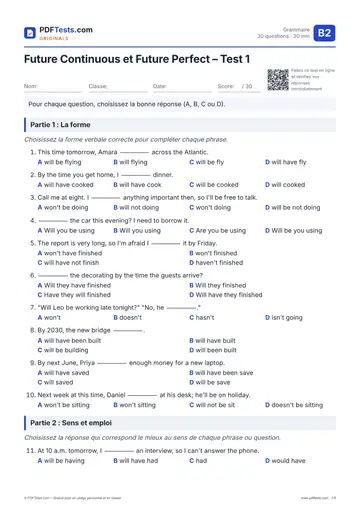
Aperçu de la page 1 : Expressions idiomatiques anglaises courantes – Test 1 Ouvrir le PDF

Faire le test en ligne

Pour chaque question, choisissez la meilleure réponse (A, B, C ou D). Choisissez vos réponses, puis cliquez sur « Vérifier mes réponses ».

Partie 1 : Que signifie l'expression ?

Lisez chaque phrase et choisissez le sens de l'expression en gras.

  1. I'm sorry I can't come tonight. I'm feeling a bit under the weather. What does 'under the weather' mean?

  2. Everyone was worried, but the final exam was a piece of cake. What does 'a piece of cake' mean?

  3. We've been working for ten hours. Let's call it a day. What does 'call it a day' mean?

  4. Hiro let the cat out of the bag about Mia's surprise party. What did Hiro do?

  5. I'd love a new laptop, but a good one would cost an arm and a leg. What does 'cost an arm and a leg' mean?

  6. Amara has been on cloud nine since she got the job. How does Amara feel?

  7. Go and buy your coffee. I'll keep an eye on your bag. What will the speaker do?

  8. When you said the project failed because of poor planning, you hit the nail on the head. What did the person do?

  9. Don't worry about the delay. We're all in the same boat. What does 'in the same boat' mean?

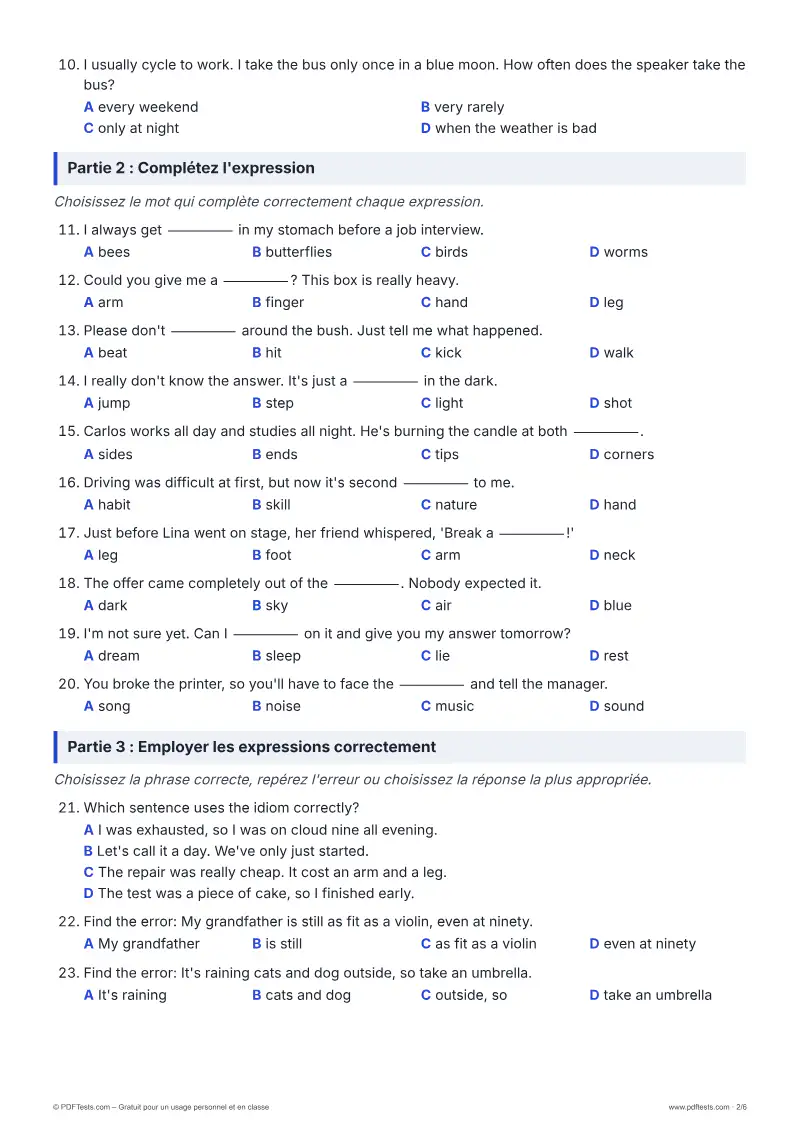
  10. I usually cycle to work. I take the bus only once in a blue moon. How often does the speaker take the bus?

Partie 2 : Complétez l'expression

Choisissez le mot qui complète correctement chaque expression.

  1. I always get _____ in my stomach before a job interview.

  2. Could you give me a _____? This box is really heavy.

  3. Please don't _____ around the bush. Just tell me what happened.

  4. I really don't know the answer. It's just a _____ in the dark.

  5. Carlos works all day and studies all night. He's burning the candle at both _____.

  6. Driving was difficult at first, but now it's second _____ to me.

  7. Just before Lina went on stage, her friend whispered, 'Break a _____!'

  8. The offer came completely out of the _____. Nobody expected it.

  9. I'm not sure yet. Can I _____ on it and give you my answer tomorrow?

  10. You broke the printer, so you'll have to face the _____ and tell the manager.

Partie 3 : Employer les expressions correctement

Choisissez la phrase correcte, repérez l'erreur ou choisissez la réponse la plus appropriée.

  1. Which sentence uses the idiom correctly?

  2. Find the error: My grandfather is still as fit as a violin, even at ninety.

  3. Find the error: It's raining cats and dog outside, so take an umbrella.

  4. A: I finally passed my driving test! B: _____

  5. A: I failed my chemistry test and I can't stop thinking about it. B: _____

Partie 4 : Les expressions dans un texte

Lisez le texte et choisissez le sens le plus juste de chaque expression telle qu'elle est employée dans le texte.

When Priya moved to a new city for her first full-time job, she felt like a fish out of water. Everything was unfamiliar: the streets, the office, even the way people spoke in meetings. Her manager, Tomás, told her to relax. 'It takes everyone a few weeks to learn the ropes,' he said. 'Ask as many questions as you like.'

During her second month, Priya offered to organise a large conference on her own. Although she was enthusiastic, she soon realised she had bitten off more than she could chew. She was working late every night and still falling behind. Just before the event, she almost got cold feet and considered asking Tomás to give the project to someone else.

Instead, she asked two colleagues for help. Working as a team, they made sure everyone was on the same page, and the conference went off without a hitch. Looking back, Priya thinks her difficult start was a blessing in disguise. 'I learned that asking for help isn't a weakness,' she says. 'Now, when a new colleague joins, I'm the first to offer support.'

  1. Tomás says it takes everyone a few weeks to 'learn the ropes'. This means to _____.

  2. Priya realised she had 'bitten off more than she could chew'. This means _____.

  3. Before the event, Priya 'almost got cold feet'. This means she _____.

  4. The conference 'went off without a hitch'. This means it happened _____.

  5. Priya thinks her difficult start was 'a blessing in disguise'. This means it was _____.

Aperçu

À propos de ce test

Ce test de vocabulaire de niveau B2 évalue votre connaissance des expressions idiomatiques anglaises les plus courantes, utilisées dans la conversation de tous les jours comme au travail. Il porte sur le sens des expressions, la complétion d'expressions figées, leur emploi correct en contexte et leur compréhension dans un court texte. Il s'adresse aux apprenants de niveau intermédiaire avancé ainsi qu'aux enseignants à la recherche d'un test d'entraînement ou de révision prêt à l'emploi.

Thèmes abordés

Expressions idiomatiquesSens des expressions en contexteExpressions figéesConversation couranteExpressions du monde professionnelCompréhension écrite

Comment utiliser ce test

  1. Téléchargez le PDF et imprimez-le, ou faites le test en ligne ci-dessous.
  2. Répondez à toutes les questions sans dictionnaire et sans vous presser.
  3. Vérifiez vos réponses et notez les points à revoir.

Notes pour l’enseignant

Utilisez ce test à la fin d'une séquence sur la langue idiomatique ou comme test diagnostique pour des groupes de niveau intermédiaire avancé. Il cible les erreurs typiques des apprenants : prendre les expressions au pied de la lettre, modifier les mots d'une expression figée (par exemple « cats and dog » ou « fish out of the water ») et employer une expression dans une situation inadaptée. En prolongement, demandez aux élèves de rédiger un court dialogue ou une petite histoire utilisant correctement cinq expressions du test.