PDFTests Originals

Verbes à particule (Phrasal Verbs) B2 – Test 1

B2 Intermédiaire avancé VocabulaireAnglais

Ce test de vocabulaire de niveau B2 évalue votre capacité à comprendre et à employer les verbes à particule (phrasal verbs) les plus courants en anglais. Il porte sur le sens en contexte, le choix du bon phrasal verb, les particules, la place du complément d'objet et les noms formés à partir de phrasal verbs. Il s'adresse aux apprenants de niveau intermédiaire avancé, aux candidats aux examens et aux enseignants à la recherche d'un quiz prêt à l'emploi pour la classe.
Questions
30
Durée
30 min
PDF
4 pages
Corrigé
Inclus
  • 100 % gratuit
  • Sans inscription
  • PDF A4 prêt à imprimer
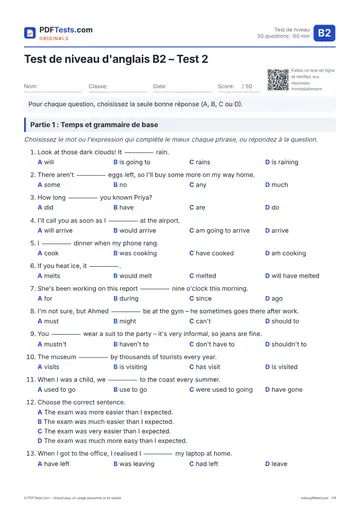
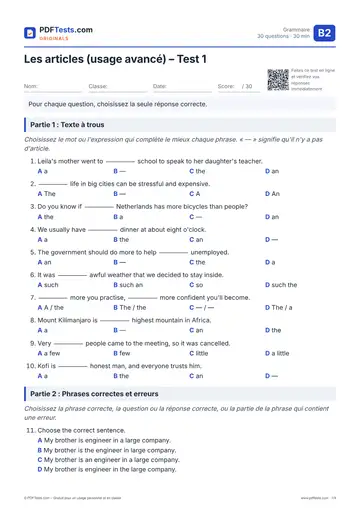
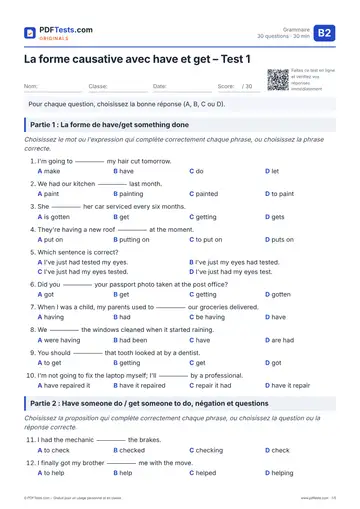
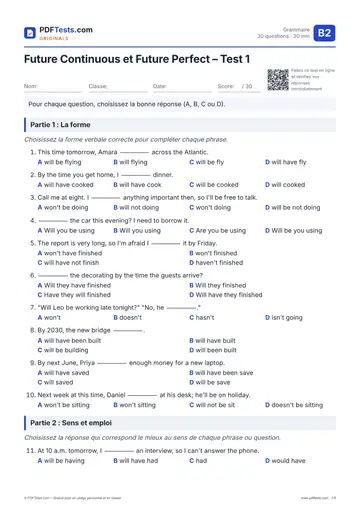
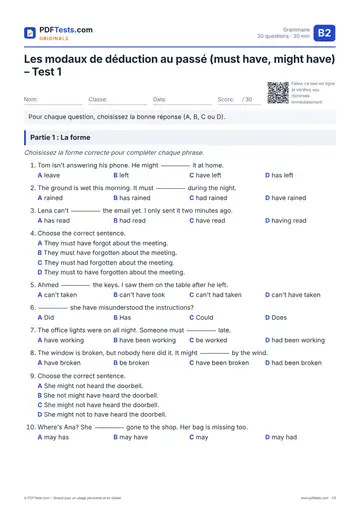
Aperçu de la page 1 : Verbes à particule (Phrasal Verbs) B2 – Test 1 Ouvrir le PDF

Faire le test en ligne

Pour chaque question, choisissez la meilleure réponse (A, B, C ou D). Choisissez vos réponses, puis cliquez sur « Vérifier mes réponses ».

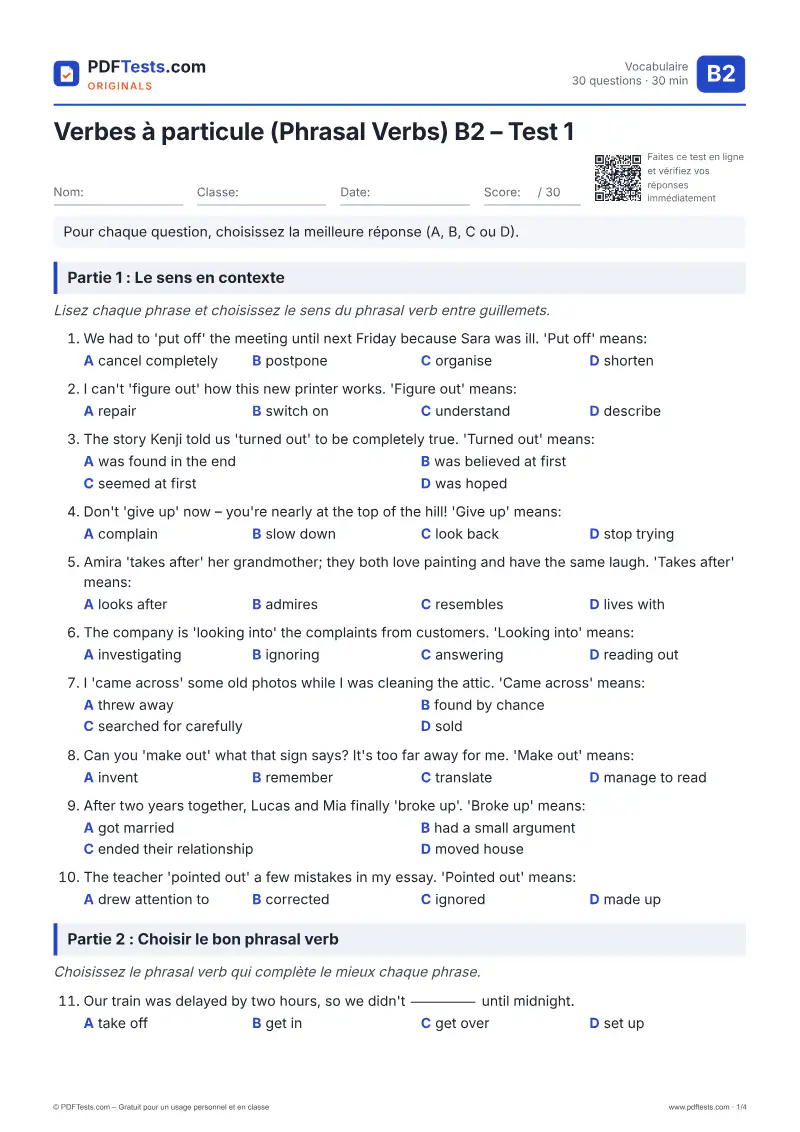
Partie 1 : Le sens en contexte

Lisez chaque phrase et choisissez le sens du phrasal verb entre guillemets.

  1. We had to 'put off' the meeting until next Friday because Sara was ill. 'Put off' means:

  2. I can't 'figure out' how this new printer works. 'Figure out' means:

  3. The story Kenji told us 'turned out' to be completely true. 'Turned out' means:

  4. Don't 'give up' now – you're nearly at the top of the hill! 'Give up' means:

  5. Amira 'takes after' her grandmother; they both love painting and have the same laugh. 'Takes after' means:

  6. The company is 'looking into' the complaints from customers. 'Looking into' means:

  7. I 'came across' some old photos while I was cleaning the attic. 'Came across' means:

  8. Can you 'make out' what that sign says? It's too far away for me. 'Make out' means:

  9. After two years together, Lucas and Mia finally 'broke up'. 'Broke up' means:

  10. The teacher 'pointed out' a few mistakes in my essay. 'Pointed out' means:

Partie 2 : Choisir le bon phrasal verb

Choisissez le phrasal verb qui complète le mieux chaque phrase.

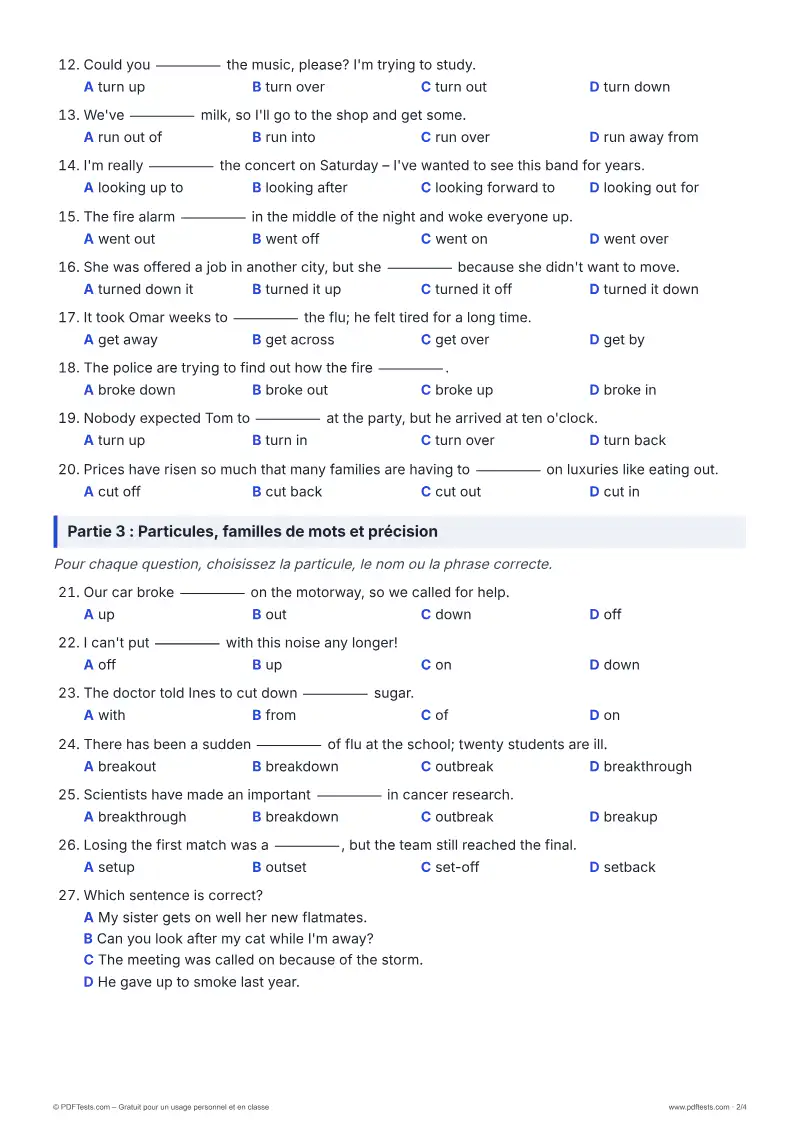
  1. Our train was delayed by two hours, so we didn't _____ until midnight.

  2. Could you _____ the music, please? I'm trying to study.

  3. We've _____ milk, so I'll go to the shop and get some.

  4. I'm really _____ the concert on Saturday – I've wanted to see this band for years.

  5. The fire alarm _____ in the middle of the night and woke everyone up.

  6. She was offered a job in another city, but she _____ because she didn't want to move.

  7. It took Omar weeks to _____ the flu; he felt tired for a long time.

  8. The police are trying to find out how the fire _____.

  9. Nobody expected Tom to _____ at the party, but he arrived at ten o'clock.

  10. Prices have risen so much that many families are having to _____ on luxuries like eating out.

Partie 3 : Particules, familles de mots et précision

Pour chaque question, choisissez la particule, le nom ou la phrase correcte.

  1. Our car broke _____ on the motorway, so we called for help.

  2. I can't put _____ with this noise any longer!

  3. The doctor told Ines to cut down _____ sugar.

  4. There has been a sudden _____ of flu at the school; twenty students are ill.

  5. Scientists have made an important _____ in cancer research.

  6. Losing the first match was a _____, but the team still reached the final.

  7. Which sentence is correct?

  8. Which sentence contains a mistake?

  9. The new manager wants to _____ a few changes in the way we work.

  10. A: Are you still going to the gym every day? B: No, I _____ last month. I just didn't have time.

Aperçu

À propos de ce test

Ce test de vocabulaire de niveau B2 évalue votre capacité à comprendre et à employer les verbes à particule (phrasal verbs) les plus courants en anglais. Il porte sur le sens en contexte, le choix du bon phrasal verb, les particules, la place du complément d'objet et les noms formés à partir de phrasal verbs. Il s'adresse aux apprenants de niveau intermédiaire avancé, aux candidats aux examens et aux enseignants à la recherche d'un quiz prêt à l'emploi pour la classe.

Thèmes abordés

Verbes à particule (phrasal verbs)Sens en contexteParticules et prépositionsPhrasal verbs séparablesNoms formés à partir de phrasal verbsCorrection d'erreurs

Comment utiliser ce test

  1. Téléchargez le PDF et imprimez-le, ou faites le test en ligne ci-dessous.
  2. Répondez à toutes les questions sans dictionnaire et sans vous presser.
  3. Vérifiez vos réponses et notez les points à revoir.

Notes pour l’enseignant

Utilisez la partie 1 comme échauffement sur le sens, puis les parties 2 et 3 pour vérifier l'emploi actif. Le test cible les erreurs typiques du niveau B2 : la confusion entre phrasal verbs construits sur le même verbe (turn up/turn down, break out/break down), l'oubli de la préposition finale (cut down on, put up with) et la place du pronom après la particule avec les verbes séparables (*turn down it). En prolongement, demandez aux élèves de rédiger leurs propres phrases avec cinq verbes sur lesquels ils se sont trompés, ou de regrouper les verbes par particule.