PDFTests Originals

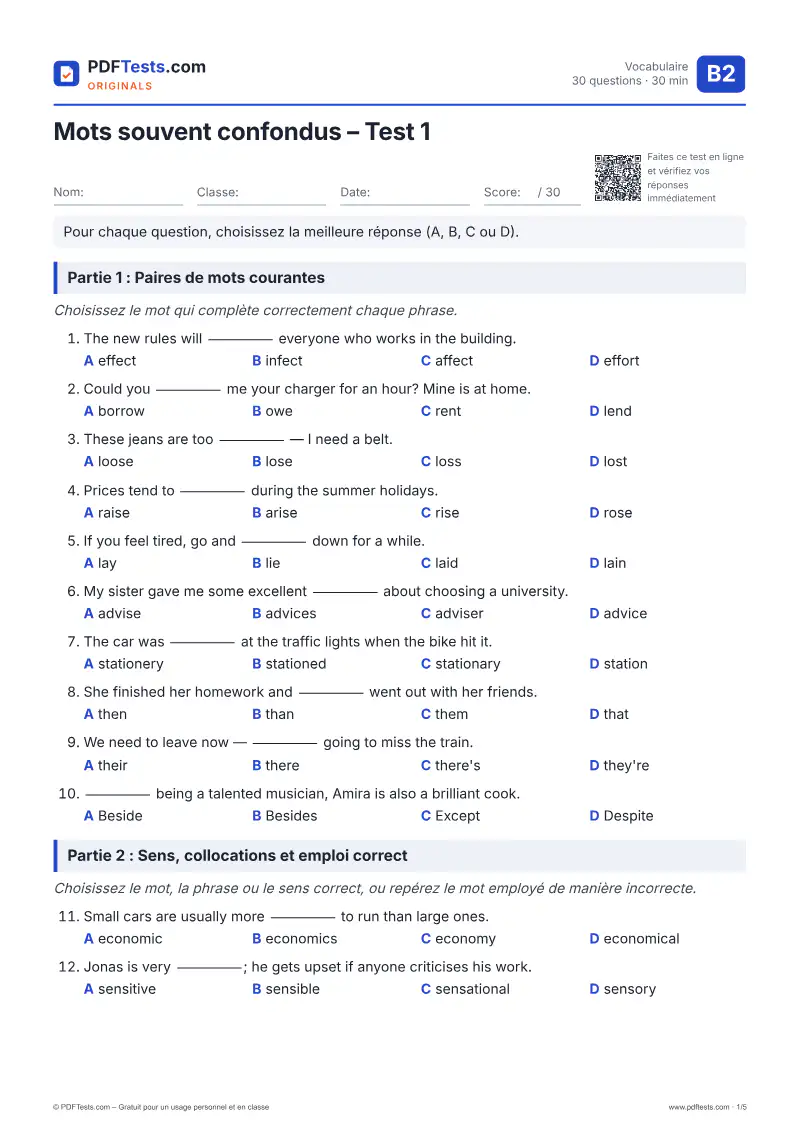
Mots souvent confondus – Test 1

B2 Intermédiaire avancé VocabulaireAnglais

Ce test de vocabulaire anglais de niveau B2 vérifie votre capacité à distinguer des mots que les apprenants confondent souvent, comme affect et effect, lend et borrow, economic et economical, ou encore historic et historical. Il porte sur le sens, les collocations, le choix du mot en contexte et les familles de mots. Il s'adresse aux apprenants de niveau intermédiaire avancé ainsi qu'aux enseignants qui préparent leurs élèves aux examens de niveau B2.
Questions
30
Durée
30 min
PDF
5 pages
Corrigé
Inclus
  • 100 % gratuit
  • Sans inscription
  • PDF A4 prêt à imprimer
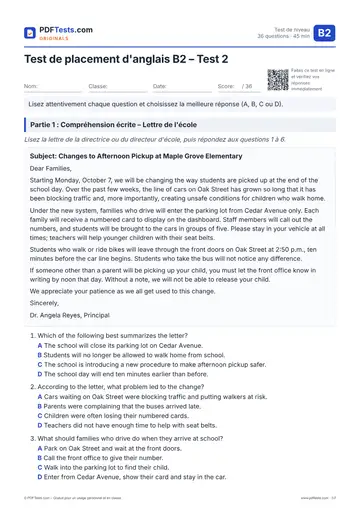
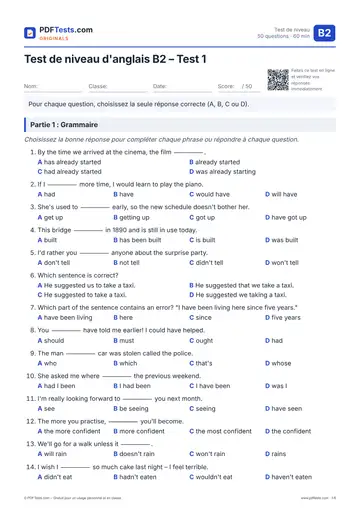
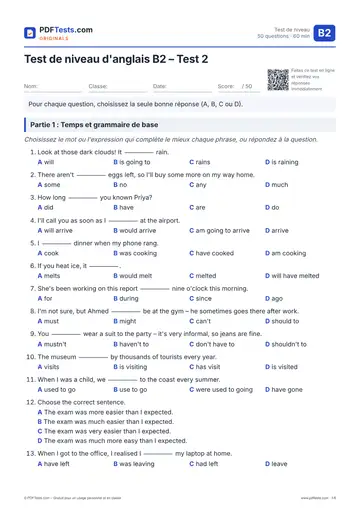
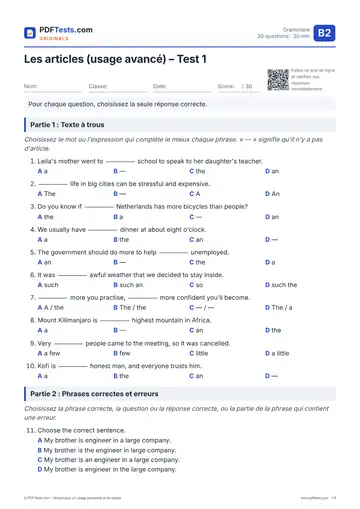
Aperçu de la page 1 : Mots souvent confondus – Test 1 Ouvrir le PDF

Faire le test en ligne

Pour chaque question, choisissez la meilleure réponse (A, B, C ou D). Choisissez vos réponses, puis cliquez sur « Vérifier mes réponses ».

Partie 1 : Paires de mots courantes

Choisissez le mot qui complète correctement chaque phrase.

  1. The new rules will _____ everyone who works in the building.

  2. Could you _____ me your charger for an hour? Mine is at home.

  3. These jeans are too _____ — I need a belt.

  4. Prices tend to _____ during the summer holidays.

  5. If you feel tired, go and _____ down for a while.

  6. My sister gave me some excellent _____ about choosing a university.

  7. The car was _____ at the traffic lights when the bike hit it.

  8. She finished her homework and _____ went out with her friends.

  9. We need to leave now — _____ going to miss the train.

  10. _____ being a talented musician, Amira is also a brilliant cook.

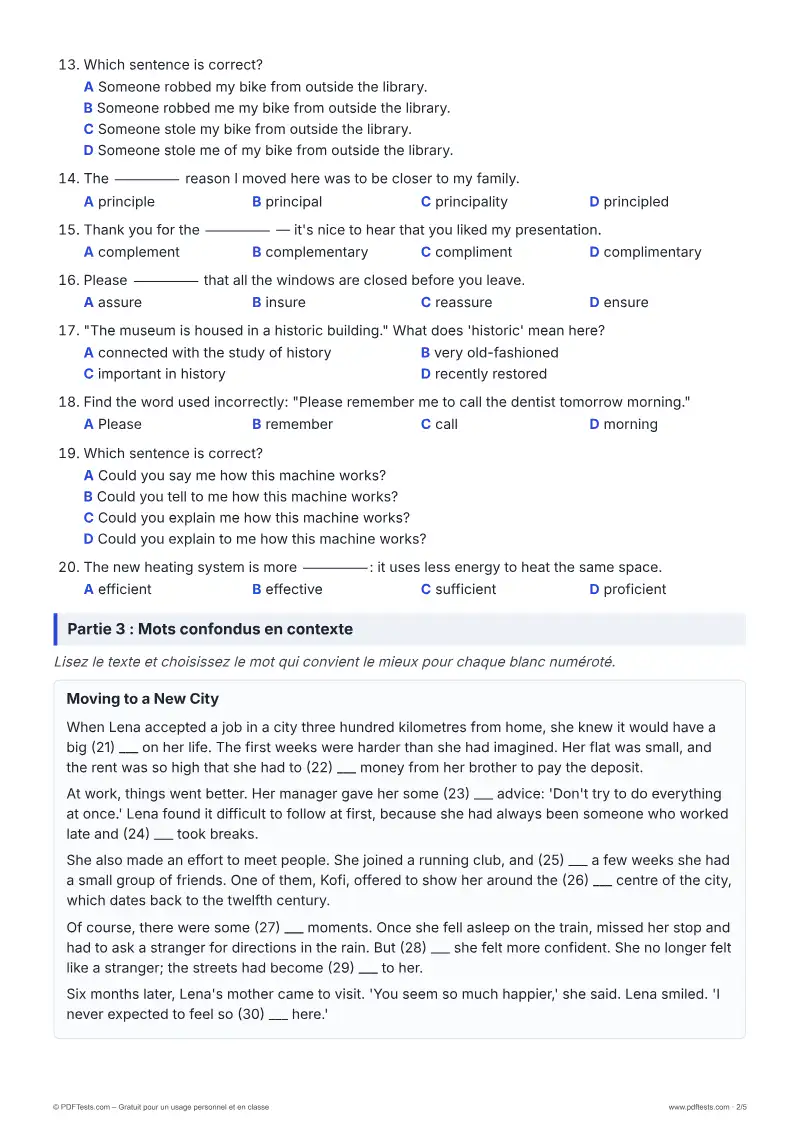
Partie 2 : Sens, collocations et emploi correct

Choisissez le mot, la phrase ou le sens correct, ou repérez le mot employé de manière incorrecte.

  1. Small cars are usually more _____ to run than large ones.

  2. Jonas is very _____; he gets upset if anyone criticises his work.

  3. Which sentence is correct?

  4. The _____ reason I moved here was to be closer to my family.

  5. Thank you for the _____ — it's nice to hear that you liked my presentation.

  6. Please _____ that all the windows are closed before you leave.

  7. "The museum is housed in a historic building." What does 'historic' mean here?

  8. Find the word used incorrectly: "Please remember me to call the dentist tomorrow morning."

  9. Which sentence is correct?

  10. The new heating system is more _____: it uses less energy to heat the same space.

Partie 3 : Mots confondus en contexte

Lisez le texte et choisissez le mot qui convient le mieux pour chaque blanc numéroté.

Moving to a New City

When Lena accepted a job in a city three hundred kilometres from home, she knew it would have a big (21) ___ on her life. The first weeks were harder than she had imagined. Her flat was small, and the rent was so high that she had to (22) ___ money from her brother to pay the deposit.

At work, things went better. Her manager gave her some (23) ___ advice: 'Don't try to do everything at once.' Lena found it difficult to follow at first, because she had always been someone who worked late and (24) ___ took breaks.

She also made an effort to meet people. She joined a running club, and (25) ___ a few weeks she had a small group of friends. One of them, Kofi, offered to show her around the (26) ___ centre of the city, which dates back to the twelfth century.

Of course, there were some (27) ___ moments. Once she fell asleep on the train, missed her stop and had to ask a stranger for directions in the rain. But (28) ___ she felt more confident. She no longer felt like a stranger; the streets had become (29) ___ to her.

Six months later, Lena's mother came to visit. 'You seem so much happier,' she said. Lena smiled. 'I never expected to feel so (30) ___ here.'

  1. (21) She knew it would have a big _____ on her life.

  2. (22) She had to _____ money from her brother to pay the deposit.

  3. (23) Her manager gave her some _____ advice.

  4. (24) She had always been someone who worked late and _____ took breaks.

  5. (25) She joined a running club, and _____ a few weeks she had a small group of friends.

  6. (26) Kofi offered to show her around the _____ centre of the city.

  7. (27) Of course, there were some _____ moments.

  8. (28) But _____ she felt more confident.

  9. (29) The streets had become _____ to her.

  10. (30) 'I never expected to feel so _____ here.'

Cette page vous a-t-elle été utile ?

Signaler une erreur

Une mauvaise réponse, une faute de frappe ou une explication peu claire ? Dites-le-nous, nous corrigerons.

S’entraîner avec une fiche: Mots souvent confondus – Fiche 1

Aperçu

À propos de ce test

Ce test de vocabulaire anglais de niveau B2 vérifie votre capacité à distinguer des mots que les apprenants confondent souvent, comme affect et effect, lend et borrow, economic et economical, ou encore historic et historical. Il porte sur le sens, les collocations, le choix du mot en contexte et les familles de mots. Il s'adresse aux apprenants de niveau intermédiaire avancé ainsi qu'aux enseignants qui préparent leurs élèves aux examens de niveau B2.

Thèmes abordés

Mots souvent confondusChoix du mot en contexteCollocationsFamilles de motsFaux amisConstructions verbales

Comment utiliser ce test

  1. Téléchargez le PDF et imprimez-le, ou faites le test en ligne ci-dessous.
  2. Répondez à toutes les questions sans dictionnaire et sans vous presser.
  3. Vérifiez vos réponses et notez les points à revoir.

Notes pour l’enseignant

Utilisez ce test comme évaluation diagnostique avant une séquence de vocabulaire ou comme révision à la fin de celle-ci. Chaque explication du corrigé précise la distinction testée, ce qui en fait un bon support pour le retour aux élèves. La partie 1 porte sur des paires très fréquentes (lend/borrow, lie/lay, loose/lose), la partie 2 sur des paires d'adjectifs et des constructions verbales de niveau B2 (economical, sensitive, explain to someone), et la partie 3 teste ces mots dans un texte suivi. En prolongement, demandez aux élèves de rédiger leurs propres phrases d'exemple pour les paires qu'ils ont ratées, ou de tenir une liste personnelle des mots qu'ils confondent.