PDFTests Originals

Use of English B1 – Test 2

B1 Intermediate GrammarEnglish

This B1 Use of English test checks your grammar and vocabulary in four exam-style parts: a multiple-choice cloze, a grammar-word cloze, word formation and key word transformations. It suits intermediate learners preparing for exams and teachers who need a ready-made class or homework test.
Questions
32
Time
40 min
PDF
6 pages
Answer key
Included
  • 100% free
  • No sign-up or email
  • Print-ready A4 PDF
Preview of page 1 of Use of English B1 – Test 2 Open PDF
Use of English B1–C2 · all exam-style tests, task types and tips

Take the test online

Read each question carefully and choose the correct option (A, B, C or D). Choose your answers, then press “Check my answers”.

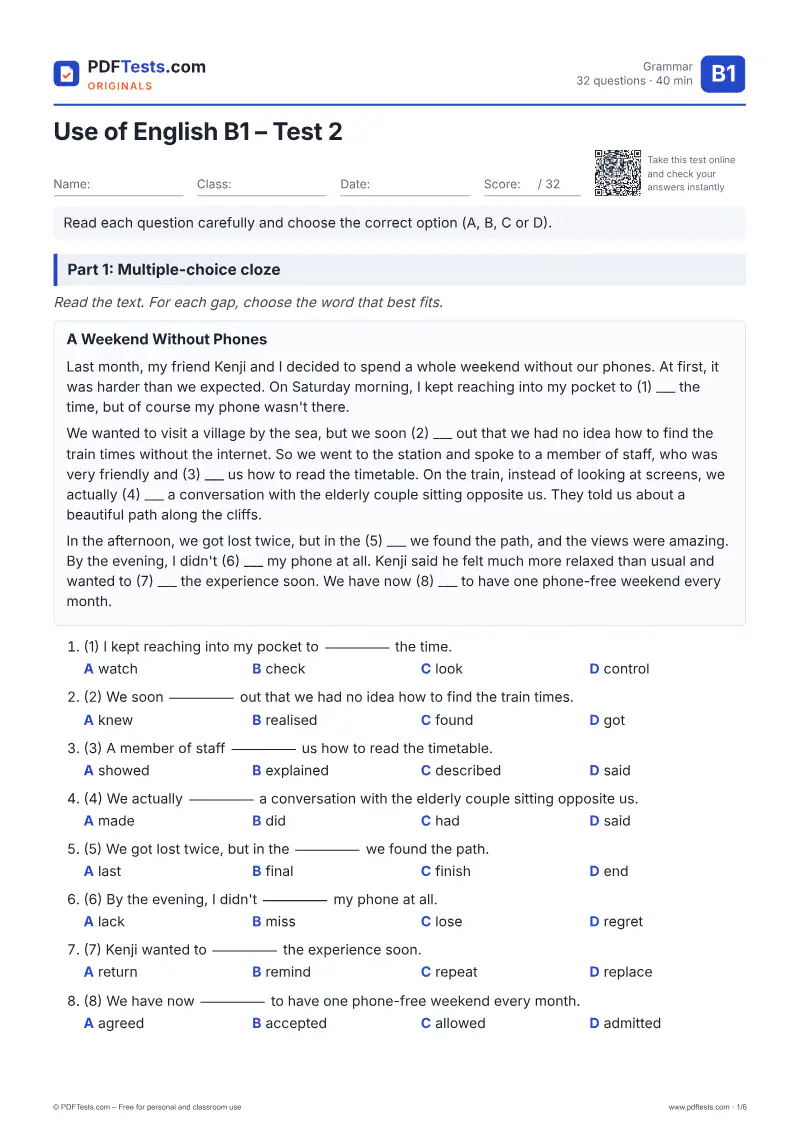
Part 1: Multiple-choice cloze

Read the text. For each gap, choose the word that best fits.

A Weekend Without Phones

Last month, my friend Kenji and I decided to spend a whole weekend without our phones. At first, it was harder than we expected. On Saturday morning, I kept reaching into my pocket to (1) ___ the time, but of course my phone wasn't there.

We wanted to visit a village by the sea, but we soon (2) ___ out that we had no idea how to find the train times without the internet. So we went to the station and spoke to a member of staff, who was very friendly and (3) ___ us how to read the timetable. On the train, instead of looking at screens, we actually (4) ___ a conversation with the elderly couple sitting opposite us. They told us about a beautiful path along the cliffs.

In the afternoon, we got lost twice, but in the (5) ___ we found the path, and the views were amazing. By the evening, I didn't (6) ___ my phone at all. Kenji said he felt much more relaxed than usual and wanted to (7) ___ the experience soon. We have now (8) ___ to have one phone-free weekend every month.

  1. (1) I kept reaching into my pocket to _____ the time.

  2. (2) We soon _____ out that we had no idea how to find the train times.

  3. (3) A member of staff _____ us how to read the timetable.

  4. (4) We actually _____ a conversation with the elderly couple sitting opposite us.

  5. (5) We got lost twice, but in the _____ we found the path.

  6. (6) By the evening, I didn't _____ my phone at all.

  7. (7) Kenji wanted to _____ the experience soon.

  8. (8) We have now _____ to have one phone-free weekend every month.

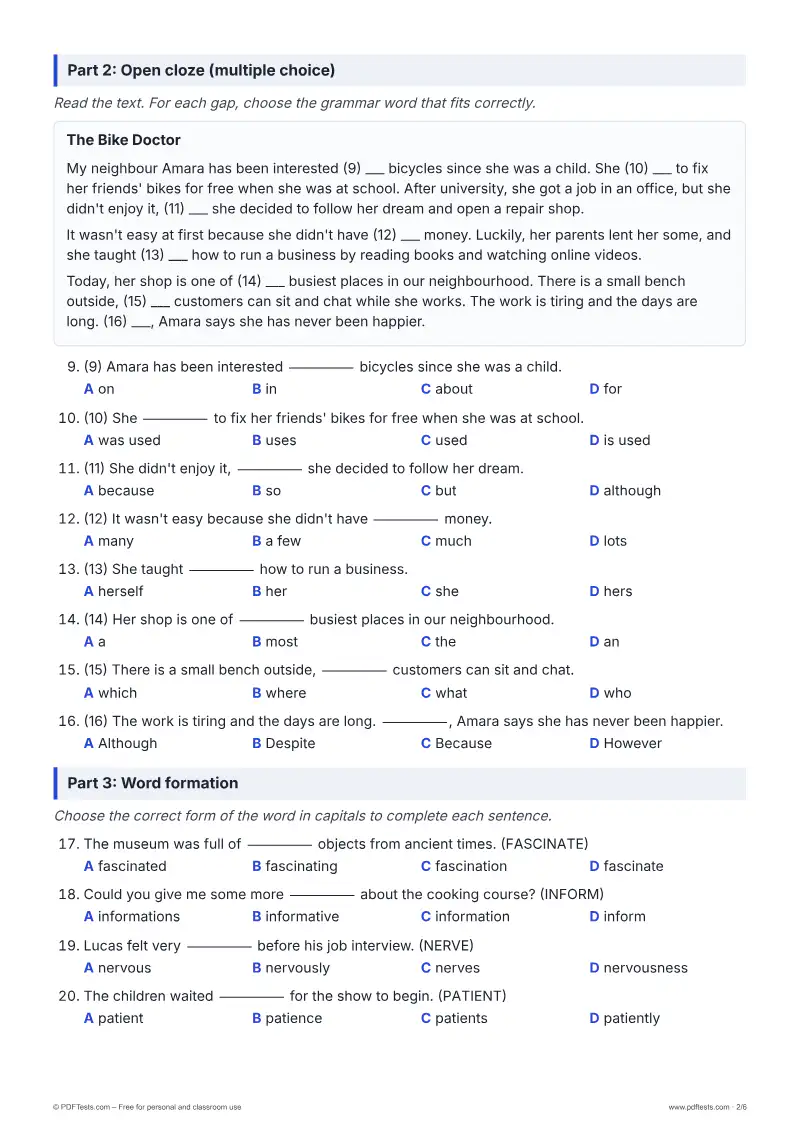
Part 2: Open cloze (multiple choice)

Read the text. For each gap, choose the grammar word that fits correctly.

The Bike Doctor

My neighbour Amara has been interested (9) ___ bicycles since she was a child. She (10) ___ to fix her friends' bikes for free when she was at school. After university, she got a job in an office, but she didn't enjoy it, (11) ___ she decided to follow her dream and open a repair shop.

It wasn't easy at first because she didn't have (12) ___ money. Luckily, her parents lent her some, and she taught (13) ___ how to run a business by reading books and watching online videos.

Today, her shop is one of (14) ___ busiest places in our neighbourhood. There is a small bench outside, (15) ___ customers can sit and chat while she works. The work is tiring and the days are long. (16) ___, Amara says she has never been happier.

  1. (9) Amara has been interested _____ bicycles since she was a child.

  2. (10) She _____ to fix her friends' bikes for free when she was at school.

  3. (11) She didn't enjoy it, _____ she decided to follow her dream.

  4. (12) It wasn't easy because she didn't have _____ money.

  5. (13) She taught _____ how to run a business.

  6. (14) Her shop is one of _____ busiest places in our neighbourhood.

  7. (15) There is a small bench outside, _____ customers can sit and chat.

  8. (16) The work is tiring and the days are long. _____, Amara says she has never been happier.

Part 3: Word formation

Choose the correct form of the word in capitals to complete each sentence.

  1. The museum was full of _____ objects from ancient times. (FASCINATE)

  2. Could you give me some more _____ about the cooking course? (INFORM)

  3. Lucas felt very _____ before his job interview. (NERVE)

  4. The children waited _____ for the show to begin. (PATIENT)

  5. The _____ of the new library has been delayed until June. (OPEN)

  6. The judges were very _____ by Mei's paintings. (IMPRESS)

  7. I'm sorry, but it's _____ to finish this report by tomorrow. (POSSIBLE)

  8. Nadia is a talented _____ who works for a local newspaper. (PHOTOGRAPH)

Part 4: Key word transformations

Choose the sentence that has the same meaning as the first sentence, uses the word in capitals and is grammatically correct.

  1. This bag is cheaper than that one. (AS)

  2. 'Where is the station?' the tourist asked me. (WHERE)

  3. They are building a new hospital in my town. (BEING)

  4. If you don't hurry, you'll miss the bus. (UNLESS)

  5. Perhaps Sam is at home. (MIGHT)

  6. I don't have a car, so I can't drive to work. (IF)

  7. The film was so boring that I fell asleep. (SUCH)

  8. Please don't make so much noise. (MIND)

Was this page helpful?

Report a mistake

Spotted a wrong answer, a typo or an unclear explanation? Tell us and we will fix it.

Practise with a worksheet: Use of English B1 – Worksheet 1

Preview

About this test

This B1 Use of English test checks your grammar and vocabulary in four exam-style parts: a multiple-choice cloze, a grammar-word cloze, word formation and key word transformations. It suits intermediate learners preparing for exams and teachers who need a ready-made class or homework test.

Topics covered

Collocations and fixed phrasesPhrasal verbsPrepositions and articlesLinkers and pronounsWord formationPassive and conditionalsReported questionsComparatives

How to use this test

  1. Download the PDF and print it, or take the test online below.
  2. Answer every question without a dictionary or time pressure.
  3. Check your answers and note the topics you need to review.

Notes for teachers

Use this test as a timed exam practice or split it into its four parts for separate lessons. It targets typical B1 errors such as wrong collocations (make/have a conversation), 'informations', 'used to' versus 'be used to', 'unless + not' and word order in reported questions. As follow-up, ask students to write their own sentences with the wrong options corrected, or to rewrite the Part 4 originals using different key words.