PDFTests Originals

Use of English B1 – Test 2

B1 Intermedio GramáticaInglés

Este test de Use of English de nivel B1 evalúa tu gramática y tu vocabulario en cuatro partes con formato de examen: un texto con huecos de opción múltiple, un texto con huecos de palabras gramaticales, formación de palabras y transformaciones con palabra clave (key word transformations). Es ideal para estudiantes de nivel intermedio que preparan un examen oficial y para profesores que buscan un test listo para usar en clase o como deberes.
Preguntas
32
Tiempo
40 min
PDF
6 páginas
Soluciones
Incluidas
  • 100 % gratis
  • Sin registro
  • PDF A4 listo para imprimir
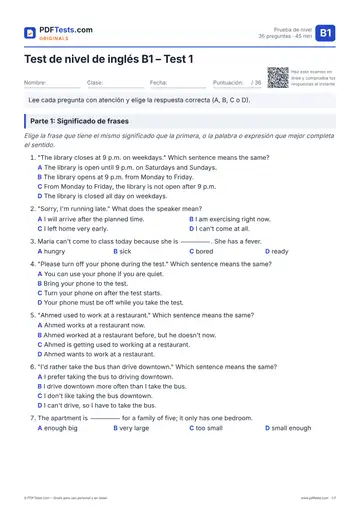
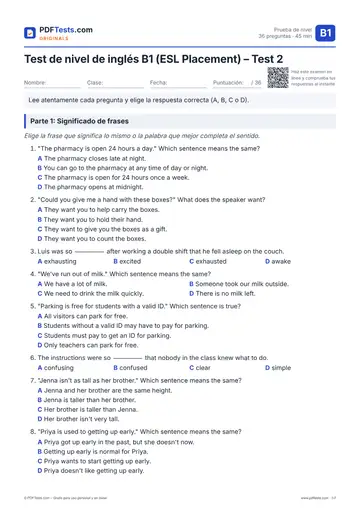
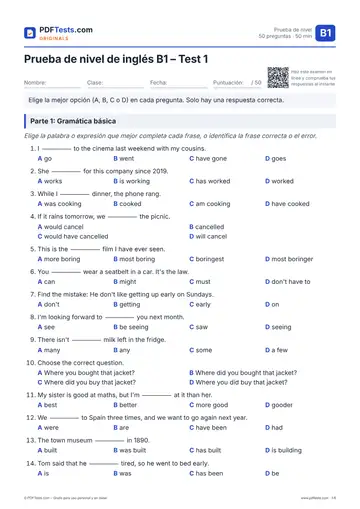
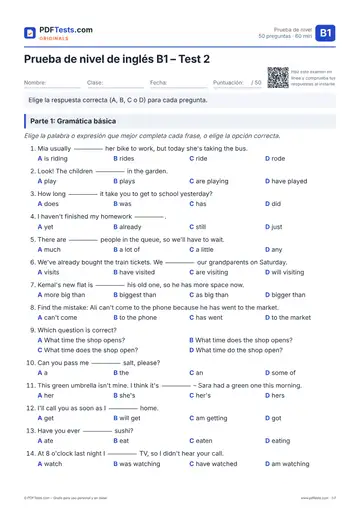
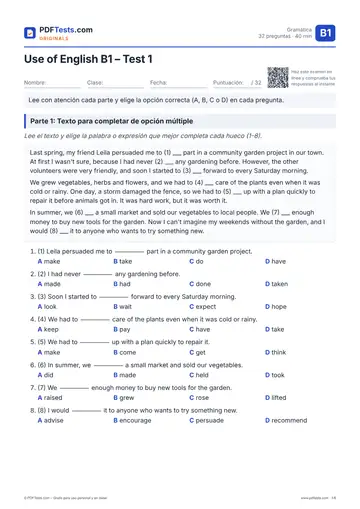
Vista previa de la página 1: Use of English B1 – Test 2 Abrir PDF
Use of English B1–C2 · todos los exámenes con formato de examen, tipos de tarea y consejos

Haz el examen en línea

Lee cada pregunta con atención y elige la opción correcta (A, B, C o D). Elige tus respuestas y pulsa «Comprobar respuestas».

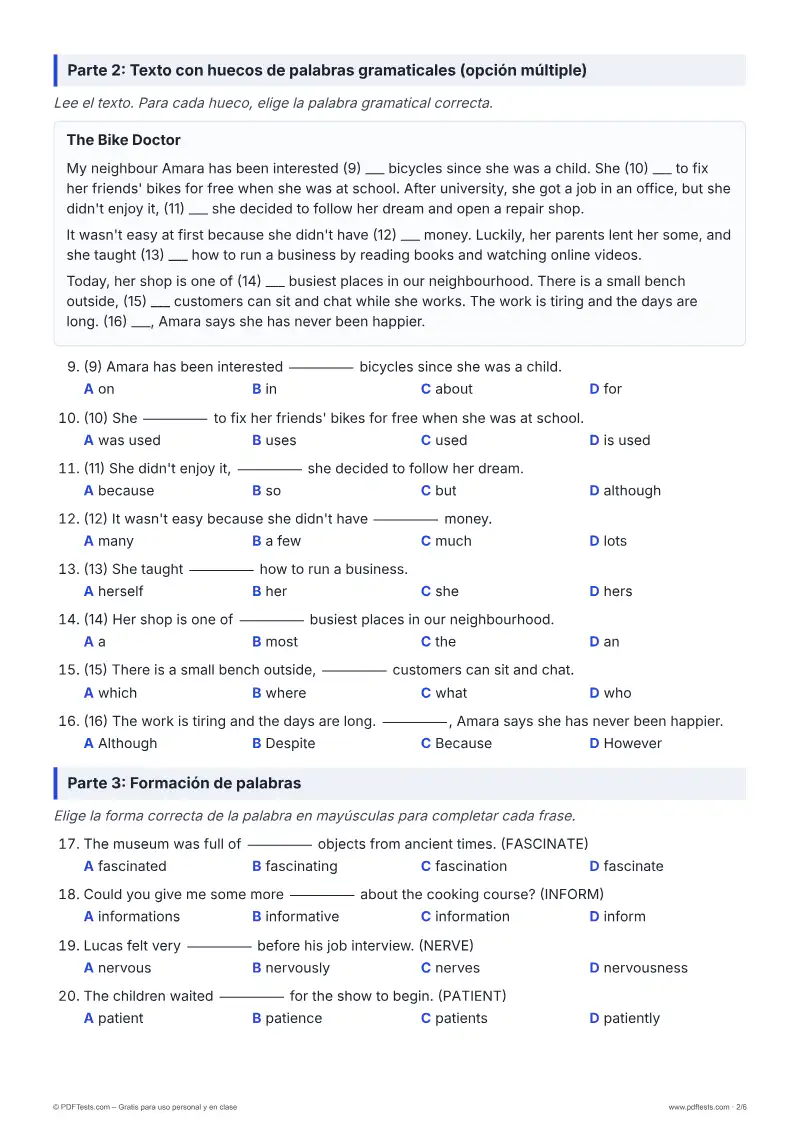
Parte 1: Texto con huecos de opción múltiple

Lee el texto. Para cada hueco, elige la palabra que mejor encaje.

A Weekend Without Phones

Last month, my friend Kenji and I decided to spend a whole weekend without our phones. At first, it was harder than we expected. On Saturday morning, I kept reaching into my pocket to (1) ___ the time, but of course my phone wasn't there.

We wanted to visit a village by the sea, but we soon (2) ___ out that we had no idea how to find the train times without the internet. So we went to the station and spoke to a member of staff, who was very friendly and (3) ___ us how to read the timetable. On the train, instead of looking at screens, we actually (4) ___ a conversation with the elderly couple sitting opposite us. They told us about a beautiful path along the cliffs.

In the afternoon, we got lost twice, but in the (5) ___ we found the path, and the views were amazing. By the evening, I didn't (6) ___ my phone at all. Kenji said he felt much more relaxed than usual and wanted to (7) ___ the experience soon. We have now (8) ___ to have one phone-free weekend every month.

  1. (1) I kept reaching into my pocket to _____ the time.

  2. (2) We soon _____ out that we had no idea how to find the train times.

  3. (3) A member of staff _____ us how to read the timetable.

  4. (4) We actually _____ a conversation with the elderly couple sitting opposite us.

  5. (5) We got lost twice, but in the _____ we found the path.

  6. (6) By the evening, I didn't _____ my phone at all.

  7. (7) Kenji wanted to _____ the experience soon.

  8. (8) We have now _____ to have one phone-free weekend every month.

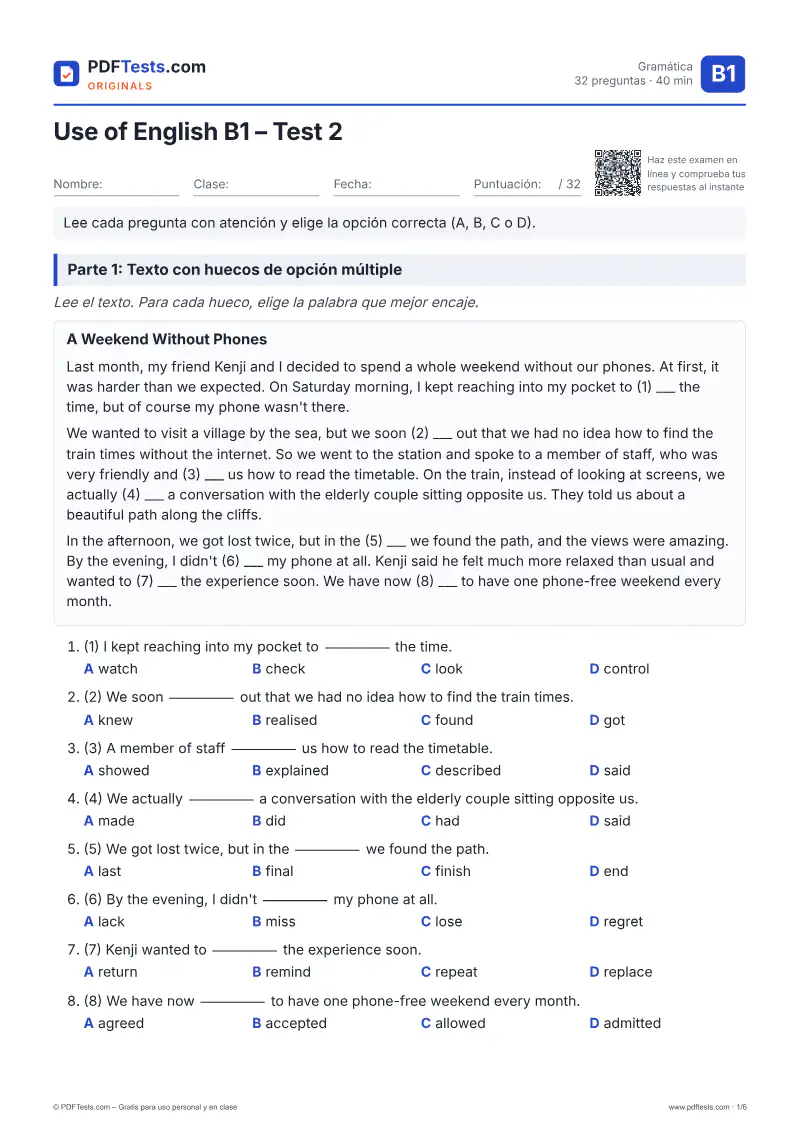
Parte 2: Texto con huecos de palabras gramaticales (opción múltiple)

Lee el texto. Para cada hueco, elige la palabra gramatical correcta.

The Bike Doctor

My neighbour Amara has been interested (9) ___ bicycles since she was a child. She (10) ___ to fix her friends' bikes for free when she was at school. After university, she got a job in an office, but she didn't enjoy it, (11) ___ she decided to follow her dream and open a repair shop.

It wasn't easy at first because she didn't have (12) ___ money. Luckily, her parents lent her some, and she taught (13) ___ how to run a business by reading books and watching online videos.

Today, her shop is one of (14) ___ busiest places in our neighbourhood. There is a small bench outside, (15) ___ customers can sit and chat while she works. The work is tiring and the days are long. (16) ___, Amara says she has never been happier.

  1. (9) Amara has been interested _____ bicycles since she was a child.

  2. (10) She _____ to fix her friends' bikes for free when she was at school.

  3. (11) She didn't enjoy it, _____ she decided to follow her dream.

  4. (12) It wasn't easy because she didn't have _____ money.

  5. (13) She taught _____ how to run a business.

  6. (14) Her shop is one of _____ busiest places in our neighbourhood.

  7. (15) There is a small bench outside, _____ customers can sit and chat.

  8. (16) The work is tiring and the days are long. _____, Amara says she has never been happier.

Parte 3: Formación de palabras

Elige la forma correcta de la palabra en mayúsculas para completar cada frase.

  1. The museum was full of _____ objects from ancient times. (FASCINATE)

  2. Could you give me some more _____ about the cooking course? (INFORM)

  3. Lucas felt very _____ before his job interview. (NERVE)

  4. The children waited _____ for the show to begin. (PATIENT)

  5. The _____ of the new library has been delayed until June. (OPEN)

  6. The judges were very _____ by Mei's paintings. (IMPRESS)

  7. I'm sorry, but it's _____ to finish this report by tomorrow. (POSSIBLE)

  8. Nadia is a talented _____ who works for a local newspaper. (PHOTOGRAPH)

Parte 4: Transformaciones con palabra clave

Elige la frase que significa lo mismo que la primera, contiene la palabra en mayúsculas y es gramaticalmente correcta.

  1. This bag is cheaper than that one. (AS)

  2. 'Where is the station?' the tourist asked me. (WHERE)

  3. They are building a new hospital in my town. (BEING)

  4. If you don't hurry, you'll miss the bus. (UNLESS)

  5. Perhaps Sam is at home. (MIGHT)

  6. I don't have a car, so I can't drive to work. (IF)

  7. The film was so boring that I fell asleep. (SUCH)

  8. Please don't make so much noise. (MIND)

¿Te ha resultado útil esta página?

Informar de un error

¿Has visto una respuesta incorrecta, una errata o una explicación poco clara? Avísanos y lo corregiremos.

Practica con una ficha: Use of English B1 – Ficha 1

Vista previa

Sobre este examen

Este test de Use of English de nivel B1 evalúa tu gramática y tu vocabulario en cuatro partes con formato de examen: un texto con huecos de opción múltiple, un texto con huecos de palabras gramaticales, formación de palabras y transformaciones con palabra clave (key word transformations). Es ideal para estudiantes de nivel intermedio que preparan un examen oficial y para profesores que buscan un test listo para usar en clase o como deberes.

Temas

Colocaciones y expresiones fijasPhrasal verbsPreposiciones y artículosConectores y pronombresFormación de palabrasPasiva y oraciones condicionalesPreguntas en estilo indirectoComparativos

Cómo usar este examen

  1. Descarga el PDF e imprímelo, o haz el examen en línea más abajo.
  2. Responde todas las preguntas sin diccionario y sin prisas.
  3. Comprueba tus respuestas y apunta los temas que debes repasar.

Notas para el profesor

Puede usar este test como simulacro de examen cronometrado o dividirlo en sus cuatro partes para trabajarlas en sesiones distintas. Se centra en errores típicos del nivel B1, como las colocaciones incorrectas (make/have a conversation), «informations», la diferencia entre «used to» y «be used to», «unless + not» y el orden de las palabras en las preguntas en estilo indirecto. Como actividad de refuerzo, pida a los alumnos que escriban sus propias frases corrigiendo las opciones erróneas o que reformulen las frases originales de la Parte 4 con otras palabras clave.