PDFTests Originals

Use of English B1 – Test 2

B1 Intermédiaire GrammaireAnglais

Ce test Use of English de niveau B1 évalue votre grammaire et votre vocabulaire en quatre parties de type examen : un texte à trous à choix multiples, un texte à trous sur les mots grammaticaux, la formation des mots et des transformations de phrases avec mot clé. Il convient aux apprenants de niveau intermédiaire qui préparent un examen ainsi qu'aux enseignants à la recherche d'un test prêt à l'emploi pour la classe ou les devoirs.
Questions
32
Durée
40 min
PDF
6 pages
Corrigé
Inclus
  • 100 % gratuit
  • Sans inscription
  • PDF A4 prêt à imprimer
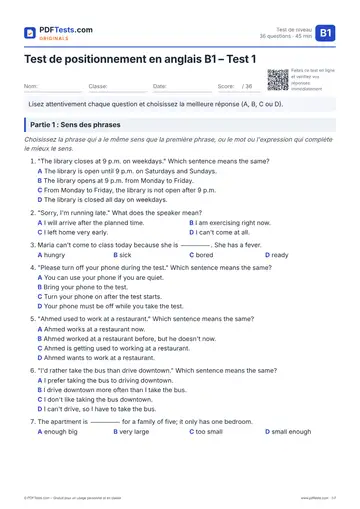
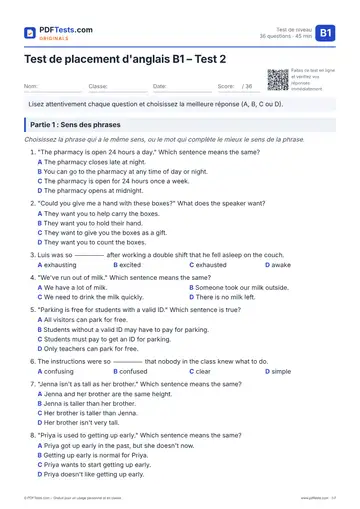
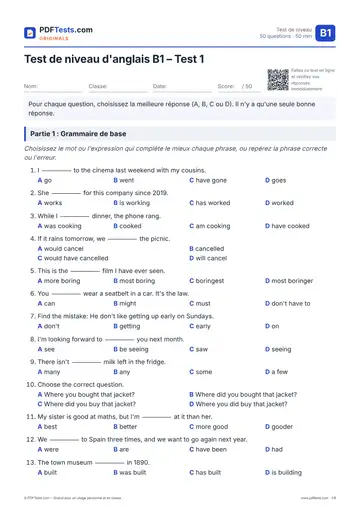
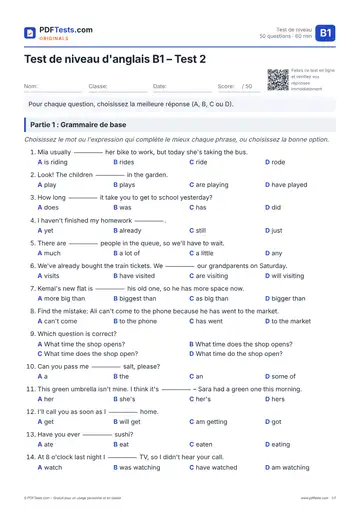
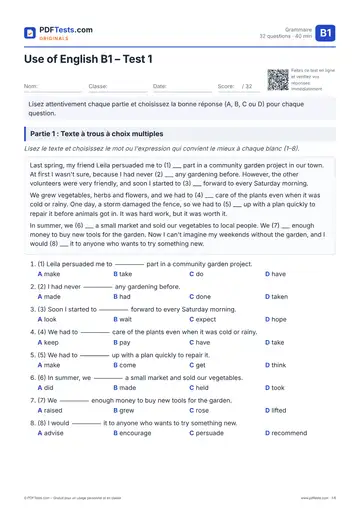
Aperçu de la page 1 : Use of English B1 – Test 2 Ouvrir le PDF
Use of English B1–C2 · tous les tests au format examen, types de tâches et conseils

Faire le test en ligne

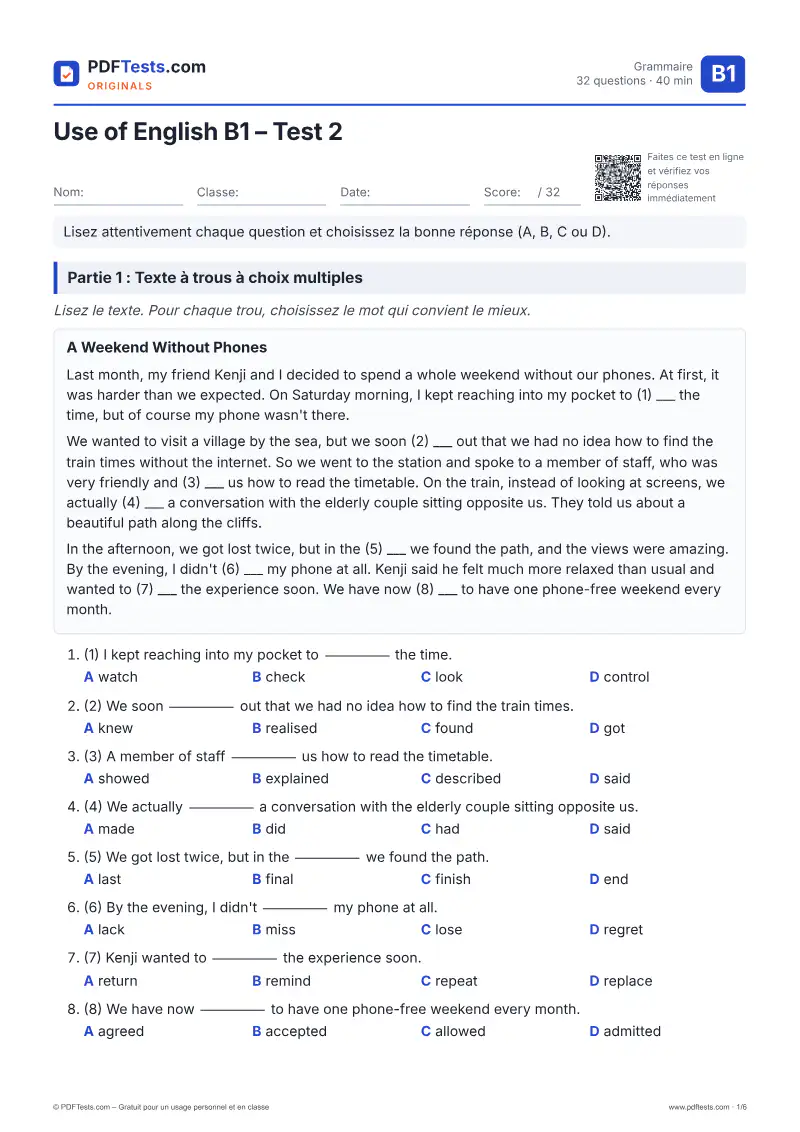
Lisez attentivement chaque question et choisissez la bonne réponse (A, B, C ou D). Choisissez vos réponses, puis cliquez sur « Vérifier mes réponses ».

Partie 1 : Texte à trous à choix multiples

Lisez le texte. Pour chaque trou, choisissez le mot qui convient le mieux.

A Weekend Without Phones

Last month, my friend Kenji and I decided to spend a whole weekend without our phones. At first, it was harder than we expected. On Saturday morning, I kept reaching into my pocket to (1) ___ the time, but of course my phone wasn't there.

We wanted to visit a village by the sea, but we soon (2) ___ out that we had no idea how to find the train times without the internet. So we went to the station and spoke to a member of staff, who was very friendly and (3) ___ us how to read the timetable. On the train, instead of looking at screens, we actually (4) ___ a conversation with the elderly couple sitting opposite us. They told us about a beautiful path along the cliffs.

In the afternoon, we got lost twice, but in the (5) ___ we found the path, and the views were amazing. By the evening, I didn't (6) ___ my phone at all. Kenji said he felt much more relaxed than usual and wanted to (7) ___ the experience soon. We have now (8) ___ to have one phone-free weekend every month.

  1. (1) I kept reaching into my pocket to _____ the time.

  2. (2) We soon _____ out that we had no idea how to find the train times.

  3. (3) A member of staff _____ us how to read the timetable.

  4. (4) We actually _____ a conversation with the elderly couple sitting opposite us.

  5. (5) We got lost twice, but in the _____ we found the path.

  6. (6) By the evening, I didn't _____ my phone at all.

  7. (7) Kenji wanted to _____ the experience soon.

  8. (8) We have now _____ to have one phone-free weekend every month.

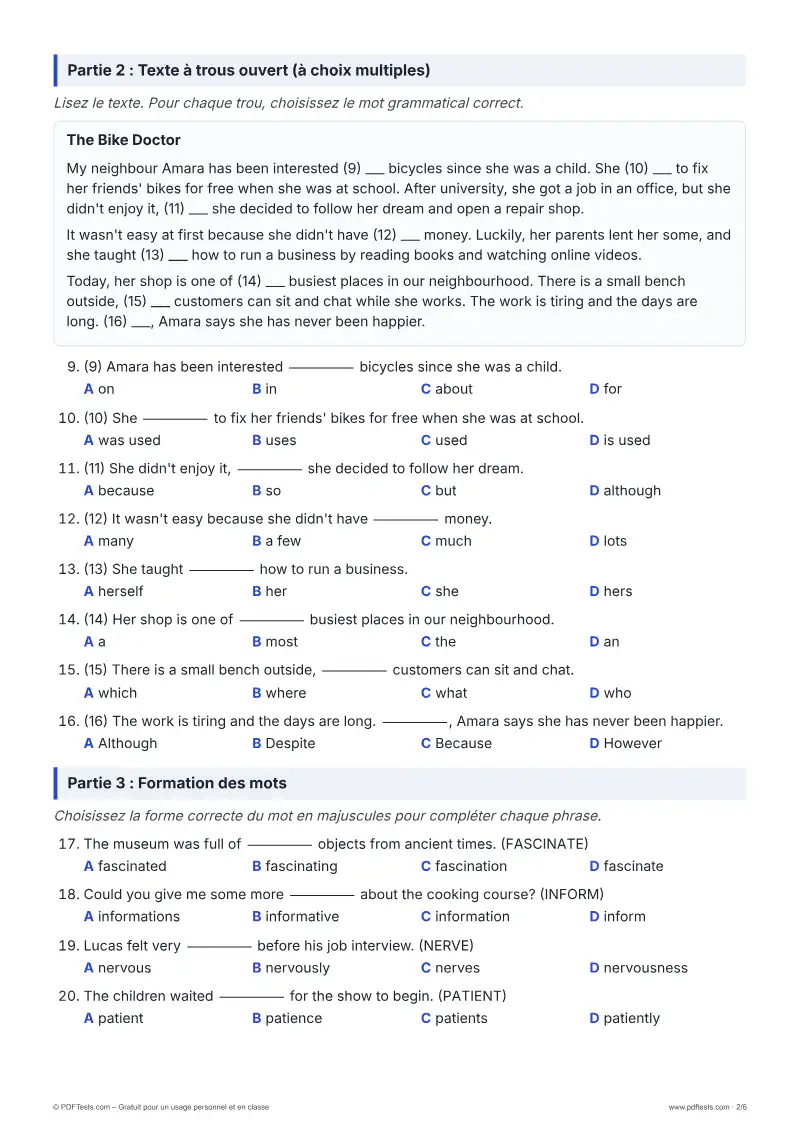
Partie 2 : Texte à trous ouvert (à choix multiples)

Lisez le texte. Pour chaque trou, choisissez le mot grammatical correct.

The Bike Doctor

My neighbour Amara has been interested (9) ___ bicycles since she was a child. She (10) ___ to fix her friends' bikes for free when she was at school. After university, she got a job in an office, but she didn't enjoy it, (11) ___ she decided to follow her dream and open a repair shop.

It wasn't easy at first because she didn't have (12) ___ money. Luckily, her parents lent her some, and she taught (13) ___ how to run a business by reading books and watching online videos.

Today, her shop is one of (14) ___ busiest places in our neighbourhood. There is a small bench outside, (15) ___ customers can sit and chat while she works. The work is tiring and the days are long. (16) ___, Amara says she has never been happier.

  1. (9) Amara has been interested _____ bicycles since she was a child.

  2. (10) She _____ to fix her friends' bikes for free when she was at school.

  3. (11) She didn't enjoy it, _____ she decided to follow her dream.

  4. (12) It wasn't easy because she didn't have _____ money.

  5. (13) She taught _____ how to run a business.

  6. (14) Her shop is one of _____ busiest places in our neighbourhood.

  7. (15) There is a small bench outside, _____ customers can sit and chat.

  8. (16) The work is tiring and the days are long. _____, Amara says she has never been happier.

Partie 3 : Formation des mots

Choisissez la forme correcte du mot en majuscules pour compléter chaque phrase.

  1. The museum was full of _____ objects from ancient times. (FASCINATE)

  2. Could you give me some more _____ about the cooking course? (INFORM)

  3. Lucas felt very _____ before his job interview. (NERVE)

  4. The children waited _____ for the show to begin. (PATIENT)

  5. The _____ of the new library has been delayed until June. (OPEN)

  6. The judges were very _____ by Mei's paintings. (IMPRESS)

  7. I'm sorry, but it's _____ to finish this report by tomorrow. (POSSIBLE)

  8. Nadia is a talented _____ who works for a local newspaper. (PHOTOGRAPH)

Partie 4 : Transformations de phrases avec mot clé

Choisissez la phrase qui a le même sens que la première, contient le mot en majuscules et est grammaticalement correcte.

  1. This bag is cheaper than that one. (AS)

  2. 'Where is the station?' the tourist asked me. (WHERE)

  3. They are building a new hospital in my town. (BEING)

  4. If you don't hurry, you'll miss the bus. (UNLESS)

  5. Perhaps Sam is at home. (MIGHT)

  6. I don't have a car, so I can't drive to work. (IF)

  7. The film was so boring that I fell asleep. (SUCH)

  8. Please don't make so much noise. (MIND)

Cette page vous a-t-elle été utile ?

Signaler une erreur

Une mauvaise réponse, une faute de frappe ou une explication peu claire ? Dites-le-nous, nous corrigerons.

S’entraîner avec une fiche: Use of English B1 – Fiche 1

Aperçu

À propos de ce test

Ce test Use of English de niveau B1 évalue votre grammaire et votre vocabulaire en quatre parties de type examen : un texte à trous à choix multiples, un texte à trous sur les mots grammaticaux, la formation des mots et des transformations de phrases avec mot clé. Il convient aux apprenants de niveau intermédiaire qui préparent un examen ainsi qu'aux enseignants à la recherche d'un test prêt à l'emploi pour la classe ou les devoirs.

Thèmes abordés

Collocations et expressions figéesVerbes à particule (phrasal verbs)Prépositions et articlesConnecteurs et pronomsFormation des motsVoix passive et phrases conditionnellesQuestions au discours indirect (reported questions)Comparatifs

Comment utiliser ce test

  1. Téléchargez le PDF et imprimez-le, ou faites le test en ligne ci-dessous.
  2. Répondez à toutes les questions sans dictionnaire et sans vous presser.
  3. Vérifiez vos réponses et notez les points à revoir.

Notes pour l’enseignant

Utilisez ce test comme entraînement chronométré à l'examen ou répartissez ses quatre parties sur plusieurs séances. Il cible des erreurs typiques du niveau B1 : mauvaises collocations (make/have a conversation), « informations », la confusion entre « used to » et « be used to », « unless + not » et l'ordre des mots dans les questions au discours indirect. En prolongement, demandez aux élèves de rédiger leurs propres phrases en corrigeant les options fausses, ou de réécrire les phrases de départ de la partie 4 avec d'autres mots clés.