PDFTests Originals

Use of English B1 – Test 2

B1 Mittelstufe GrammatikEnglisch

Dieser Use-of-English-Test auf Niveau B1 prüft Grammatik und Wortschatz in vier prüfungsnahen Teilen: einem Multiple-Choice-Lückentext, einem Lückentext mit Grammatikwörtern, Aufgaben zur Wortbildung und Satzumformungen mit Schlüsselwort (Key Word Transformations). Er eignet sich für Lernende auf mittlerem Niveau, die sich auf eine Prüfung vorbereiten, und für Lehrkräfte, die einen fertigen Test für den Unterricht oder als Hausaufgabe suchen.
Fragen
32
Zeit
40 Min.
PDF
6 Seiten
Lösungen
Enthalten
  • 100 % kostenlos
  • Ohne Anmeldung
  • Druckfertiges A4-PDF
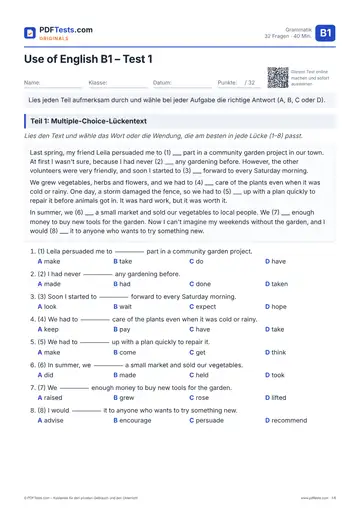
Vorschau von Seite 1: Use of English B1 – Test 2 PDF öffnen
Use of English B1–C2 · alle Tests im Prüfungsformat, Aufgabentypen und Tipps

Test online machen

Lies jede Aufgabe genau durch und wähle die richtige Antwort (A, B, C oder D). Wählen Sie Ihre Antworten und klicken Sie auf „Antworten prüfen“.

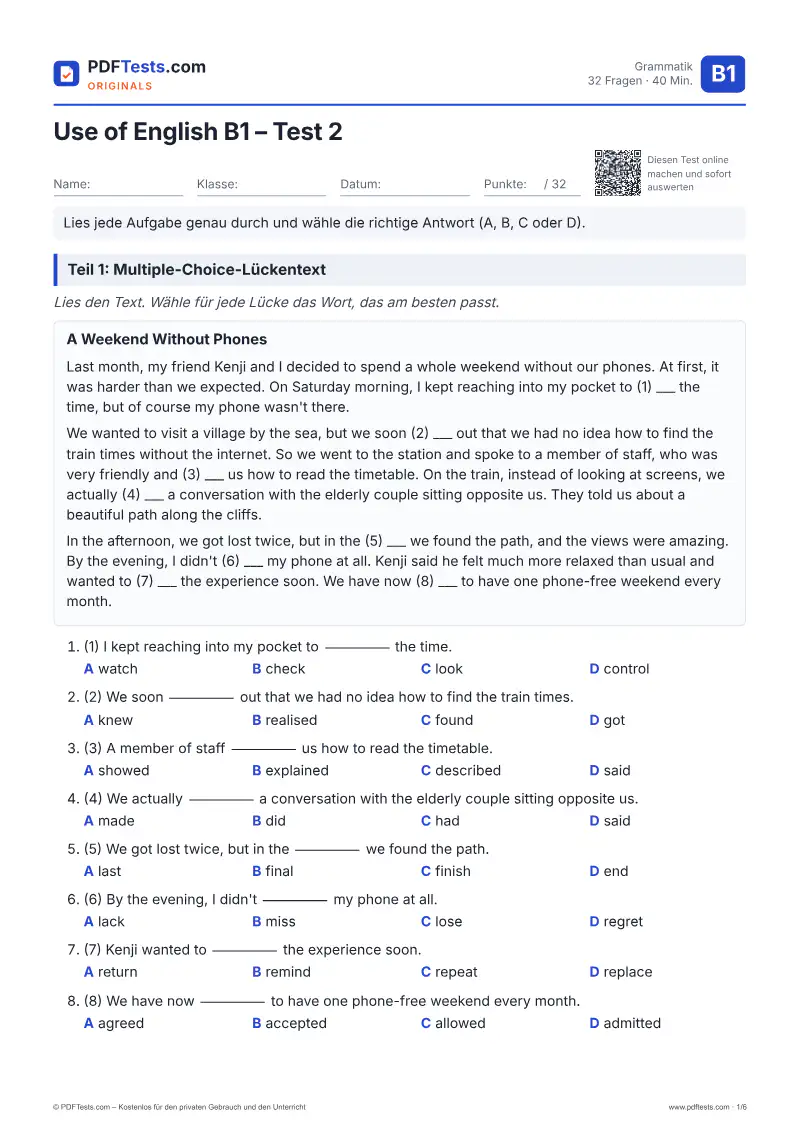
Teil 1: Multiple-Choice-Lückentext

Lies den Text. Wähle für jede Lücke das Wort, das am besten passt.

A Weekend Without Phones

Last month, my friend Kenji and I decided to spend a whole weekend without our phones. At first, it was harder than we expected. On Saturday morning, I kept reaching into my pocket to (1) ___ the time, but of course my phone wasn't there.

We wanted to visit a village by the sea, but we soon (2) ___ out that we had no idea how to find the train times without the internet. So we went to the station and spoke to a member of staff, who was very friendly and (3) ___ us how to read the timetable. On the train, instead of looking at screens, we actually (4) ___ a conversation with the elderly couple sitting opposite us. They told us about a beautiful path along the cliffs.

In the afternoon, we got lost twice, but in the (5) ___ we found the path, and the views were amazing. By the evening, I didn't (6) ___ my phone at all. Kenji said he felt much more relaxed than usual and wanted to (7) ___ the experience soon. We have now (8) ___ to have one phone-free weekend every month.

  1. (1) I kept reaching into my pocket to _____ the time.

  2. (2) We soon _____ out that we had no idea how to find the train times.

  3. (3) A member of staff _____ us how to read the timetable.

  4. (4) We actually _____ a conversation with the elderly couple sitting opposite us.

  5. (5) We got lost twice, but in the _____ we found the path.

  6. (6) By the evening, I didn't _____ my phone at all.

  7. (7) Kenji wanted to _____ the experience soon.

  8. (8) We have now _____ to have one phone-free weekend every month.

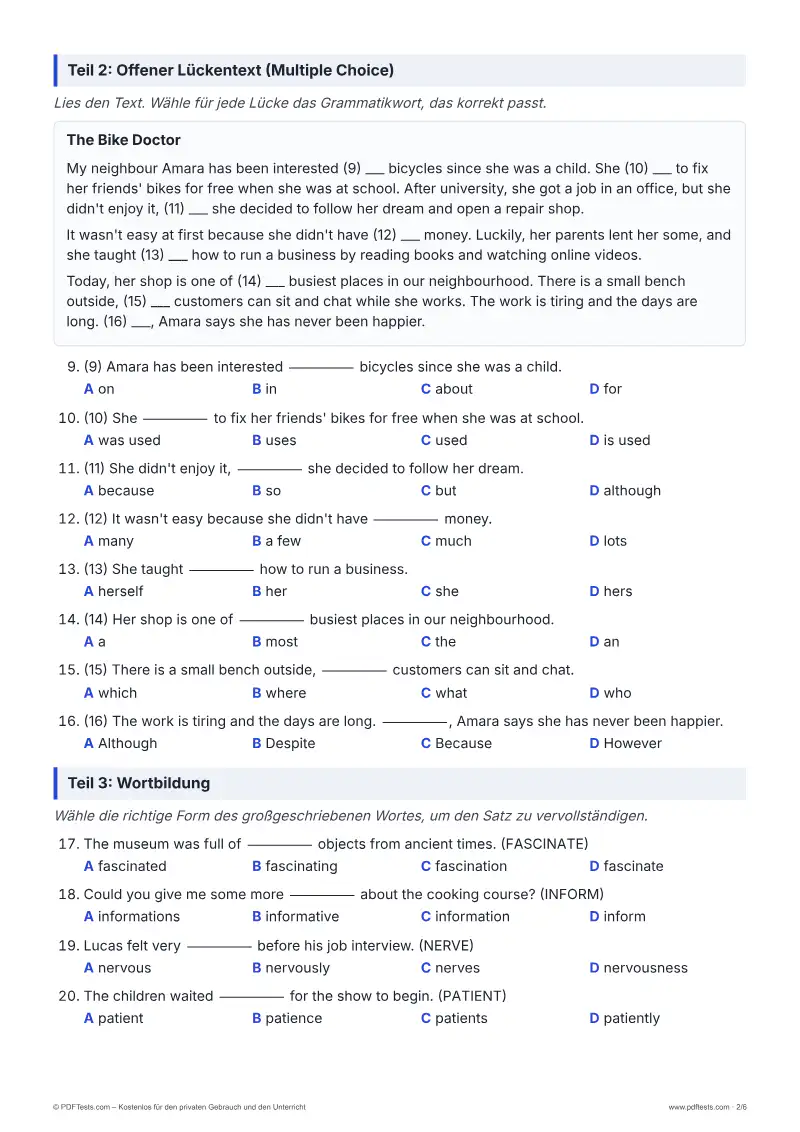
Teil 2: Offener Lückentext (Multiple Choice)

Lies den Text. Wähle für jede Lücke das Grammatikwort, das korrekt passt.

The Bike Doctor

My neighbour Amara has been interested (9) ___ bicycles since she was a child. She (10) ___ to fix her friends' bikes for free when she was at school. After university, she got a job in an office, but she didn't enjoy it, (11) ___ she decided to follow her dream and open a repair shop.

It wasn't easy at first because she didn't have (12) ___ money. Luckily, her parents lent her some, and she taught (13) ___ how to run a business by reading books and watching online videos.

Today, her shop is one of (14) ___ busiest places in our neighbourhood. There is a small bench outside, (15) ___ customers can sit and chat while she works. The work is tiring and the days are long. (16) ___, Amara says she has never been happier.

  1. (9) Amara has been interested _____ bicycles since she was a child.

  2. (10) She _____ to fix her friends' bikes for free when she was at school.

  3. (11) She didn't enjoy it, _____ she decided to follow her dream.

  4. (12) It wasn't easy because she didn't have _____ money.

  5. (13) She taught _____ how to run a business.

  6. (14) Her shop is one of _____ busiest places in our neighbourhood.

  7. (15) There is a small bench outside, _____ customers can sit and chat.

  8. (16) The work is tiring and the days are long. _____, Amara says she has never been happier.

Teil 3: Wortbildung

Wähle die richtige Form des großgeschriebenen Wortes, um den Satz zu vervollständigen.

  1. The museum was full of _____ objects from ancient times. (FASCINATE)

  2. Could you give me some more _____ about the cooking course? (INFORM)

  3. Lucas felt very _____ before his job interview. (NERVE)

  4. The children waited _____ for the show to begin. (PATIENT)

  5. The _____ of the new library has been delayed until June. (OPEN)

  6. The judges were very _____ by Mei's paintings. (IMPRESS)

  7. I'm sorry, but it's _____ to finish this report by tomorrow. (POSSIBLE)

  8. Nadia is a talented _____ who works for a local newspaper. (PHOTOGRAPH)

Teil 4: Satzumformung mit Schlüsselwort

Wähle den Satz, der dieselbe Bedeutung wie der erste Satz hat, das großgeschriebene Wort enthält und grammatisch korrekt ist.

  1. This bag is cheaper than that one. (AS)

  2. 'Where is the station?' the tourist asked me. (WHERE)

  3. They are building a new hospital in my town. (BEING)

  4. If you don't hurry, you'll miss the bus. (UNLESS)

  5. Perhaps Sam is at home. (MIGHT)

  6. I don't have a car, so I can't drive to work. (IF)

  7. The film was so boring that I fell asleep. (SUCH)

  8. Please don't make so much noise. (MIND)

War diese Seite hilfreich?

Fehler melden

Falsche Lösung, Tippfehler oder unklare Erklärung? Schreiben Sie uns, wir korrigieren es.

Mit einem Arbeitsblatt üben: Use of English B1 – Arbeitsblatt 1

Vorschau

Über diesen Test

Dieser Use-of-English-Test auf Niveau B1 prüft Grammatik und Wortschatz in vier prüfungsnahen Teilen: einem Multiple-Choice-Lückentext, einem Lückentext mit Grammatikwörtern, Aufgaben zur Wortbildung und Satzumformungen mit Schlüsselwort (Key Word Transformations). Er eignet sich für Lernende auf mittlerem Niveau, die sich auf eine Prüfung vorbereiten, und für Lehrkräfte, die einen fertigen Test für den Unterricht oder als Hausaufgabe suchen.

Themen

Kollokationen und feste WendungenPhrasal VerbsPräpositionen und ArtikelKonnektoren und PronomenWortbildungPassiv und Bedingungssätze (Conditionals)Indirekte Fragen (Reported Questions)Steigerung (Comparatives)

So nutzen Sie diesen Test

  1. Laden Sie das PDF herunter und drucken Sie es aus – oder machen Sie den Test unten online.
  2. Beantworten Sie alle Fragen ohne Wörterbuch und ohne Zeitdruck.
  3. Prüfen Sie Ihre Antworten und notieren Sie, was Sie wiederholen sollten.

Hinweise für Lehrkräfte

Der Test eignet sich als Prüfungssimulation mit Zeitvorgabe, lässt sich aber auch in seine vier Teile aufteilen und auf mehrere Stunden verteilen. Er zielt auf typische B1-Fehler ab, etwa falsche Kollokationen (make/have a conversation), „informations“, die Verwechslung von „used to“ und „be used to“, „unless“ mit zusätzlicher Verneinung sowie die Wortstellung in indirekten Fragen. Zur Vertiefung können die Lernenden eigene Sätze schreiben, in denen sie die falschen Antwortoptionen korrigieren, oder die Ausgangssätze aus Teil 4 mit anderen Schlüsselwörtern umformulieren.