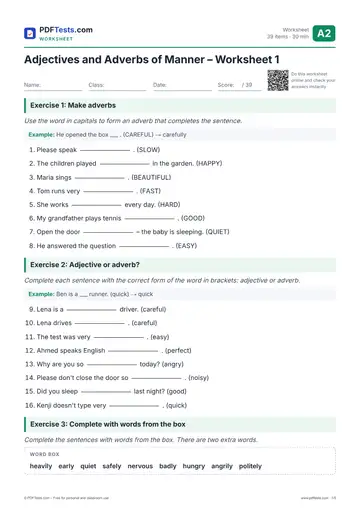
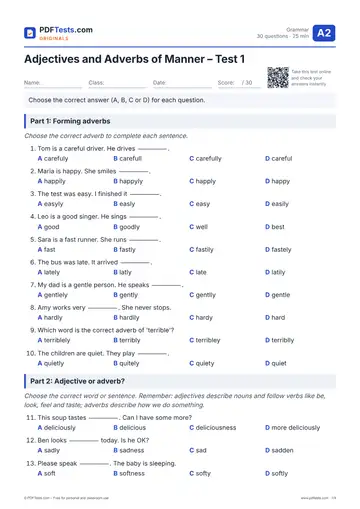
Adjectives describe people and things, as in a careful driver or a quiet room. Adverbs of manner describe actions. They tell us how someone does something: She drives carefully. Please speak quietly. Most adverbs of manner are made by adding -ly to an adjective, but some common ones, like well, fast and hard, are irregular.
Adjective or adverb: the basic difference
Ask yourself one question: am I describing a noun or a verb?
| Word type | Describes | Answers the question | Example |
|---|---|---|---|
| Adjective | a noun (person, thing, place) | What kind? What is it like? | Tom is a slow walker. |
| Adverb of manner | a verb (an action) | How? | Tom walks slowly. |
Here are more pairs. The meaning is similar, but the grammar is different:
- She is a good singer. → She sings well.
- They are noisy neighbours. → They play music noisily.
- It was an easy test. → I passed the test easily.
- He’s a fast runner. → He runs fast.
- Be careful. → Carry the box carefully.
Where adjectives go
Adjectives usually go in one of two places:
- Before a noun: a beautiful song, heavy rain, an expensive phone
- After be and other linking verbs: The song is beautiful. The rain was heavy. That phone looks expensive.
Adjectives never change for plural nouns: two old houses, not two olds houses.
How to form adverbs of manner
For most adjectives, just add -ly. Some endings need a small spelling change.
| Adjective ending | Rule | Examples |
|---|---|---|
| most adjectives | add -ly | quick → quickly, slow → slowly, bad → badly, quiet → quietly |
| -l | add -ly (you get -lly) | careful → carefully, beautiful → beautifully, real → really |
| -e | keep the e, add -ly | polite → politely, safe → safely, nice → nicely, rude → rudely |
| consonant + -y | change y to i, add -ly | easy → easily, happy → happily, angry → angrily, lucky → luckily |
| consonant + -le | change -le to -ly | gentle → gently, terrible → terribly, comfortable → comfortably |
| -ic | add -ally | automatic → automatically, dramatic → dramatically |
Spelling notes:
- true → truly (not truely). This is an exception to the -e rule.
- full → fully (only one extra l).
- public → publicly is an exception to the -ic rule.
Irregular adverbs
Some very common adverbs do not follow the rules. Learn these by heart.
| Adjective | Adverb | Example |
|---|---|---|
| good | well | She plays the piano well. |
| fast | fast | Don’t drive so fast. |
| hard | hard | My parents work hard. |
| late | late | The train arrived late. |
| early | early | I got up early today. |
| straight | straight | Go straight home after school. |
Be careful: hardly and lately exist, but they have different meanings.
- hardly = almost not: I hardly slept last night. (= I slept very little.)
- lately = recently: Have you seen Anna lately?
Fastly is not a word. Always say fast.
Adjectives that end in -ly
Some words end in -ly but are adjectives, not adverbs: friendly, lovely, lonely, silly, ugly, lively, elderly. You cannot add another -ly. Instead, use in a … way:
- The waiter was friendly. → He spoke to us in a friendly way.
- It was a silly question. → She answered in a silly way.
A few time words, such as daily, weekly and monthly, can be both adjective and adverb: a daily newspaper / I read the news daily.
Word order with adverbs of manner
An adverb of manner usually goes after the verb, or after the object if there is one. Do not put it between the verb and its object.
| Structure | Example |
|---|---|
| subject + verb + adverb | The baby is sleeping peacefully. |
| subject + verb + object + adverb | She speaks Spanish fluently. |
| subject + modal + verb + adverb | You can’t park here … You can’t drive fast on this road. |
| subject + verb + adverb + place/time | He walked slowly to the door. |
With can, the adverb comes after the main verb: My sister can swim well. For more on this verb, see our guide to can and can’t for ability.
Some -ly adverbs can also go before the main verb, especially in stories: She quietly closed the door. Irregular adverbs like well, fast and hard always go after the verb or object.
Questions with How
The question word for adverbs of manner is How:
- How does your brother drive? — He drives dangerously.
- How did you sleep? — I slept well, thanks.
- How do I open this file? — Click the icon twice… then wait patiently.
Making adverbs stronger and comparing them
You can put very, really or quite before an adverb of manner: She sings really well. He spoke quite quickly.
To compare actions, use more + -ly adverb, or the irregular forms:
- Could you speak more slowly, please?
- Paula runs faster than me.
- I feel better today. / He played worse than last week.
You can learn the full rules in our guide to comparatives and superlatives.
Linking verbs: when an adjective follows a verb
This is the most important exception. Some verbs do not describe an action. They describe a state or how something seems. These are called linking verbs, and they are followed by an adjective, not an adverb.
Common linking verbs: be, become, get, look, seem, feel, sound, smell, taste.
- You look tired. (not tiredly)
- This pizza tastes delicious.
- Your idea sounds great.
- I feel bad about the mistake.
- It’s getting dark.
Some of these verbs can also be action verbs. Then they take an adverb. Compare:
| Linking verb + adjective (state) | Action verb + adverb (action) |
|---|---|
| She looks angry. (= she seems angry) | She looked angrily at me. (= the way she looked) |
| The milk smells bad. | The dog smelled the food carefully. |
| The soup tastes salty. | He tasted the soup slowly. |
Good or well after feel?
Well can also be an adjective meaning healthy:
- I’m not well today. I’ve got a cold. (= not healthy)
- I feel good about my exam. (= happy, positive)
Both I feel good and I feel well are correct, but well usually talks about health.
Adverbs of manner vs adverbs of frequency
Learners sometimes mix these two types of adverb. They answer different questions and go in different places.
| Type | Question | Examples | Position |
|---|---|---|---|
| Adverb of frequency | How often? | always, usually, often, never | before the main verb |
| Adverb of manner | How? | carefully, well, fast, badly | after the verb or object |
You can use both in one sentence: She always drives carefully. I usually sleep well. Read more in our guide to adverbs of frequency.
Common mistakes
✗ She speaks English very good. → ✓ She speaks English very well. Good is an adjective; to describe an action, use well.
✗ He drives very careful. → ✓ He drives very carefully. Drives is an action verb, so it needs an adverb.
✗ She speaks well English. → ✓ She speaks English well. Don’t put the adverb between the verb and its object.
✗ He runs fastly. → ✓ He runs fast. Fast is the same as an adjective and an adverb; fastly doesn’t exist.
✗ I work hardly every day. → ✓ I work hard every day. Hardly means almost not; the adverb of hard is hard.
✗ We arrived lately. → ✓ We arrived late. Lately means recently.
✗ You look nicely today. → ✓ You look nice today. Look here is a linking verb (= seem), so it takes an adjective.
✗ The food smells badly. → ✓ The food smells bad. Smell describes a state here, so use an adjective.
✗ She is a quickly learner. → ✓ She is a quick learner. The word describes the noun learner, so it must be an adjective.
✗ He smiled at me friendly. → ✓ He smiled at me in a friendly way. Friendly is an adjective and has no -ly adverb form.
✗ The children played happyly. → ✓ The children played happily. After a consonant, change y to i before adding -ly.
Quick check
- My grandmother walks very ___. (slow / slowly)
- This cake tastes ___. (wonderful / wonderfully)
- He’s a ___ driver. (dangerous / dangerously)
- Correct the mistake: She speaks well French.
- Make the adverb: easy → ___
Answers
- slowly – it describes how she walks (an action).
- wonderful – taste is a linking verb, so it takes an adjective.
- dangerous – it describes the noun driver.
- She speaks French well. – the adverb goes after the object.
- easily – consonant + y changes to -ily.
Next step
Now put the rules into practice: test yourself with our A2 Adjectives and Adverbs of Manner test and check which mistakes you still make, especially with good/well, irregular forms and linking verbs. When you feel confident, try other topics from our A2 English tests, and later move on to the B1 -ed and -ing adjectives test to learn the difference between words like bored and boring.
Practise this topic: Adjectives and Adverbs of Manner
Was this page helpful?
What was the problem?
Thank you for your feedback!