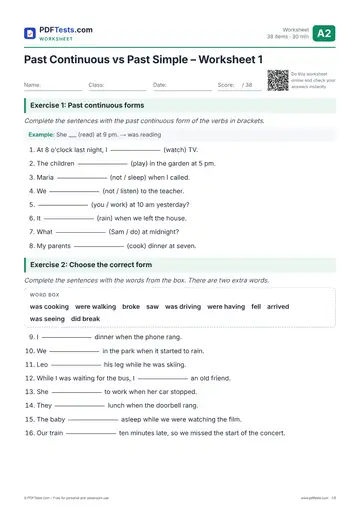
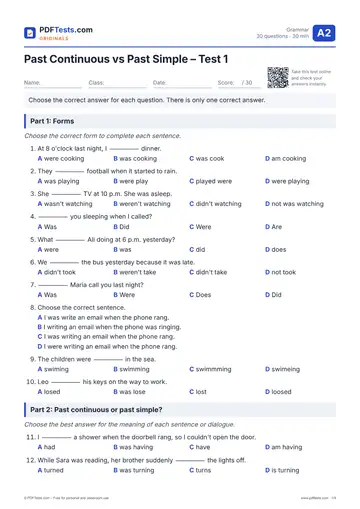
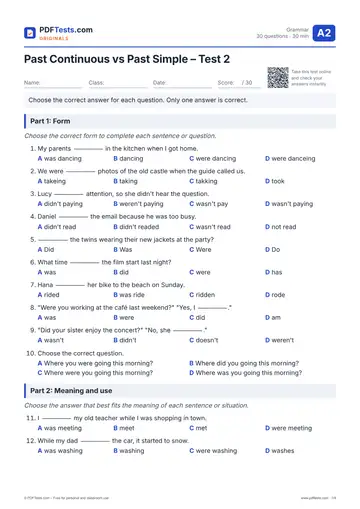
The past continuous (was/were + verb-ing) describes an action that was in progress at a moment in the past. The past simple (worked, went, saw) describes a finished action. We often use them together: the past continuous for the longer background action and the past simple for the short action that happened in the middle of it.
I was watching TV when the phone rang.
The two tenses at a glance
| Past continuous | Past simple | |
|---|---|---|
| Form | was/were + verb-ing | verb + -ed or irregular form |
| Meaning | action in progress, not finished at that moment | complete, finished action |
| Typical length | longer, background action | shorter action or event |
| Example | At 8 pm I was cooking. | At 8 pm I cooked dinner. |
| Typical words | while, at 8 o’clock, all evening | when, yesterday, last week, ago |
How to form the past continuous
Use was or were (the past of be) + the -ing form of the main verb. If you need to review was and were, see our guide to the past simple of to be.
Affirmative
| Subject | was/were | verb-ing |
|---|---|---|
| I / he / she / it | was | working |
| you / we / they | were | working |
She was reading a book. They were playing football.
Negative
| Subject | was not / were not | verb-ing |
|---|---|---|
| I / he / she / it | wasn’t | working |
| you / we / they | weren’t | working |
I wasn’t sleeping. We weren’t listening.
Questions and short answers
| Was/Were | subject | verb-ing | Short answers |
|---|---|---|---|
| Was | I / he / she / it | working? | Yes, he was. / No, he wasn’t. |
| Were | you / we / they | working? | Yes, they were. / No, they weren’t. |
What were you doing at 10 o’clock? Was it raining when you left?
Spelling of the -ing form
The spelling rules are the same as for the present continuous:
- Most verbs: add -ing → read → reading, play → playing
- Verbs ending in -e: drop the e → make → making, write → writing
- One syllable, consonant + vowel + consonant: double the last letter → run → running, sit → sitting, stop → stopping
- Verbs ending in -ie: change to -y → lie → lying, die → dying
How to form the past simple
Regular verbs add -ed (walk → walked, live → lived, study → studied). Irregular verbs have their own forms (go → went, see → saw, buy → bought). Negatives and questions use did + the base form: I didn’t see him. Did you call? For full rules and a list of irregular verbs, read our Past Simple guide.
When to use the past continuous
1. An action in progress at a specific time in the past
The action started before that time and continued after it.
- At 7 o’clock this morning, I was having breakfast.
- What were you doing at midnight?
- This time last year, we were living in Madrid.
Compare: At 7 o’clock I had breakfast means breakfast started at 7. At 7 o’clock I was having breakfast means I was in the middle of breakfast at 7.
2. Background description in a story
We use the past continuous to set the scene: the weather, what people were doing, the situation.
- It was raining and people were waiting for the bus.
- The sun was shining and the children were laughing.
3. Two long actions happening at the same time
Use the past continuous for both actions, usually with while.
- While I was cooking, my husband was setting the table.
- She was talking on the phone while she was driving.
When to use the past simple
1. Finished actions at a known time
- I visited my grandparents last weekend.
- We moved to London in 2020.
2. A series of actions, one after another
- He got up, had a shower and left the house.
- She opened the door, saw the mess and called her brother.
3. A short action that interrupts a longer one
This is the most common way the two tenses work together.
- I was walking home when I saw an accident.
- We were having dinner when the lights went out.
Interrupted actions: when and while
Think of a long line (past continuous) and a short point that cuts it (past simple).
| Long action (past continuous) | Short action (past simple) |
|---|---|
| I was taking a shower | when the doorbell rang. |
| She was crossing the road | when she dropped her phone. |
| They were sleeping | when the alarm went off. |
While usually comes before the long action (past continuous). When usually comes before the short action (past simple).
- While I was studying, my friend called.
- I was studying when my friend called.
Both sentences have the same meaning. Notice the comma: use one when the when/while part comes first.
- When the film started, we were still buying popcorn.
- We were still buying popcorn when the film started.
When the tense changes the meaning
The choice of tense can change the story:
- When Anna arrived, we were having dinner. → We started dinner before she arrived.
- When Anna arrived, we had dinner. → She arrived first, then we had dinner.
Verbs we don’t usually use in the continuous
Some verbs describe states, not actions. We normally use them in the past simple, even for a situation that continued.
Common state verbs: know, like, love, hate, want, need, believe, understand, remember, belong, seem.
- I knew the answer. (not I was knowing)
- She wanted a new bike. (not She was wanting)
- We didn’t understand the question.
Signal words
| Past continuous | Past simple |
|---|---|
| while | when (+ short action) |
| at 6 pm yesterday, at that moment | yesterday, last night, last year |
| all day, all evening (in progress) | … ago, in 2019, on Monday |
| this time last week | then, after that, first, suddenly |
Signal words help, but always think about the meaning: was the action in progress or complete?
Common mistakes
✗ I watching TV when you called. → ✓ I was watching TV when you called. The past continuous needs was or were.
✗ They was playing tennis. → ✓ They were playing tennis. Use were with you, we, they.
✗ I was walking home when I was seeing an accident. → ✓ I was walking home when I saw an accident. The short, interrupting action is in the past simple.
✗ While I cooked, the phone was ringing. → ✓ While I was cooking, the phone rang. The long action is past continuous; the short one is past simple.
✗ I was knowing her name. → ✓ I knew her name. Know is a state verb and is not normally used in the continuous.
✗ Were you went to the party? → ✓ Did you go to the party? Past simple questions use did + base form.
✗ She was stoping the car. → ✓ She was stopping the car. Double the final consonant in short verbs like stop, run, sit.
✗ Yesterday I was going to the cinema with Tom. (for the whole finished event) → ✓ Yesterday I went to the cinema with Tom. For a complete event, use the past simple.
Quick check
Choose the correct form.
- I ___ (read) a book when the lights went out.
- While we were walking in the park, it ___ (start) to rain.
- What ___ you ___ (do) at 9 o’clock last night?
- She ___ (not / listen) when the teacher explained the homework.
- I ___ (know) the answer, but I didn’t say anything.
Answers
- was reading – long action in progress, interrupted.
- started – short action that happened during the walk.
- were you doing – action in progress at a specific time.
- wasn’t listening – she was in the middle of not paying attention.
- knew – know is a state verb.
Next step
Now practise choosing between the two tenses in real sentences: test yourself with our A2 Past Continuous vs Past Simple test. If the irregular past forms slow you down, try the A2 Past Simple test first, and when you feel confident, move on to telling longer stories with our guide to narrative tenses.
Was this page helpful?
What was the problem?
Thank you for your feedback!