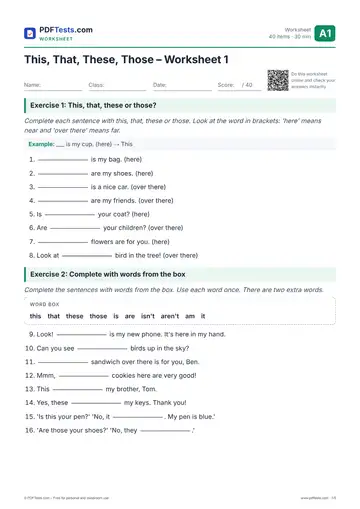
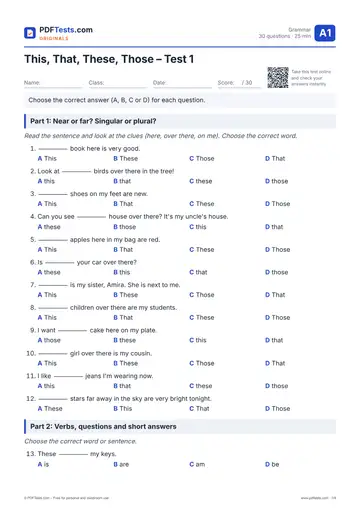
This, that, these and those are words we use to point at people and things. They tell the listener two things: is it near or far, and is it one thing or more than one? Use this and these for things near you, and that and those for things further away.
The basic rule: near or far, one or many
Think of two questions. First: is the thing near me (here) or not near me (there)? Second: is it singular (one) or plural (two or more)?
| Singular (one) | Plural (two or more) | |
|---|---|---|
| Near (here) | this | these |
| Far (there) | that | those |
- This phone is new. (one phone, in my hand)
- These phones are new. (two or more phones, near me)
- That house is big. (one house, across the street)
- Those houses are big. (two or more houses, far from me)
Remember: a plural noun needs these or those. If you are not sure about plural forms like children, people or boxes, look at our guide to plural nouns.
When to use this, that, these and those
1. Pointing at things and people
This is the most common use. You can see the thing, and you show it to someone.
- Look at this photo. It’s my family.
- Can I have that cake, please? The chocolate one.
- These shoes are very comfortable.
- Who are those people over there?
2. Introducing people
When you introduce someone, use this is for one person and these are for two or more people. We usually use this, not that, because the person is next to us.
- This is my sister, Emma.
- These are my colleagues, Sam and Priya.
- Mum, this is Leo. He’s in my class.
3. On the phone
On the phone, say this is to say who you are.
- Hello, this is Anna. Can I speak to Mr Jones?
To ask who the other person is, British English often uses Is that…? and American English often uses Is this…?
- Hi, is that Tom? (British)
- Hi, is this Tom? (American)
4. Talking about time
This can mean “now” or “the current one”. That often means a time in the past.
- I’m busy this week.
- What are you doing this evening?
- I remember my first day at school. That day was very hot.
5. Reacting to something someone says
We often use that to talk about an idea or something another person just said.
- “I’ve got a new job.” “That’s great.”
- “Let’s go to the beach.” “That’s a good idea.”
- “The train is late again.” “Oh no, that’s bad.”
Form
With the verb to be
This and that go with is. These and those go with are. For a full explanation of am, is, are, see our guide to the verb to be.
| Affirmative | Negative | Question | |
|---|---|---|---|
| this | This is my bag. | This isn’t my bag. | Is this your bag? |
| that | That’s my car. | That isn’t my car. | Is that your car? |
| these | These are my keys. | These aren’t my keys. | Are these your keys? |
| those | Those are my friends. | Those aren’t my friends. | Are those your friends? |
Short forms:
- that is → that’s (very common in speaking and writing)
- this is → no short form in writing. Write this is, not
this’s. - these are, those are → no short forms in writing.
Short answers
When you answer a question with this or that, use it in the answer. With these or those, use they.
| Question | Short answer |
|---|---|
| Is this your coat? | Yes, it is. / No, it isn’t. |
| Is that your dog? | Yes, it is. / No, it isn’t. |
| Are these your glasses? | Yes, they are. / No, they aren’t. |
| Are those your children? | Yes, they are. / No, they aren’t. |
Before a noun or alone
You can use these words before a noun or alone (without a noun).
- Before a noun: This book is interesting. / I like those trainers.
- Alone: This is interesting. / I like those.
You can also put an adjective between the word and the noun:
- this red bag
- those old buildings
- these small apples
This one, that one
When it is clear what you are talking about, you can use this one or that one instead of repeating the noun.
- “Which T-shirt do you want?” “This one, please.”
- I don’t like this chair. I prefer that one.
For plurals, it is usually more natural to use these or those alone:
- “Which glasses are yours?” “Those.” (more natural than “those ones”)
Pronunciation notes
All four words start with the soft th sound /ð/. Put your tongue between your teeth and use your voice. It is the same sound as in the, they and mother.
| Word | Sound | Tip |
|---|---|---|
| this | /ðɪs/ | short i, like in sit; ends in /s/ |
| these | /ðiːz/ | long ee, like in see; ends in /z/ |
| that | /ðæt/ | a like in cat |
| those | /ðəʊz/ (UK), /ðoʊz/ (US) | like nose; ends in /z/ |
The difference between this and these is important. This has a short sound and a hissing /s/. These has a long sound and a buzzing /z/. If you say these with a short sound, people may hear this.
Signal words: here and there
The words here and there often go together with these words. They help you choose.
- here → this / these: This is my seat here. / These biscuits here are for you.
- there → that / those: That man over there is my teacher. / Look at those birds up there.
Other clues for that and those: over there, pointing with your hand, or something in the past (that day, that summer).
Clues for this and these: something in your hand, on your body or very close (this shirt I’m wearing), and time words like this morning, this year.
This/that or it?
Learners sometimes confuse this and that with it.
Use this or that when you first point to or show something. After that, use it (or they for plurals), because the listener already knows what you mean.
- This is my new laptop. It’s very fast.
- Those are my grandparents. They live in Spain.
- “What’s that?” “It’s a guitar.”
Notice the last example: the question uses that, but the answer uses it.
Also, don’t confuse that with there. That points to a thing; there is a place or part of there is / there are.
- That is a nice café. (pointing at it)
- There is a nice café near my house. (saying it exists)
You can learn more in our guide to there is and there are.
Common mistakes
✗ This are my books. → ✓ These are my books. Books is plural, so use these + are.
✗ These book is old. → ✓ This book is old. / These books are old. This goes with a singular noun; these goes with a plural noun.
✗ That are my parents. → ✓ Those are my parents. Parents is plural and far, so use those.
✗ This is my friends. → ✓ These are my friends. Two or more people need these are.
✗ I like this shoes. → ✓ I like these shoes. Shoes is plural.
✗ Is this your bag? – Yes, this is. → ✓ Yes, it is. Short answers use it (or they), not this.
✗ Are those your keys? – Yes, those are. → ✓ Yes, they are. Use they in short answers for plurals.
✗ These people is nice. → ✓ These people are nice. People is plural, so the verb is are.
✗ This’s my phone. → ✓ This is my phone. There is no written short form of this is.
✗ Hello, I am Anna on the phone. → ✓ Hello, this is Anna. On the phone, say this is + your name.
Quick check
Choose the correct word.
- Look at ___ birds over there. (this / those)
- ___ is my brother, Max. (This / These)
- “Is that your car?” “Yes, ___ is.” (that / it)
- ___ apples here are very sweet. (These / That)
- “I passed my exam.” “___ great.” (That’s / Those are)
Answers
- those – plural and far away (over there).
- This – introducing one person.
- it – short answers use it.
- These – plural and near (here).
- That’s – reacting to what someone said.
Next step
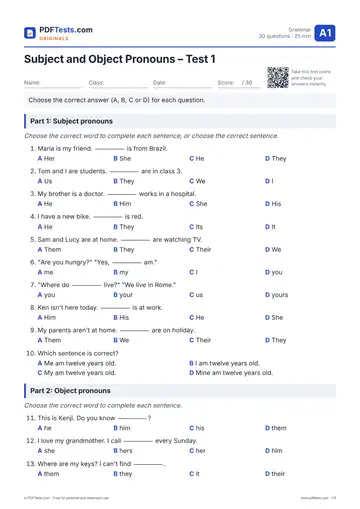
Now practise choosing between near and far, singular and plural: test yourself with our A1 This, That, These, Those test. Pay attention to the noun after each gap, because it tells you if you need a singular or plural form. When you feel confident, try more topics from our English A1 tests to build a strong base in everyday grammar.
Practise this topic: This, That, These, Those
Was this page helpful?
What was the problem?
Thank you for your feedback!