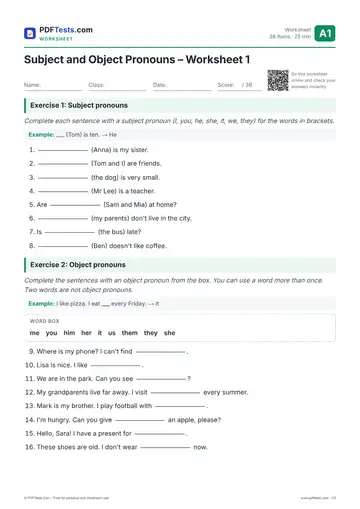
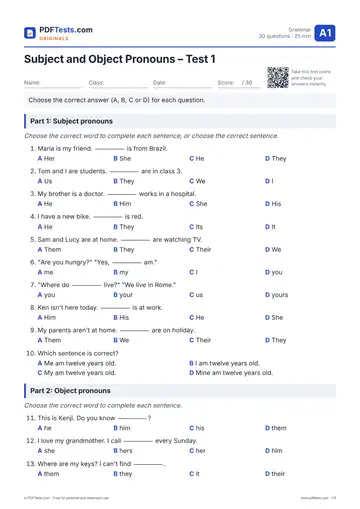
Subject pronouns (I, you, he, she, it, we, they) are the person or thing that does the action. They usually come before the verb. Object pronouns (me, you, him, her, it, us, them) receive the action. They come after a verb or after a preposition like with, for or to.
- She likes him. (She does the action. He receives it.)
- They call us every Sunday.
Why we use pronouns
Pronouns replace nouns, so we don’t repeat the same words again and again.
- Anna is my sister. Anna lives in London. I visit Anna every summer. (repetitive)
- Anna is my sister. She lives in London. I visit her every summer. (natural)
In English, a normal sentence must have a subject. You can’t leave it out, even when the meaning is clear.
- It is raining. (not Is raining.)
- I am tired. (not Am tired.)
Form: the two sets of pronouns
| Person | Subject pronoun | Object pronoun | Example |
|---|---|---|---|
| 1st singular | I | me | I know Tom. Tom knows me. |
| 2nd singular | you | you | You are nice. I like you. |
| 3rd singular (man/boy) | he | him | He is late. Call him. |
| 3rd singular (woman/girl) | she | her | She is a doctor. Ask her. |
| 3rd singular (thing/animal) | it | it | It is my phone. I use it every day. |
| 1st plural | we | us | We are here. Can you see us? |
| 2nd plural | you | you | You are my best friends. I love you. |
| 3rd plural | they | them | They are my shoes. I need them. |
Three pronouns don’t change: you, it and (in writing) nothing else. You and it are the same as subject and object. All the others change.
Notes on individual pronouns
- I is always a capital letter, even in the middle of a sentence: Tom and I are friends.
- You can mean one person or more than one person. The context tells you: Sara, are you OK? / Kids, are you ready?
- It is for things, animals and situations: I have a cat. It is black. We also use it for weather, time and distance: It’s cold. It’s 3 o’clock. It’s 5 km to the station.
- They / them is for more than one person, animal or thing: I like these jeans. They are cheap. I want them.
- They / them can also mean one person when we don’t know if the person is a man or a woman: Someone called. They didn’t leave a message.
Where pronouns go in a sentence
Subject pronouns: before the verb
In affirmative and negative sentences, the subject pronoun comes first, then the verb.
| Sentence type | Pattern | Example |
|---|---|---|
| Affirmative | subject + verb | We live in Madrid. |
| Negative | subject + don’t/doesn’t/am not… + verb | He doesn’t eat meat. |
| Question | (do/does/is/are) + subject + verb | Do they speak English? |
| Question with to be | am/is/are + subject | Is she your teacher? |
In questions, the subject pronoun comes after the auxiliary verb or after am/is/are, but it is still a subject pronoun. Don’t change it to an object pronoun.
- Where does he work? (not Where does him work?)
If you want to practise am/is/are with subject pronouns, read our guide to the verb to be.
Object pronouns: after the verb
- I love you.
- Can you help me?
- My parents phone us every weekend.
- I don’t understand it.
- Where are my keys? I can’t find them.
Object pronouns: after prepositions
After words like with, for, to, at, from, about, behind, next to, always use an object pronoun.
- Come with me.
- This present is for you.
- Look at her. She’s dancing.
- Can you sit next to him?
- We often talk about them.
Two pronouns in one sentence
A sentence can have a subject pronoun and an object pronoun. The subject is the person who acts; the object is the person who receives the action.
| Subject | Verb | Object | Meaning |
|---|---|---|---|
| She | loves | him. | She feels the love. He receives it. |
| He | loves | her. | He feels the love. She receives it. |
| We | help | them. | We do the helping. |
| They | help | us. | They do the helping. |
With verbs like give, send and show, the person usually comes straight after the verb: Give me the book. Send her a message. Show us your photos.
Pronouns in short answers and replies
In everyday speech, we often use an object pronoun alone in short replies.
- Who wants coffee? — Me!
- I’m hungry. — Me too.
- Who’s there? — It’s me.
- I don’t like horror films. — Me neither.
These are normal and correct in spoken English. In full sentences, keep the subject pronoun: I want coffee.
Pronunciation note
In fast, natural speech, some object pronouns are weak and short:
- him often sounds like ’im: Tell him → /ˈtelɪm/
- her often sounds like ’er: Ask her → /ˈɑːskə/
- them often sounds like ’em: Call them → /ˈkɔːləm/
You don’t need to say them this way, but it helps you understand native speakers. Always write the full form.
Subject pronouns vs possessive adjectives
Learners often mix up pronouns with possessive adjectives (my, your, his, her, its, our, their). A possessive adjective shows who something belongs to and always comes before a noun.
| Subject pronoun | Object pronoun | Possessive adjective |
|---|---|---|
| I | me | my |
| you | you | your |
| he | him | his |
| she | her | her |
| it | it | its |
| we | us | our |
| they | them | their |
Compare:
- He is my brother. I see him every day. His car is red.
- She is a teacher. I know her. Her students like her.
Note that her is both the object pronoun (I know her) and the possessive adjective (her students). Look at the next word: if a noun follows, it is possessive.
For more on my, your, his and ’s, see our guide to possessive adjectives. Later, at A2, you will learn possessive pronouns like mine and yours.
Common mistakes
✗ Him is my friend. → ✓ He is my friend. Before the verb, use a subject pronoun.
✗ My teacher likes I. → ✓ My teacher likes me. After the verb, use an object pronoun.
✗ Can you come with we? → ✓ Can you come with us? After a preposition, use an object pronoun.
✗ Is very hot today. → ✓ It is very hot today. English sentences need a subject, so use it for weather.
✗ My brother he works in a bank. → ✓ My brother works in a bank. Don’t repeat the subject with a pronoun.
✗ I have a new phone. I love him. → ✓ I love it. Use it for things, not he/him or she/her.
✗ Do you like this song? Yes, I like. → ✓ Yes, I like it. Verbs like like, love and want need an object.
✗ i live in Paris. → ✓ I live in Paris. I is always a capital letter.
✗ Me and my sister go to school together. → ✓ My sister and I go to school together. In the subject position, use I, and it is polite to put the other person first.
✗ They is my parents. → ✓ They are my parents. They takes a plural verb: are, have, go (not is, has, goes).
Quick check
Choose the correct word.
- Where is Maria? I can’t see (she / her).
- (We / Us) are from Brazil.
- This coffee is for (you / your).
- I like these shoes. I want to buy (it / them).
- Tom is late. (He / Him) is always late.
Answers
- her – it comes after the verb see, so it’s an object pronoun.
- We – it is the subject, before the verb are.
- you – after the preposition for, use the object pronoun; your needs a noun after it.
- them – shoes is plural.
- He – it is the subject, before the verb is.
Next step
Now put the rules into practice: test yourself with our A1 Subject and Object Pronouns test, which checks the position of pronouns after verbs and prepositions, it vs them, and confusion with possessive adjectives. If you get a question wrong, come back to the table and the common mistakes section. When you feel confident, continue with the present simple, where choosing he/she/it correctly decides whether the verb takes -s, or browse all our English A1 tests.
Practise this topic: Subject and Object Pronouns
Was this page helpful?
What was the problem?
Thank you for your feedback!