Be going to is a common way to talk about the future in English. Use it for plans and intentions (things you have already decided to do) and for predictions based on what you can see or know now. The form is simple: am / is / are + going to + base verb, as in I’m going to visit my grandmother this weekend.
When to use be going to
1. Plans and intentions
Use be going to when you decided something before you speak. The decision is already in your head.
- I’m going to start a new job in May.
- We’re going to paint the kitchen this weekend.
- She’s going to learn Spanish next year.
- Are you going to watch the match tonight?
The plan does not need a fixed time or a ticket. It is enough that you intend to do it.
- I’m going to call my dad later.
- He’s going to be a doctor one day.
2. Predictions with evidence
Use be going to when you can see or know something now that tells you what will happen next.
- Look at those black clouds. It’s going to rain.
- Be careful. That glass is going to fall.
- The score is 4–0. They’re going to win.
- She’s going to have a baby in June.
In each sentence there is a clear reason in the present: the clouds, the position of the glass, the score.
Form
Be going to has three parts: the verb be (am / is / are), the words going to, and the base form of the main verb (no -s, no -ing, no -ed). If you need to review am, is, are, see our guide to the verb to be.
Affirmative
| Subject | be | going to | base verb | Short form |
|---|---|---|---|---|
| I | am | going to | work | I’m going to work |
| You | are | going to | work | You’re going to work |
| He / She / It | is | going to | work | She’s going to work |
| We | are | going to | work | We’re going to work |
| They | are | going to | work | They’re going to work |
In speaking and informal writing, we almost always use the short forms: I’m, you’re, he’s, she’s, it’s, we’re, they’re.
Negative
Add not after be. Do not use don’t or doesn’t.
| Full form | Short form |
|---|---|
| I am not going to buy it. | I’m not going to buy it. |
| You are not going to like this. | You aren’t going to like this. / You’re not going to like this. |
| He is not going to come. | He isn’t going to come. / He’s not going to come. |
| We are not going to stay long. | We aren’t going to stay long. / We’re not going to stay long. |
| They are not going to win. | They aren’t going to win. / They’re not going to win. |
Note: there is no short form amn’t. Say I’m not going to.
Questions and short answers
Put be before the subject.
| Question | Yes | No |
|---|---|---|
| Am I going to need a coat? | Yes, you are. | No, you aren’t. |
| Are you going to cook tonight? | Yes, I am. | No, I’m not. |
| Is she going to drive? | Yes, she is. | No, she isn’t. |
| Are we going to be late? | Yes, we are. | No, we aren’t. |
| Are they going to move house? | Yes, they are. | No, they aren’t. |
In short answers with yes, do not use the contraction: say Yes, I am, not Yes, I’m.
Wh- questions
Put the question word at the start: question word + be + subject + going to + verb.
- What are you going to do after school?
- Where is he going to stay in London?
- When are they going to get married?
- How are we going to get there?
Going to go and going to + place
With the verb go, you can say going to go, but many speakers prefer a shorter form.
- I’m going to go to the gym tonight. (correct)
- I’m going to the gym tonight. (also correct and very common)
The second sentence is actually the present continuous of go. Both mean the same here. You can read more about this tense in our Present Continuous guide.
Pronunciation: gonna
In fast, informal speech, going to often sounds like gonna /ˈɡʌnə/ or /ˈɡənə/.
- I’m gonna be late. (= I’m going to be late.)
- It’s gonna rain.
You will hear gonna in films, songs and conversation. Do not write it in emails, essays or exams. Also, gonna is only used before a verb. You cannot say I’m gonna the shop.
Signal words
These time expressions often appear with be going to:
- tonight, tomorrow, this weekend, this evening
- next week / month / year / summer
- soon, later, one day
- in two days, in a few weeks
For predictions, look for evidence words: Look!, Watch out!, Be careful!, I can see…
Be going to vs will
Learners often confuse be going to and will. At A2 level, these are the key differences.
| be going to | will |
|---|---|
| Plan decided before speaking: I’m going to buy a new laptop. I saw one online yesterday. | Decision made at the moment of speaking: Oh, this laptop is on sale. I’ll buy it. |
| Prediction based on present evidence: Look at that man. He’s going to fall. | Prediction based on opinion or belief: I think you’ll love this film. |
| — | Offers and promises: I’ll help you. I’ll call you tomorrow. |
Compare these pairs:
-
A: We need milk. B: I’ll get some. (B decides now.)
-
A: Why are you putting on your coat? B: I’m going to get some milk. (B decided before.)
-
I think it’ll be sunny tomorrow. (my opinion)
-
Look at that blue sky. It’s going to be a beautiful day. (evidence now)
In many prediction sentences both forms are possible and the difference is small. But for plans and instant decisions, the choice matters. To study will in more detail, read our guide to will for predictions, offers and promises. When you are ready for all the future forms together, see Future Forms (will, going to, present continuous).
Common mistakes
✗ I going to visit Paris. → ✓ I’m going to visit Paris. You need the verb be (am / is / are).
✗ She’s going to calls you. → ✓ She’s going to call you. After going to, use the base verb with no -s.
✗ We’re going to watching a film. → ✓ We’re going to watch a film. Use the base verb, not the -ing form.
✗ He’s going visit his aunt. → ✓ He’s going to visit his aunt. Don’t forget to.
✗ Do you going to come? → ✓ Are you going to come? Make questions with be, not do.
✗ I don’t going to tell him. → ✓ I’m not going to tell him. Make negatives with be + not, not don’t.
✗ The phone’s ringing. I’m going to answer it. → ✓ The phone’s ringing. I’ll answer it. A decision made right now uses will.
✗ I’m gonna finish the report by Friday. (in a work email) → ✓ I’m going to finish the report by Friday. Gonna is for informal speech only.
Quick check
Complete or correct each sentence.
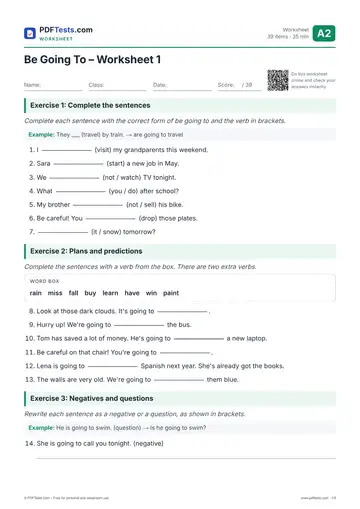
- Look at that child on the wall. He ___ (fall).
- We ___ (not / watch) TV tonight. We’re too tired.
- ___ your sister ___ (buy) a new phone?
- Choose the best answer: The doorbell is ringing. “I’ll open it” or “I’m going to open it”?
- Correct the mistake: They going to move to Leeds next year.
Answers
- is going to fall (prediction with evidence)
- aren’t going to watch / ’re not going to watch
- Is your sister going to buy a new phone?
- I’ll open it (a decision made at the moment of speaking)
- They**’re** going to move to Leeds next year. (be is missing)
Next step
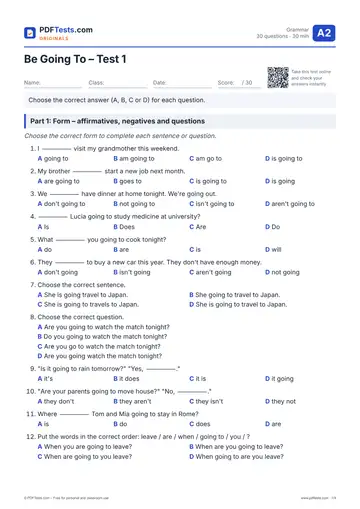
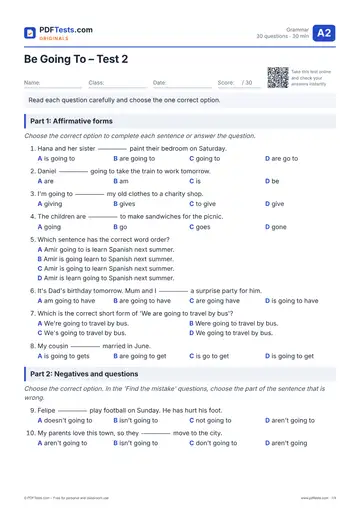
Now practise what you have learned: test yourself with our A2 Be Going To test, and pay attention to the questions and negatives, as they are where most mistakes happen. If you choose will when the answer is going to (or the other way round), reread the comparison table above and then try the A2 Will Future test to practise the difference.
Was this page helpful?
What was the problem?
Thank you for your feedback!