Possessive pronouns are the words mine, yours, his, hers, ours and theirs. They show who something belongs to. They replace a possessive adjective and a noun, so you don’t repeat the noun: This isn’t my coat. Mine is black. Use them when the listener already knows which thing you mean.
The forms
Each person has two possessive words. The possessive adjective (my, your, her…) always comes before a noun. The possessive pronoun (mine, yours, hers…) stands alone.
| Subject pronoun | Possessive adjective + noun | Possessive pronoun (alone) |
|---|---|---|
| I | my bag | mine |
| you | your bag | yours |
| he | his bag | his |
| she | her bag | hers |
| it | its bowl | (rarely used) |
| we | our bag | ours |
| you (plural) | your bags | yours |
| they | their bag | theirs |
Some patterns to help you remember:
- Yours, hers, ours, theirs add -s to the possessive adjective.
- Mine is different. It does not end in -s.
- His is the same word in both columns: It’s his phone. The phone is his.
- Its almost never stands alone as a pronoun. Use it before a noun: The cat is eating its food.
- Yours is the same for one person and for many people.
Pronunciation note: ours sounds like hours, and theirs sounds like there’s.
How to use possessive pronouns
1. To avoid repeating a noun
This is the main use. The noun is already clear, so you don’t say it again.
- Is this your bag or mine? (= my bag)
- My phone battery is dead. Can I use yours? (= your phone)
- Their house is bigger than ours. (= our house)
- I’ve got my ticket. Has Emma got hers?
2. To answer questions with whose
We often use possessive pronouns in answers to whose questions. You can learn more about whose in our guide to question words.
- Whose keys are these? – They’re mine.
- Whose is this jacket? – I think it’s his.
- Whose idea was it? – It was theirs.
3. After the verb be
A possessive pronoun often comes after is, are, was or were.
- This seat is mine.
- Is this pen yours?
- The choice is yours.
- Those suitcases were ours, not theirs.
4. As the subject or object of a sentence
A possessive pronoun can be the subject, the object, or come after a preposition.
- Subject: Your English is really good. Mine isn’t.
- Subject: Their flat is small, but ours has three bedrooms.
- Object: I forgot my umbrella, so Sara lent me hers.
- After a preposition: Can you check your answers with mine?
- After a preposition: Our garden is next to theirs.
5. In the phrase a friend of mine
We say a friend of mine, a colleague of yours, a cousin of hers. This means one of my friends, one of your colleagues and so on.
- Lucy is a friend of mine. (= one of my friends)
- Is he a colleague of yours?
- We had dinner with some neighbours of ours.
Don’t say a friend of me or a friend of my. After of in this pattern, always use the possessive pronoun.
6. In comparisons
Possessive pronouns are very common after than and as.
- Your phone is newer than mine.
- Her score was higher than his.
- Our car isn’t as fast as theirs.
Singular or plural verb?
Possessive pronouns never change. Mine can mean one thing or many things. The verb agrees with the thing, not with the person.
| Sentence | Thing | Verb |
|---|---|---|
| Your bag is heavy. Mine is light. | one bag | is |
| Your shoes are new. Mine are old. | more than one shoe | are |
| His car is red. Ours is white. | one car | is |
| Their kids are at school. Ours are at home. | more than one child | are |
Never add -s to make mine plural: ✗ mines.
Spelling: no apostrophe
Possessive pronouns never have an apostrophe (’).
- ✓ yours, hers, ours, theirs
- ✗ your’s, her’s, our’s, their’s
Be careful with two words that look similar:
- its (possessive) – The company changed its name.
- it’s (= it is / it has) – It’s cold today.
- whose (possessive) – Whose phone is this?
- who’s (= who is / who has) – Who’s that man?
Possessive pronoun or possessive adjective?
This is the most common problem for learners. The rule is simple: look at the next word.
- If a noun comes next, use the possessive adjective (my, your, her…).
- If no noun comes next, use the possessive pronoun (mine, yours, hers…).
| Possessive adjective + noun | Possessive pronoun (no noun) |
|---|---|
| This is my coffee. | This coffee is mine. |
| Is that your car? | Is that car yours? |
| Her room is tidy. | The tidy room is hers. |
| Our teacher is from Canada. | The teacher from Canada is ours. |
| Their dog barks a lot. | The dog that barks a lot is theirs. |
You cannot use both together. Mine car and my mine are both wrong. If you need a review of the first column, read our guide to possessive adjectives and ’s.
Don’t confuse them with object pronouns
Object pronouns (me, you, him, her, us, them) are for the person who receives an action: Call me later. They don’t show possession. So The red bike is her is wrong; the correct sentence is The red bike is hers. See our guide to subject and object pronouns for the full list.
Possessive pronouns and ’s
With names and nouns, we use ’s to show possession. The ’s form can also stand alone, like a possessive pronoun, when the noun is clear.
- Whose car is that? – It’s Anna’s. (= Anna’s car)
- This isn’t my coffee. It’s Jack’s.
- Our flat is smaller than my parents’. (plural noun ending in -s: add only ’)
You can also say a friend of Tom’s, in the same way as a friend of mine.
Common mistakes
- ✗ This book is my. → ✓ This book is mine. – My must have a noun after it.
- ✗ That is mine car. → ✓ That is my car. – Before a noun, use the possessive adjective.
- ✗ Is this your’s? → ✓ Is this yours? – Possessive pronouns never have an apostrophe.
- ✗ The red bike is her. → ✓ The red bike is hers. – Her is an object pronoun or adjective, not a possessive pronoun.
- ✗ These shoes are mines. → ✓ These shoes are mine. – Mine never takes -s.
- ✗ She’s a friend of me. → ✓ She’s a friend of mine. – The fixed pattern is a friend of + possessive pronoun.
- ✗ Their car is old, but our is new. → ✓ Their car is old, but ours is new. – No noun follows, so use the pronoun.
- ✗ Who’s umbrella is this? → ✓ Whose umbrella is this? – Who’s means who is.
- ✗ My sister’s shoes are new. Mine is old. → ✓ Mine are old. – The verb agrees with shoes, which is plural.
Quick check
Complete or correct each sentence.
- Is this phone yours or ___? (I)
- Whose bike is this? – It’s ___. (she)
- Correct the mistake: The blue car is our’s.
- Choose the correct word: Tom is a friend of (me / mine).
- Choose the correct word: That isn’t (your / yours) jacket. (Your / Yours) is on the chair.
Answers
- mine – Is this phone yours or mine?
- hers – It’s hers.
- The blue car is ours. – no apostrophe.
- mine – Tom is a friend of mine.
- your, Yours – That isn’t your jacket. Yours is on the chair. The first is before a noun; the second stands alone.
Next step
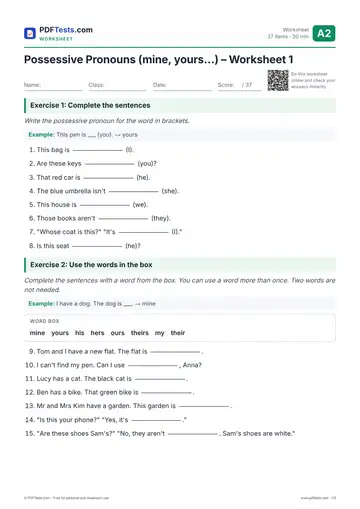
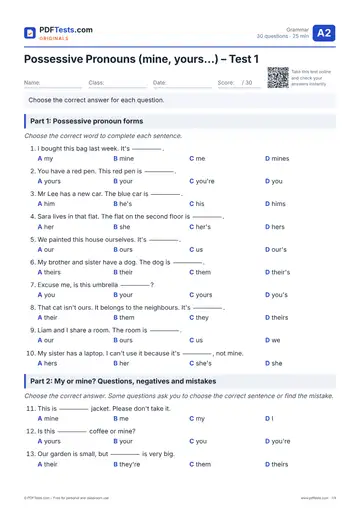
Now practise the difference between my and mine, her and hers, our and ours in real sentences. Test yourself with our A2 Possessive Pronouns test, and check your answers against the tables above. If you still mix up the adjectives (my, your, their) and the ’s form, go back one step and try the A1 Possessive Adjectives and ’s test first.
Practise this topic: Possessive Pronouns (mine, yours, his, hers…)
Was this page helpful?
What was the problem?
Thank you for your feedback!